Trump’s Greenland Deal Puts His Annexation Plans on Ice
After doing lasting damage to the relationship between the US and Europe, Donald Trump got roughly the same deal over Greenland he could have obtained by asking politely. The administration’s plan to acquire the island has been put on the back burner.
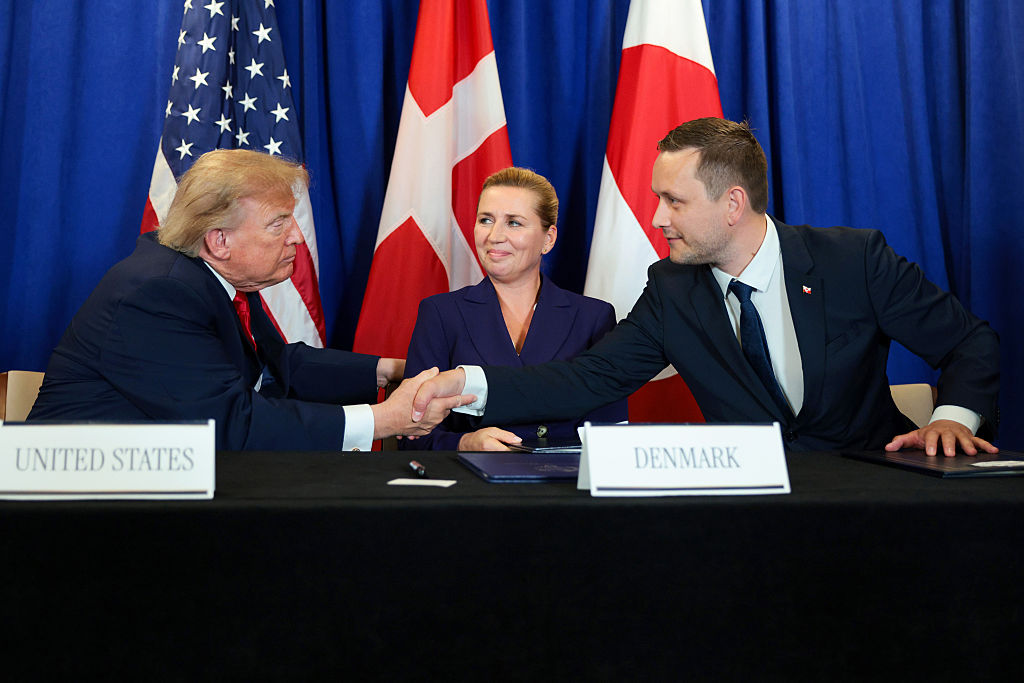
Donald Trump recently concluded an agreement with the governments of Greenland and Denmark over the status of the Arctic island. Trump presented it as a big victory for his efforts, but the substance of the agreement told a different story. (Chip Somodevilla / Getty Images)
Donald Trump recently concluded an agreement with the governments of Greenland and Denmark over the status of the Arctic island. Trump presented it as a big victory for his efforts, claiming that it granted the United States “permanent control over security, and all other needs, in Greenland, completely addressing ALL of our many US concerns.”
The substance of the agreement told a different story. After doing lasting damage to the relationship between the United States and Europe, the Trump administration got more or less the same deal it could have obtained by asking politely. Trump’s repeatedly stated plan to acquire Greenland has been put on the back burner.
End of the Saga?
“Greenland belongs to the Greenlanders — it cannot be taken from us,” Greenlandic Prime Minister Jens Frederik Nielsen proclaimed in a Facebook post that showed him grinning contentedly. A saga that has brought hitherto unprecedented attention to his country seemed to be coming to an end.
The deal, signed by the leaders of Greenland, Denmark, and the United States at the United Nations General Assembly in New York, permits the US to open two bases in Greenland, Mestersvig in the east and Narsarsuaq in the south. Mestersvig is a base for the Sirius Patrol, a dogsled unit of the Danish military operating in the remote Northeast Greenland National Park. Narsarsuaq is an airfield that was constructed during the World War II as a US airbase and that closed as an international airport earlier this year.
A recent investigation by the Danish newspaper Politiken found that when the Americans left most of their Greenlandic bases after finding Cold War replacements for them, they abandoned “several thousand tons of hazardous or contaminated waste.” At Narsarsuaq, this waste material included oil drums and asbestos sheets scattered around the old base.
The Trump administration has presented this outcome as a vindication of its strategy. But the United States has long been able to construct new facilities in Greenland if it has the consent of the other parties.
The 1951 Defense of Greenland Agreement, reached after the US had taken responsibility for Greenland’s security during Denmark’s wartime occupation, established this principle. The negotiations that have proceeded in earnest since the start of 2026 could have happened without any US threats to take control of the island.
“Sensitive Sectors”
However, the new agreement does contain several changes in other areas. Whereas the 1951 agreement was valid for as long as NATO existed, the new version, officially intending to “amend and supplement” the old one, stresses its permanence and includes provisions for a future independent Greenland.
At the same time, it requires that an independent Greenland “agree to remain in NATO, including by applying to become a member if necessary.” This suggests that some commentary inspired by the absence of any reference to NATO in Trump’s post was slightly overblown.
In other respects, the deal formalizes an unwritten understanding that investment in “sensitive sectors or activities” by non-NATO states is unwelcome. This understanding was already clear during the first Trump administration, when Denmark provided funding for Greenlandic airport upgrades to avoid a hostile US reaction over potential Chinese investment in the project.
Back in 2016, Denmark rejected a Chinese bid to take over the Kangilinnguit naval base due to “security concerns.” China’s much-vaunted Arctic ambitions have been constrained in recent years. While the exact meaning of the term “sensitive” is open to debate, the US seems to have obtained an effective veto over any future Russian or Chinese presence in Greenland.
Questions also remain elsewhere: the agreement does not address the question of resource extraction in Greenland (apart from a clause that prohibits “control” or “strong influence” by non-NATO states and investors, unless the parties agree that their activities “would not constitute a threat to national security or public order”). Trump’s threats prompted the formation of a unity government after the last election, with four of the five parties in the Greenlandic parliament taking part before one withdrew earlier this year. This means that policy differences between its constituent parties over this question have been left unresolved.
Demokraatit, the party of Greenland’s prime minister, Jens Frederik Nielsen, is in favor of extraction, while Inuit Ataqatigiit, the party of his foreign minister, Múte Egede, takes a different stance. It won the 2021 Greenlandic election on a platform of opposition to a uranium and rare earth mining project in the country’s south.
Disputes between the Greenlandic government and a US oil firm with links to Trump have sporadically flared up over the question of which licenses it needs and whether the licenses it already has access to are valid. If these disputes drag on into next summer, and Trump-friendly figures within Greenland Energy get the president’s ear, things could erupt again. An agreement on security does not preclude a later dispute on other issues, especially where there is money to be made.
White Gold Rush
Although some elements of the deal could prove consequential, its most significant part may well be the opening preamble. For the first time in the relationship between Greenland and the United States, this is an agreement negotiated from the outset by a Greenlandic government.
In January 2026, two Inuit scholars released a briefing paper on the ongoing impact of colonization on Greenland. Vivi Vold and Kunuk (Sandra) Inutiq highlighted Washington’s “imperialist and colonialist” rhetoric but stressed that Denmark could not “demand silence” on other topics in the name of unity against the United States. Two of the cases that they mentioned bear repeating here.
First, disgraceful episodes such as the implantation of IUDs into thousands of Inuit women and girls between the 1960s and the 1980s, many of whom did not give their consent, remain unresolved. Rival reports were released in August this year, after a group of four experts could not agree on a verdict.
The report released by the Greenlandic government suggested that the term “genocide,” which Múte Egede had used during his time as prime minister, could not be ruled out. The other report, produced by two of the experts who split from the government-backed group, reached a less strident conclusion. Neither report had a Greenlandic Inuit coauthor.
Second, mining of the mineral cryolite, which is important for the production of aluminium, generated vast amounts of wealth for Denmark in the late nineteenth and early twentieth centuries. As it happens, the naval base China unsuccessfully sought to purchase in 2016 was originally constructed by the US Navy to protect the very same cryolite mine. In Greenland, American influence is never far away.
There was a fierce controversy in Denmark after the public service broadcaster DR released a documentary called Greenland’s White Gold in the buildup to the 2025 Greenlandic election. The documentary attempted to calculate the scale of this windfall and suggested that it may have amounted to 400 billion kroner in today’s money.
By making this calculation, the program makers sought to push back against a persistent Danish idea that Denmark’s contribution to the Greenlandic government budget is akin to a generous gift. An economist who had appeared in the documentary questioned one of its core calculations, and the Danish culture minister strongly criticized it. After initially standing by the program, DR pulled it from its streaming service, and a senior editor resigned.
The fact that an issue like this could flare up at the height of the “Greenland crisis” reveals the deep feelings that persist within what many still view as a colonial relationship. US posturing has disrupted Denmark’s gradual acknowledgment of its history with Greenland, allowing the former colonizer to portray itself as a protective elder sibling.
No Good Colonizers
The standoff has also diverted attention from other domestic issues. In May 2025, local hotel owner Mike Nicolaisen organized a protest against the lack of investment in Tasiilaq, the largest settlement on Greenland’s east coast. Six hundred people — one-third of the town’s population and nearly a sixth of the entire region’s inhabitants — showed up.
Nicolaisen and his wife, Anette, subsequently announced the formation of a new “Party for an Independent East Greenland.” In an interview with KNR, Greenland’s national broadcaster, he described the protest as a “cry for help” and said that the aspirant party was necessary to bring attention to his region: “The only time we’re remembered is when it’s about suicide, misery, and alcohol.”
Decades of underinvestment in the regions and a lack of employment opportunities has drawn people to move either to the capital, Nuuk, or to Copenhagen. Population growth in Nuuk has kept house prices extremely high, combined with slow construction rates and the difficulty of finding empty land on the rocky peninsula upon which the city is situated. There is also a significant problem of homelessness.
The Greenlandic government cannot trust that this new deal will permanently satisfy the United States. But skilful negotiation by the Danish and Greenlandic governments has avoided a doomsday scenario. Trump is now claiming a win at little cost to his negotiating partners, and arguments over resource extraction have been deferred.
Now that the specter of Greenland’s potential seizure by force has been put to bed for the time being, there is more space for reckoning with the ongoing legacies of colonization, which can help prevent the formation of new relationships based on similar premises. Trump may have brought Denmark and Greenland closer together, but there is still no such thing as a better colonizer.