Trump’s Goal Is to Suppress Votes, Not Prevent Election Fraud
Donald Trump says the SAVE Act is about stopping noncitizens from voting. But the real target is the millions of working-class citizens who don't have an updated passport or paper birth certificate sitting in a drawer.
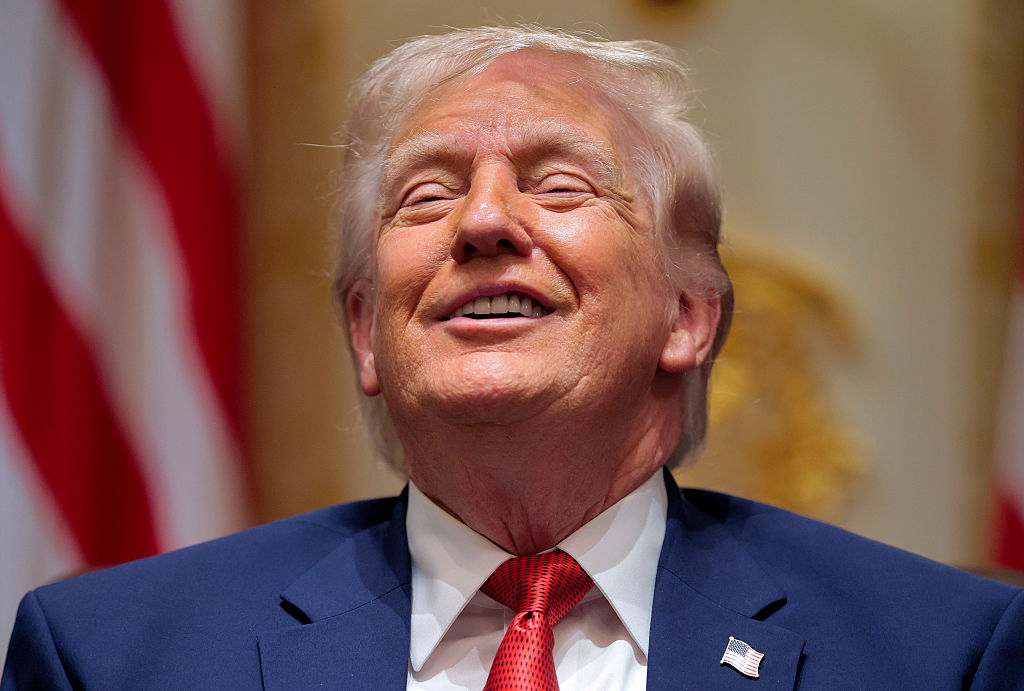
The Republican Party seems to have decided that the 2026 and 2028 elections will be easier for them if a lot fewer Americans vote. (Chip Somodevilla / Getty Images)
Donald Trump has a very simple explanation for why his political enemies object to his proposed election law, the Safeguard American Voter Eligibility Act (otherwise known as the “SAVE America Act” or just the “SAVE Act”). He laid it out in his State of the Union address earlier this year.
One reason, because they want to cheat. There’s only one reason. They make up all excuses. They say it’s racist. They come up with things. You almost say, ‘What imagination they have.’ They want to cheat.
According to Trump, “cheating” (by which he primarily means noncitizens voting) is currently “rampant.” The SAVE Act would save us from this problem by requiring everyone who registers to vote to prove they’re a citizen by producing documentation, such as a passport or birth certificate. While the law has several other controversial provisions, the president and his allies routinely express astonishment that anyone anywhere could have a problem with this central requirement.
But in truth, anyone who wants as many citizens as possible to exercise their right to vote should have a problem with this law.
All available evidence shows that noncitizens showing up to vote is vanishingly rare. For example, the Heritage Foundation — a right-wing, pro-Trump think tank that promotes “mass deportations” and advocates laws like the SAVE Act allegedly designed to crack down on noncitizen voting — did a study of available records that shows only one hundred cases of noncitizens voting in the entire country between 1982 and 2025. To put that number in perspective, 144 million people voted in the 2024 election. One hundred cases in forty-three years is a microscopic number.
Meanwhile, though, quite a few of those 154 million voting citizens might have been deterred by the SAVE Act. According to an estimate from the Brennan Center, about 21.3 million voting-age American citizens lack ready access to proof-of-citizenship documents. Millions more married women do have that documentation but haven’t updated it to reflect their married names. People lose passports, misplace birth certificates, let documents expire and never get around to renewing them — all kinds of mundane scenarios that would leave them ineligible to register.
Of course, with a little planning, someone without these documents could procure them in time to register for the next election. But even at the most conservative estimate, millions fewer would. Right now, many Americans register to vote because someone has set up a table to register voters at a school, shopping complex, church, farmer’s market, or downtown on a busy day. The SAVE Act would render these efforts to increase democratic participation almost completely pointless, given how few of us routinely carry around a passport or a birth certificate every day while we work, shop, or drop our kids off at school.
Nor is the problem restricted to voters who don’t take the initiative to register. Just about all of us, at one time or another, have had the experience of trying to do something, running into bureaucratic obstacles, and not getting around to trying again for months, if at all. Millions of people will no doubt begin the process of voter registration, get tied up, and drop it. A basic principle of economics is that every time you raise the cost (in money, in time, or in irritation) of doing something, a predictable consequence will be that fewer people will do it.
Think about the public health rationale for raising taxes on cigarettes, for example. No one thinks there’s some huge population of smokers who can afford to spend exactly $10 on a pack of Marlboro Reds and won’t be able to scrape together $11. It’s that they think that the more you need to trade off (in this case, financially) to do something, the less likely you are to do it, and that even mild increases can have that effect. Making people renew their passports, order a paper birth certificate, or change their documents to reflect their married name before they can exercise the most basic rights of citizens in a democratic republic means fewer of them will do so.
In particular, the people most likely to be successfully deterred by adding bureaucratic hoops they have to go through in order to vote are poor and working-class Americans who work long hours and stress about paying their bills. If you’re already juggling two jobs and a long commute, renewing your passport or ordering a birth certificate before you can register to vote is the kind of thing that gets lost in the shuffle. You just don’t have as much downtime between tasks as a comfortable middle-class person.
And that’s exactly the point of the law. Republicans want people in the demographics they’re (rationally) worried are turning against them to be discouraged by the hassle of registering to vote. Trump and his allies know that their program of slashing health care benefits, rolling back civil liberties, busting unions, and pouring $2.1 billion a day into the war in Iran is deeply unpopular. Rather than risk the wrath of the electorate they’d otherwise face in this fall’s midterms, Trump and the Republicans would rather engineer a smaller and more prosperous pool of voters — and sell it as an anti-fraud policy. They’re so much safer that way.