The Genoa Protesters Were Right About Global Capitalism
Twenty-five years ago, 300,000 people marched in Genoa against the G8 summit. The Italian state responded with tear gas, rubber bullets, and improvised torture chambers, but history has vindicated the critique of capitalist globalization by the protesters.
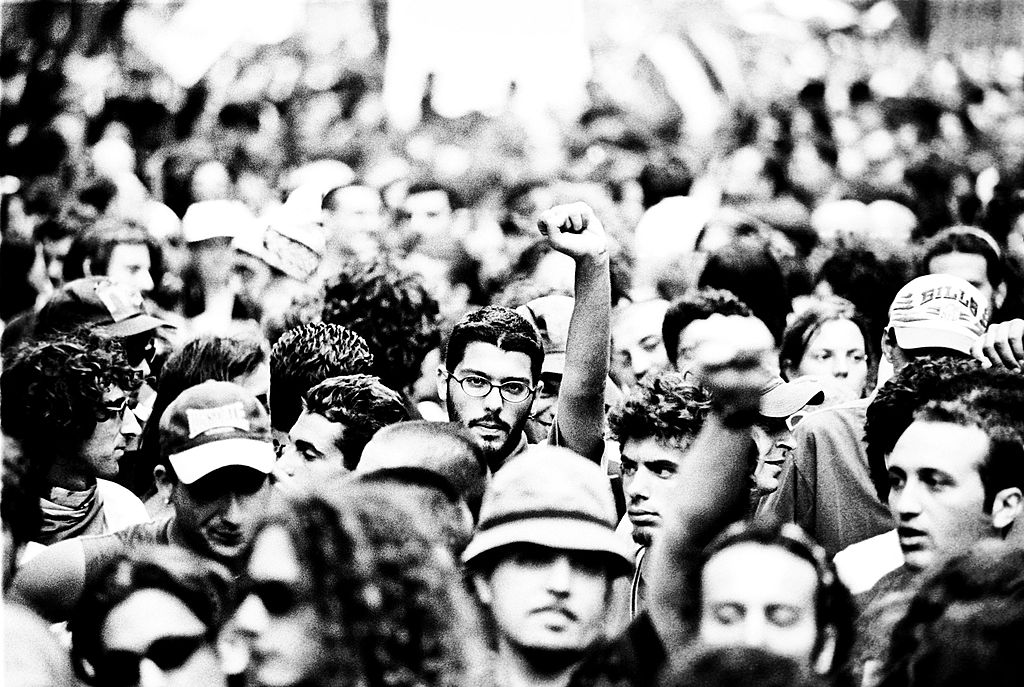
The movement that protested in Genoa 25 years ago asked the right questions but was defeated before its diagnosis could become common sense. It left behind a void now occupied by those who give the worst possible answers to those very questions. (Giorgio Cosulich de Pecine / Getty Images)
I took the train to Genoa for the protest against the G8 summit on the evening of July 20, 2001. I had long planned to attend Saturday’s demonstration; then came the news that in Piazza Alimonda, a police officer had shot and killed a twenty-three-year-old, Carlo Giuliani. At that point, going was no longer a choice. That night the trains to Genoa were full of people like me: folks who could not stay home after Carlo’s death.
On July 21, in a militarized city the day after a killing, three hundred thousand of us marched anyway. Union members, scouts, church groups, families with strollers, alongside students and radical collectives. Those who were there also remember how it ended: the police charge on the authorized march, the tear gas along the waterfront, and then, that night, the raid on a school where activists were sleeping and the abuse of detainees in a makeshift holding facility. Acts that Italian and European courts would eventually call by the only word they deserve: torture.
Does it still make sense to talk about the Seattle movement and the Genoa G8, twenty-five years later? Absolutely. Not out of nostalgia, and not only for the sake of justice, though the memory of Carlo and of the victims of that night’s violence would be reason enough. But because that movement asked the right questions twenty years ahead of time, was defeated before its diagnosis could become common sense, and left behind a void now occupied by those who give the worst possible answers to those very questions.
What We Were Actually Saying
It is worth recalling what the “movement of movements” actually argued, because its caricature, imposed by the neoliberal right, according to which the “no-globals” were an anti-modern backlash against trade and progress, may have done more damage than the repression itself. The movement born in Seattle in 1999 was not against trade: it was against a specific model of globalization.
It was against the Washington Consensus and International Monetary Fund (IMF) structural adjustment, which imposed austerity and privatization as the price of refinancing the debts of the Global South. Against the Agreement on Trade-Related Aspects of Intellectual Property Rights (TRIPS), which denied generic drugs to AIDS patients in sub-Saharan Africa in the name of pharmaceutical companies’ intellectual property. Against an architecture (the World Trade Organization, the IMF, bilateral treaties) that removed economic policy from democratic control and handed it to bodies nobody had elected.
Above all, the movement had an intuition that looks prophetic in hindsight: neoliberal globalization put the workers of the Global North and South on the same side of the distributive conflict. Capital mobility against the relative immobility of labor: the credible threat of offshoring shifted bargaining power and squeezed wages simultaneously in Detroit and Ciudad Juárez, in Turin and Jakarta.
The movement’s answer was to raise the floor for everyone: enforceable labor standards, debt cancellation, global union rights, taxation of capital flows instead of raising walls. “Teamsters and Turtles”: in Seattle, industrial unions marched with environmentalists, Via Campesina farmers with NGOs, in a coalition that had never been seen before and has not been seen since.
We Were Right Too Soon
What was a street slogan in 2001 is today, almost word for word, mainstream economics. Dani Rodrik warned, as early as 1997, that deep trade integration would erode national social contracts. His “trilemma” — hyperglobalization, democracy, and national sovereignty cannot coexist, one of the three has to go — is in some ways the academic formalization of what the movement was shouting outside the red zones.
The “China shock” studies by David Autor and his coauthors documented that import competition destroyed manufacturing employment concentrated in specific local areas, without the smooth reallocation promised by economic models, and that those same areas later drifted toward political polarization and Donald Trump. Branko Milanović’s “elephant curve” showed in a single chart who won and who lost: Asia’s middle classes and the global top 1 percent on one side, the working classes of rich countries on the other. Even the IMF, in 2016, published an article whose title would have sounded like a joke in Genoa: “Neoliberalism: Oversold?” The Association for the Taxation of Financial Transactions and for Citizens’ Action (ATTAC) menu, served cold twenty years later.
For those who, like me, work in the tradition of classical and post-Keynesian economics, none of this is surprising: globalization worked to discipline labor in the distributive conflict, and the fall of the wage share in advanced economies (documented by a now vast literature) is its accounting trace. Nor were critical economists missing at the time. Joseph Stiglitz had just left the World Bank, slamming the door behind him, Jeffrey Sachs was lending his name to debt cancellation, and a small network of economists (from Samir Amin in the Global South to Dean Baker and Mark Weisbrot in the United States) was supplying the movement with analytical foundations.
But these were voices outside the choir, and it took the China shock and the 2008 crisis for the choir to change its tune. Therein lies the political tragedy: by the time the movement’s diagnosis was finally certified by the profession, the field had already been occupied by forces diametrically opposed to the movement.
The Great Reversal
The movement did not die a natural death. It was repressed in Genoa with planned violence: the court rulings on the police raids, and Italy’s condemnation by the European Court of Human Rights, stand as a reminder of which way the scales of violence tipped.
But above all, September 11 closed the political space: after the attack on the Twin Towers, any challenge to the global order was reclassified as a security threat, and summits retreated to the Canadian mountains and the Gulf deserts. The movement’s energy flowed into the mobilization against the Iraq War, with the largest demonstration in human history, on February 15, 2003, which nevertheless failed to stop the violence.
There were internal limits too, and they must be acknowledged: a coalition united in its “no” but with no shared program or institutional outlet, and an ambiguity about the “diversity of tactics” that handed the media a law-and-order frame and made it possible never to talk about debt, patents, global labor rights, and the Tobin tax. But these were aggravating factors, not causes.
The social question the movement was answering, however, could not be more current. Wages in the Global North kept stagnating, factories kept closing, and, in 2008, deregulated finance produced exactly the crisis foretold in Porto Alegre. The discontent the movement had expressed was left orphaned of representation.
And here comes the decisive step, which is the real reason we still need to talk about Genoa: that discontent was reorganized by the Right along a completely opposite axis. No longer capital against labor, but national worker against foreign worker: the migrant who “steals jobs” at home, the Chinese worker who “steals jobs” from abroad.
It is a textbook ideological operation: take a vertical, distributive conflict and rotate it into a horizontal, identity-based one. The enemy is no longer the model of globalization but its weakest link, the worker who moves in search of opportunity.
The nationalist right won by using the movement’s diagnosis — globalization impoverishes workers — and reversing its cure: protectionism without redistribution, borders closed to people and wide open to capital, welfare chauvinism in place of international solidarity. Donald Trump imposes tariffs and dismantles labor law; Europe’s national populists collect working-class votes and vote against the minimum wage.
The same script is now being repeated on artificial intelligence: the Right that proclaims itself the champion of workers entrusts AI’s development to pure laissez-faire, with no rules on automation, algorithmic surveillance, or labor displacement. Technology too, like borders, serves capital above all as an instrument of labor discipline. Deglobalization is now actually happening: trade wars, reshoring, and industrial policy are everywhere; but it is the nationalist version, not the solidaristic, democratic one imagined in the social forums.
The Migrant Question as a Test
On no terrain has the reversal been more effective than migration, and that is where it must be overturned. Wage competition exists (denying it means handing the argument to the Right), but it exists because it benefits employers, not newcomers.
The exploitable migrant worker undercuts wages precisely because he is exploitable: without legal status he cannot join a union, file a complaint, or refuse inhumane conditions. Labor market segmentation is a policy choice — think of guest-worker quotas that manufacture irregular status, amnesties on the cheap, employer-tied permits — not a natural consequence of migration.
Italian history offers a fitting precedent. In the 1950s and ’60s, the same things now said about migrants were said about southern Italians moving to the industrial North: they steal jobs, they depress wages, they don’t integrate. The unions did not demand that the trains from Naples be stopped: they organized them. Same rights, same contract, same union card, from day one.
It is the only class response available today as well: either labor organizes by including those who move, or capital will keep using borders as an instrument of wage segmentation. Which was exactly Seattle’s starting point.
Being Right Is Not Enough
The lesson of Genoa, twenty-five years later, is not that we were wrong. It is that being right is not enough. A movement can win the battle of ideas — and we won that one, as witnessed by the fact that our arguments can now be read in the papers of Harvard scholars and in IMF reports — and lose the battle of politics, if the conflict it expresses finds no representation. Because that conflict never goes unrepresented for long: if you don’t organize it, someone else will, in your place.
Talking about Genoa today means not commemorating a defeat, but studying the mechanism of the reversal in order to invert it. The material conditions are all there: the crisis of hyperglobalization is now plain to see, and even ruling classes are desperately searching for a replacement model. The question is what will shape the transition: the nationalism that segments and disciplines, or a new alliance between the workers of the Global North and South, within and across borders.
That march on July 21, three hundred thousand people, the day after a killing, proved the second option is no seminar-room utopia: it existed, in flesh and blood, and its defeat was anything but inevitable.
Carlo Giuliani would be forty-eight today. The world that the movement he was part of described has arrived right on schedule. The other possible world, instead, remains entirely to be built.