Gloria Steinem Was No Enemy of the Left

Left-wing dismissals and establishment celebrations both have Gloria Steinem wrong.
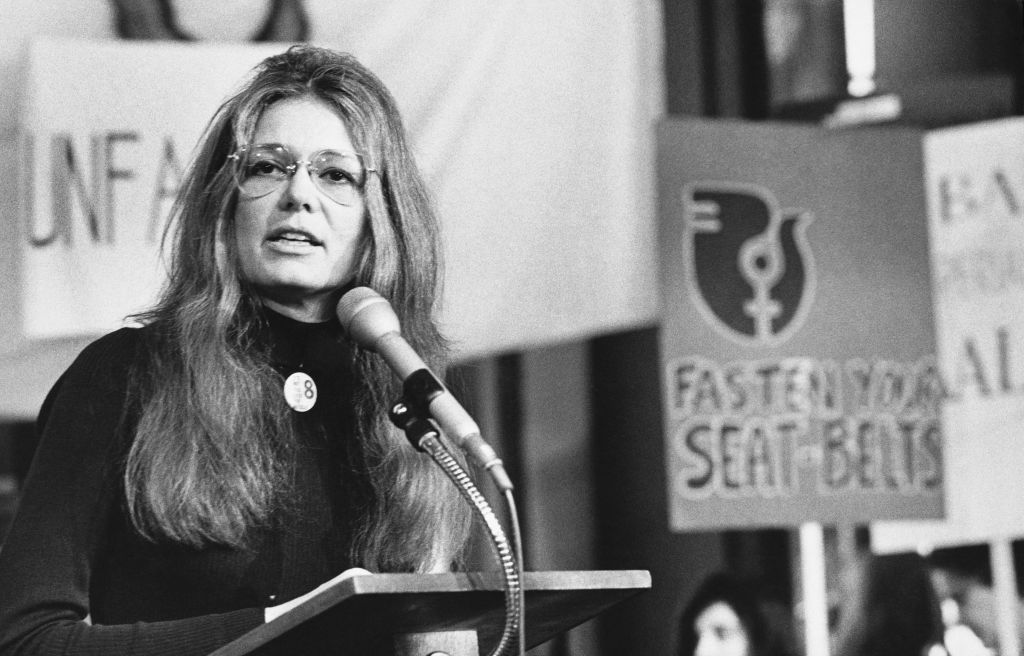
American feminist and activist Gloria Steinem speaks at a rally outside the United Nations, New York, New York, 1978.

Gloria Steinem speaks at a rally outside the United Nations, New York, New York, 1978. (Bettye Lane / Photo Researchers History / Getty Images)


In 2016, Gloria Steinem backed Hillary Clinton and dismissed young women who supported Bernie Sanders as doing so only because “the boys are with Bernie.” (She later said she misspoke). After her death last week, Steinem has been extravagantly praised in the mainstream media. Is it any wonder, then, that some leftists see Gloria Steinem as the “godmother of neoliberal feminism”?

Yet left-wing dismissals and establishment celebrations both have Steinem wrong.

At the height of her influence in the 1960s and ’70s, when she was a leading spokesperson for women’s liberation, Steinem was very much on the Left. Far from representing feminism for the 1 percent, Steinem believed that feminism had to represent all women and fundamentally remake society. Like many other major figures of second-wave feminism, she backed far-reaching reforms of the kind that many on the Left today support: federally funded childcare, a generous guaranteed annual income for all, strong labor unions, and opposition to racism and militarism.

Steinem is best understood as a left-liberal who sought transformative reforms within existing institutions. Working within established institutions hardly made her a tool of the establishment. Like Michael Harrington, she sought the “left wing of the possible.” Indeed, she remained closely connected to the organization Harrington founded, the Democratic Socialists of America (DSA), up until the moment she betrayed it in 2016 by backing Hillary over Bernie. Had Steinem lived in Europe rather than the United States, she would have been easily identified as a socialist. After all, at the height of the Cold War, she wrote her senior thesis on George Orwell, whom she praised as a “socialist libertarian.”

Steinem is misunderstood partly because most historical accounts of the 1960s and 1970s focus solely on the growth of radical social movements, the implosion of Cold War liberalism, and the conservative backlash, erasing the extent to which many American liberals became radicalized during this period. In 1972, the Democratic Party nominated the most left-wing candidate in its history. George McGovern captured the nomination by mobilizing the energies of the antiwar, civil rights, and feminist movements. He advocated defunding the military-industrial complex to meet pressing domestic needs such as childcare provision and fighting poverty and racial inequality. Steinem was closely allied to McGovern, though she outflanked him on the left.

Both before and after her public embrace of feminism in 1969, Steinem was a central player on the leftmost wing of the Democratic Party. She was a vital broker — of ideas, organizations, and people — who connected social movements to mainstream political institutions and helped make a space where the Left and liberalism could meet.

By the late 1960s, Steinem had become a prominent political activist. She helped organize a February 1968 advertisement of four hundred writers and editors who protested the Vietnam War by pledging to withhold 10 percent of their federal income taxes (the estimated amount of the federal budget devoted to the war). She worked tirelessly on behalf of the United Farm Workers (UFW), an insurgent labor union organizing migrant farm workers in California and employing national boycotts of non-union-harvested produce. Steinem wrote press releases for the union, raised money for its activities, and used her connections to help place UFW leader Cesar Chavez on the cover of Time.

Steinem also worked with Local 1199, the hospital workers’ union key to progressive politics in New York City. The predominantly African American and Puerto Rican workers whom 1199 organized were, she wrote, like farmworkers, “systematically excluded from 35 years of protective labor legislation” and had been “blackmailed into subsidizing society with unpaid labor.” To Steinem, it was “more and more clear that there has to be a new wave of labor organizing as far-reaching as in the thirties, but this time including all those who have been unprotected by legislation and unions: migrant workers; hospital and domestic workers; all the invisible poor.”

In 1969, Steinem announced that she was joining the feminist movement and quickly became its best-known spokeswoman. In this role, she advocated not just gender equality but the broader goals of equality and justice for which she had long fought. Steinem declared feminism “an integral part of rescuing this country from its old, expensive patterns of elitism, racism, and violence.” Feminists, she pronounced, were “not interested in imitating the inhuman male role, but in revolutionizing society.”

Steinem took seriously the notion that feminism needed to represent all women. Keen to spread her message, she conducted a series of widely attended “Women’s Liberation Speaking Tours” across the country. She always spoke alongside a black woman in order to establish the diversity of the women’s liberation movement, publicize African American feminism, and underline that the feminist movement’s goals were inextricable from those of the black freedom struggle.

Achieving feminism’s goals, Steinem claimed, required significant reform of capitalism. The recognition of women as “full human beings” required paying them equally for their work, including compensating housewives for their domestic labor. Steinem’s economic model was Sweden. Then under the leadership of Olof Palme, Sweden pursued both redistributionist policies and feminist ones such as free childcare and giving housewives the right to receive a percentage of their husbands’ income. Sweden, Steinem claimed, “is so far ahead of us . . . that Swedish statements on sex and equality sound like bulletins from the moon.”

Steinem’s efforts to transform American politics in a feminist and left-liberal direction were embodied in the National Women’s Political Caucus (NWPC), the organization that she helped found in 1971 along with Bella Abzug, Shirley Chisholm, and Betty Friedan. The NWPC’s founding statement of purpose had the far-reaching ambition of utilizing women’s political power for “the elimination of sexism, racism, violence and poverty” from American society by forming “coalitions with other oppressed groups.” It advocated housing for all, reform of the criminal justice system, comprehensive health care, a guaranteed annual income, the right for all workers to unionize under the National Labor Relations Act, and “an end to war.”

Achieving such aims, they recognized, would be expensive. However, they asserted that the country’s “enormous resources” were sufficient if they were “reordered to pay for life instead of for death.”

Steinem also advanced her left-liberal views in her most lasting achievement: Ms. magazine. Far from simply advocating individual change for middle-class women, the early issues of Ms. advanced a broad left-liberal agenda. The first issue contained articles on abortion rights, the housewife role, raising children without sex roles, and a piece by Pentagon Papers whistleblower Daniel Ellsberg on how macho ideas had driven the escalation of the Vietnam War. It also contained an influential article by Johnnie Tillmon, the African American director of the National Welfare Rights Organization who wrote from personal experience as a welfare recipient. Tillmon denounced welfare as a “super-sexist marriage” where you “trade in a man for the man.” She called instead for paying “a living wage for child-raising and housekeeping.”

Steinem’s left-liberal views were typical of the women’s liberation movement. To be sure, a vocal group of radical feminists criticized liberals for working within established institutions. And some liberal feminists pursued women’s rights as an isolated issue. But the majority of feminists, including those in the NWPC, at Ms., and in the National Organization of Women, linked feminism to a broader program of social transformation that also targeted economic inequality and militarism.

It may seem difficult to reconcile this view of Steinem as on the Left with the fact that in the late 1950s, she took a job with a CIA-funded organization that recruited young Americans to attend international Communist youth festivals abroad. Steinem’s involvement with the CIA was hardly admirable, but it’s not like she was planning the Bay of Pigs invasion. In any case, her association ended after she moved to New York City in 1962 to become a journalist. It is ridiculous to assert that Steinem remained a CIA agent who secretly worked within the women’s liberation movement to subvert it.

It is fair to criticize Steinem for not being radical enough and for moving to the center in some key ways in her later years. But it is simply wrong to say that she “never shared” the goals of the women’s liberation movement or that she promoted a “conservative, anti-left feminism.” This mistaken view of Steinem reflects a misguided left-wing mentality that divides everyone into the “establishment” and “the radicals,” while ignoring the broad space in between. We should remember Steinem for having embodied a potent combination of feminism with left-liberal politics.