Gloria Steinem Was the Godmother of Neoliberal Feminism

Gloria Steinem died this week at age 92. The establishment’s favorite “radical” feminist, Steinem worked with the CIA to promote reactionary propaganda and helped direct the women’s liberation movement into a corporate-friendly, anti-socialist direction.
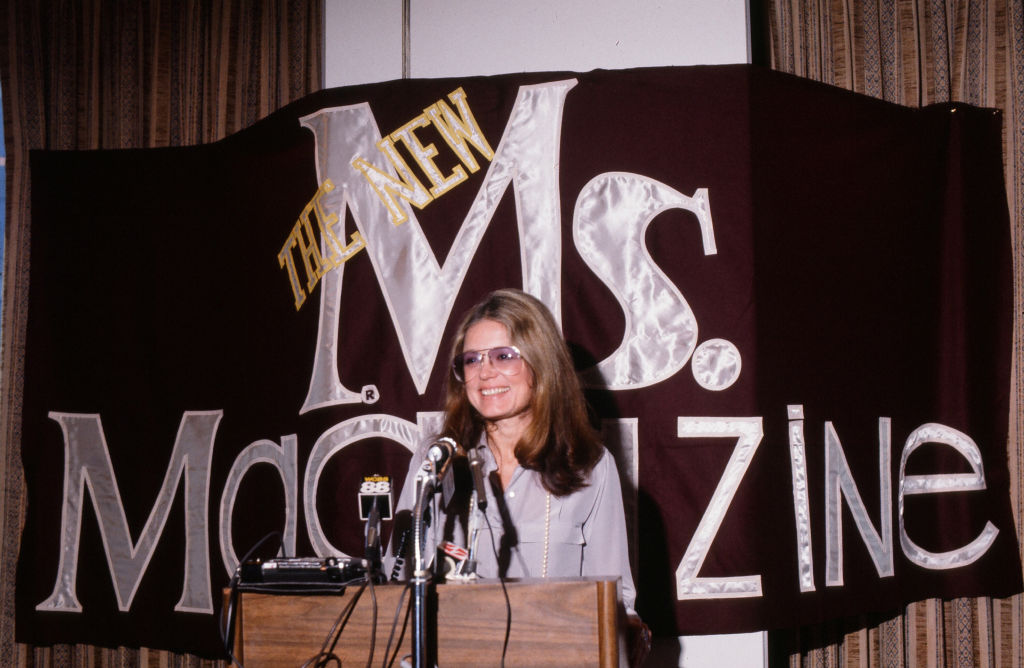
Gloria Steinem speaks from a podium at a press conference about Ms. magazine in the 1980s.

It’s a shame that the women’s liberation movement was, for 50 years, personified by Gloria Steinem — someone who never really shared that movement’s emancipatory goals. (Robert R. McElroy / Getty Images)


Gloria Steinem, the establishment’s favorite radical feminist, died on September 2.

The mainstream media has gone all out in praising her, with the Wall Street Journal and The New York Times united in their adulation. The Times called her the “personification of the women’s movement” and credited her with helping to usher in “sweeping cultural transformations across virtually every facet of American life, from the boardroom to the courtroom to the bedroom.” They approvingly quote her self-description as an “entrepreneur of social change.”

For many people, she is the only radical feminist they can name, eclipsing the extraordinary women who planned and launched the successful women’s liberation movement starting in 1967.

Steinem did wield enormous influence. Ms. magazine and the Ms. Foundation for Women, which she cofounded, came to define what was worthy in the feminist project. But to the women’s liberation pioneers she displaced, this meant silencing the radicals and promoting the anodyne. When Steinem described Ms. as “a kind of connective tissue for women all across this country who felt isolated until we came along and let them know they were not alone,” feminist pioneers saw Steinem as taking credit for work already done by the movement.

The women’s liberation movement didn’t need Ms. to publicize it. It had already been on the front page of nearly every mass circulation magazine and had produced ten mass-market anthologies by 1971, selling millions of copies. The movement published one hundred small newspapers and journals, including Off Our Backs, It Ain’t Me Babe, and Woman’s World.

And it had already won substantial victories by the time Steinem emerged on the scene. Thousands of working-class women were suing employers for sex discrimination. Abortion was legalized in New York State in 1970. The Equal Rights Amendment passed the House of Representatives in 1971 and the Senate in March 1972, followed immediately by twenty-two states.

The Rise of Ms. Magazine

So it was with an eye to the market already created by the radicals that Steinem, then thirty-seven and a professional magazine writer, collaborated with New York magazine editor Clay Felker to start Ms. magazine. The inaugural issue appeared as a section of New York in December 1971; it launched separately in July 1972. Washington Post publisher Katharine Graham invested, and Warner Communications put in $1 million but asked only for a 25 percent stake, an unusually generous arrangement.

Some women’s liberation pioneers were at first glad to hear of the new publication. Kathie Sarachild of Redstockings, who coined the phrase “Sisterhood Is Powerful” and authored the germinal 1968 “Program for Feminist Consciousness-Raising,” said she initially though Ms. would act as a feminist muckraker magazine, doing investigative journalism on behalf of women’s cause.

She and other women’s liberation movement founders were soon disillusioned.

It’s not that Steinem didn’t know who had led the movement up to the point she entered. In 1969, writing for New York magazine, she had attended the first-ever Redstockings abortion speak-out. She recalled the scene in her 1983 book, Outrageous Acts and Everyday Rebellions:

A local feminist group had asked women to testify about their real life experiences with illegal abortion. I sat in a church basement listening to women stand before an audience and talk about desperately trying to find someone who would help them, enduring pre-abortion rapes from doctors, being asked to accept sterilization as the price of abortion, and endangering their lives in an illegal, unsafe medical underground. . . .  Suddenly I was no longer learning intellectually what was wrong. I knew. I had had an abortion when I was newly out of college, and had told no one.

Yet the women who had taught her so much largely failed to find a place in the pages of Ms. three years later. Ellen Willis, pop music critic for The New Yorker and a Redstockings founder, did manage to make the cut starting in 1973. She resigned after two years, calling Ms. editorial policy “conservative, anti-left feminism.” In her resignation letter, Willis wrote: “No attempt has ever been made to recruit and hire experienced feminist writers, theorists, organizers. . . .  Ms.’s politics [include] a mushy, sentimental idea of sisterhood designed to obscure political conflicts between women.”

“Basically, it’s a change yourself line, the women’s magazine line,” Sarachild reflected later. “But the tricky thing about Ms. is that they pretend to be different. I bet there are certain women who wouldn’t bother reading women’s magazines who read Ms.”

The editing reflected the politics, and radicals described Ms. editing as torture. Patricia Mainardi, author of the groundbreaking 1968 manifesto the “The Politics of Housework,” recalled:

They would use a bullshit word instead of a strong word. I had the word “loved.” They changed it to “had a fondness for.” . . .  Cindy Nemser wrote in an article about Alice Neel, “Alice Neel is the foremost portrait painter in our time.” In Ms. this became, “She may indeed be the foremost portrait painter of the last 40 years.” It’s sneaky editing, downgrading women’s contribution to art. Ms.’s line is women are no good in art. They have been oppressed and damaged by their oppression. They’re inferior. It’s a goody-goody line: we have to work harder to overcome our oppression.

This made a sad contrast to the radicals, whose daring truth-telling had organized millions on the idea that what appeared to be women’s individual, personal problems were in fact political and rooted in their oppression by men. This was what they meant by the slogan “The Personal Is Political.”

Establishment Feminism

Ms. pioneered the use of private foundation funding to steer feminist movement priorities. The Ms. Foundation dispensed money to approved feminist projects and created a database of feminists around the country and the world. It seeded the founding of the National Black Feminist Organization (NBFO), a Ms.-aligned black women’s group. The NBFO is often cited as the very first black feminist organization in the United States. Repeating the pattern for the women’s liberation movement as a whole, the group blotted out the more radical organizing that preceded it, including the Student Nonviolent Coordinating Committee Black Women’s Liberation Committee, its successor, the Third World Women’s Alliance, and the Patricia Robinson–led group Poor Black Women, all groups with radical and anti-imperialist politics.

Before the rise of Ms., movement originators had received widespread coverage. Kate Millett was on the cover of Time in 1970. That same year hundreds of feminists occupied the offices of Ladies’ Home Journal editor John Mack Carter, demanding an issue they edited (and free daycare for the magazine’s workforce). They won an eight-page supplement titled “The New Feminism.”

But soon, the media went to Steinem for their “radical” feminism. Redstockings called it the “historic invisibility treatment”: The women who developed the movement’s strategy were written out of the picture. They became anonymous foremothers — while many were still in their twenties and thirties.

Betty Friedan was too well-known to sideline, but the media loved to counterpose Steinem to Friedan, the older, unhip, allegedly less radical feminist who founded the National Organization for Women in 1966. In fact, Friedan’s politics were well to the left of Steinem’s — under her maiden name, Goldstein, Friedan had served as a staffer of the United Electrical, Radio and Machine Workers of America, the union that held out against the demand that US unions expel their leftist leaders.

While Friedan presented herself as reformist to evade red-baiting, she argued astutely for undermining the the basis of men’s power over women by advocating for programs and structures that would give women the economic foundation for independence from men. “Without childcare, it’s all just talk,” she argued.

Steinem, styled as more radical, volunteered for Angela Davis’s bail committee, posed with her fist raised with Dorothy Pittman Hughes in October 1971, and toured the country with radical black lawyer Florynce Kennedy to lecture on feminism.

Steinem loved witty aphorisms that expressed terrible politics. She quoted actress Lee Grant: “I’ve been married to a Marxist and a Fascist, and neither one of them ever took out the garbage.” Aside from garbage being a rare bit of male-coded housework, the quote implies that communists and fascists are equally bad. You wouldn’t expect a fascist to do housework.

She liked to quote a woman cab driver in Boston who told her, “If men could get pregnant, abortion would be a sacrament.” While funny, this gets the causality of women’s oppression backward. Founding radical feminist theorist Simone de Beauvoir argued that women are oppressed because we do reproductive labor: if men could get pregnant, they would be the oppressed sex.

Steinem’s concept of a “liberated woman” (who, as she quipped, has sex before marriage and a job after) directly contradicted the the very heart of the radical movement’s argument — that women are oppressed as a class and can’t make themselves free individually.

Where did her politics come from? She seemed have one foot in the establishment from the start, dating John F. Kennedy speechwriter Ted Sorensen; then Franklin Thomas, who would soon lead the Ford Foundation; and, in the 1980s, real estate developer Mortimer Zuckerman. Vivian Gornick recalled, “Gloria was uptown; we were downtown. She hung out with Establishment figures; we had only ourselves.”

Steinem and the CIA

In 1967, the left-wing magazine Ramparts exposed the river of secret CIA money flowing into the National Student Association, the United States’ largest student group. After the revelations, Steinem spoke to the press about her role in recruiting anti-communist students to attend and disrupt the World Youth Festivals, which started in the socialist world and planned for the first time to venture outside the iron curtain in Vienna in 1959 and Helsinki in 1962.

She worked full-time as director of the Independent Service for Information on the Vienna Youth Festival, later renamed the Independent Research Service (IRS), a CIA conduit that flooded the festivals with anti-communist and pro-US propaganda. At the Helsinki festival, which drew 18,000 people from 137 countries, the IRS produced a daily newspaper published in three languages, coedited by Steinem and Clay Felker.

One of the 1959 publications with her name on it, A Review of Negro Segregation in the United States, claimed that the problem of racial discrimination had essentially been solved in the United States and that leftover problems were due to black people’s psychology. Low voter registration was because “in many areas of the South there exists a profound apathy among Negroes to the this paramount responsibility of good citizenship.”

The CIA’s goal had been to make the festivals so fraught — by encouraging violent clashes — that the countries sponsoring them would cancel them. As it turned out, the following two were canceled because the planned hosts, Algeria in 1965 and then Ghana in 1966, experienced coups. In Ghana, the CIA was involved, according to agency officer John Stockwell.

In the 1967 interviews, Steinem said the CIA funding was no problem. “Far from being shocked by this involvement I was happy to find some liberals in government in those days who were far-sighted and cared enough to get Americans of all political views to the festival,” she told The New York Times. She also said she was not asked to report on people she met there.

Since Steinem wasn’t well-known at the time, it was eight years later that the New York–based feminist group Redstockings discovered the connection, after Steinem had rocketed to the front of the movement.

Redstockings published an exposé in 1975, suggesting that the substitution of Ms. and Steinem for the “original, authentic activists that started the movement” looked similar to other CIA operations that “create or support ‘parallel’ organizations which provide an alternative to radicalism.” It also pointed out that a report published by Steinem’s organization on the Vienna festival included short dossiers on dozens of student leaders from around the world — contrary to her claim she never reported on attendees.

Steinem at first refused to respond to the charges, but when she did, she again defended her role and that of the CIA at the festivals. However, she did put considerable effort into suppressing the argument made by Redstockings. Random House planned to bring out a mass-market edition of the self-published book Redstockings book Feminist Revolution, which included a chapter on Steinem. Steinem threatened to sue Random House, and the publisher caved and censored the chapter. Steinem’s lawyers also threatened The Village Voice and even sent a threatening letter to every member of the board of the Columbia Tenants Union in New York City when its newspaper, The Heights and Valley News, printed a series on Steinem and the censorship.

Women’s Equality and the Neoliberal Turn

By the late 1980s, Steinem was famous for Ms. and for being the radical feminist but had not yet written a book laying out her vision of feminism (the anthology Outrageous Acts and Everyday Rebellions in 1983 collected her writing in Ms.and elsewhere).

When it finally came, Revolution From Within: A Book of Self-Esteem (1992) affirmed everything about her politics that had dismayed the radicals who started the movement. The book, which received a six-figure advance, continued the women’s magazine line that women needed to make internal changes.

“Without self-esteem, the only change is an exchange of masters; with it, there is no need for masters,” she wrote. Of course, we don’t have masters because we need them but because they need us. This basic inversion was symptomatic of her politics.

By contrast, women’s liberation feminists argued that women, like other oppressed people, are in constant struggle against our bonds — a concept they called the “Pro-Woman Line” — in fact, we take every bit of space available and find ingenious workarounds even when there is none. It was discrimination, exploitation, punishment, and constant everyday pressure that constrained us. This hard-won analysis was developed through the main program of the movement, consciousness-raising.

Ms. watered down this important organizing tool, publishing a guide to consciousness-raising that used the name and the form but missed the substance, reducing it to a therapy group where women blew off steam and got sisterly support. The original idea was to use the data that emerged in testimony to assess women’s true situation, dig at the root cause, and analyze who benefits. The program was inspired by the Southern civil rights movement’s “tell it like it is” public testifying and had parallels in the Chinese Revolution’s “speak bitterness” sessions. It was not intended as a safe space.

As corporate attacks in the late 1970s and early ’80s destroyed unions and working-class living conditions and wages plunged for all workers, Friedan and feminist radicals alike argued that advancing women’s equality now required confrontation with corporate power to get guarantees of childcare and health care, paid family leave, and shorter work hours for everyone. Friedan called it the “second stage” of feminism in a book by that name. Redstockings called for the abolition of private health insurance companies and a robust social wage, to give women independence from men and employers.

The Ms. wing of the movement fragmented into thousands of nonprofits, competing for grants from rich people by each proposing “winnable” small-bore solutions to the wreckage left by the employer offensive. This blinkered feminist vision was reflected in the Democratic Party establishment. Meanwhile, long hours, low pay, and worsening conditions for raising kids made women vulnerable to a right-wing nostalgia for to the “glorious thirty” postwar years of family-supporting jobs and stay-at-home moms.

In recent years, Steinem dropped all pretense of radicalism. She supported Hillary Clinton in the 2016 Democratic primary against Bernie Sanders, and in an interview that year on Real Time With will Maher suggested that young women only supported Sanders because “that’s where the boys are; the boys are with Bernie.” She later claimed she misspoke.

Media hagiography of Steinem reached a fever pitch in the last decade with a TV dramatization of her life, The Glorias; a play, Gloria: A Life; and glowing profiles in the The New York Times, The New Yorker, and elsewhere.

This wave of Steinem-mania coincided with a time that young women were questioning the utility of a 1 percent feminism, represented by such figures as Clinton, Madeleine Albright, and Sheryl Sandberg. Had the goal of women’s liberation really been exploitative corporations and a violent US empire run by women? Steinem was again trotted out to steer the discussion into safe channels, but by the time of her appearance with Maher, she was just giving feminists a bad name.

Women’s liberation movement pioneers, to a woman, came out of the civil rights movement, the antiwar movement, and the student left. They believed that consistent feminism leads to socialism, and vice versa. Following Beauvoir, they wanted to dig deep and abolish the exploitation of women and the oppression required to maintain it. Starting in the 1960s, they planned and built a successful radical movement that profoundly changed the situation of women in the United States and reverberated worldwide.

It’s a crime that their movement was for fifty years personified by someone who never shared its goals.