The Left Should Start Using the Word “Evil”

Susan Neiman

According to philosopher Susan Neiman, the Left abandons the concept of good and evil at our own peril. If we refuse to use such morally freighted language, we concede it entirely to people who will use it for immoral ends.
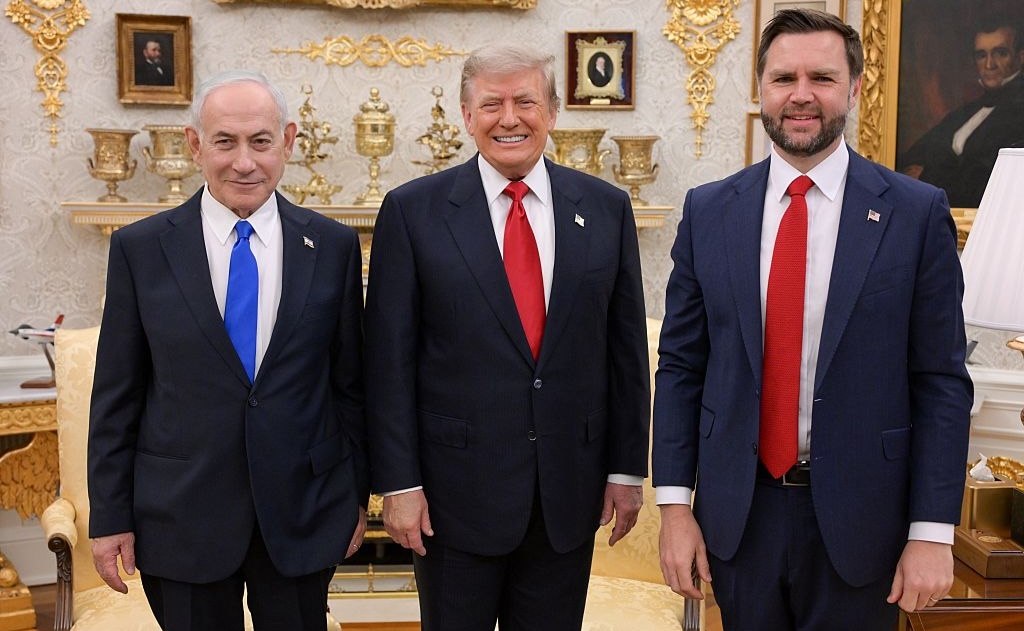
US President Donald Trump and Vice President J. D. Vance (R) meet Israeli Prime Minister Benjamin Netanyahu at the White House in Washington, DC, on July 28, 2026.

The Left must adopt the language of good and evil, argues philosopher Susan Neiman. If the cold-blooded murder of fishermen, or schoolgirls, or peacefully protesting demonstrators isn’t evil, what is? “Authoritarian” is too weak to do it justice. (Maâayan Toaf [GPO] / Handout / Anadolu via Getty Images)


Interview by
Kristen R. Ghodsee

Follow the news out of Washington for a week, and the usual vocabulary of political criticism starts to feel insufficient. Words like “authoritarian” and “illiberal” describe styles of governance. They say much less about what it is like to watch an administration indulge shameless sadism, pursuing cruelty for its own apparent enjoyment. The word that fits better is one many on the Left have trained ourselves not to use: “evil.”

Our reluctance is not without reason. Evil calls to mind a Sunday school admonition or George W. Bush’s “axis of evil,” a phrase that helped sell the immoral and disastrous war on terror. A long materialist tradition treats moral ideas as downstream of economic realities and cautions against idealism that overly concerns itself with the questions of values and culture. Evil conjures childish boogeymen and unhelpful abstractions, not the social structures we want to seriously analyze.

At the same time, the Left’s case for decent wages, housing, health care, and a world beyond class divisions is indisputably a moral case — whatever our theory says about the mechanics at play. And we don’t try to hide this: indeed, our movements often succeed best when we combine people’s self-interest with their sense of justice, neglecting neither.

On some level, we know that we can’t do without the language of good. A new book, Call It Evil: Understanding the Trump Era by philosopher Susan Neiman, argues that we can’t do without the language of evil either, and that rejecting it has left us disarmed. Neiman contends that the Left has surrendered moral vocabulary to fundamentalists and in doing so has let a bleak theory of human nature pass for plain realism. She traces that theory to distorted readings of Adam Smith and Charles Darwin and to a deliberate, well-funded effort by American business to spread it.

Neiman directed the Einstein Forum in Potsdam, Germany, from 2000 until earlier this year and has written about evil for decades, most notably in Evil in Modern Thought. Her other books include Learning from the Germans and Left Is Not Woke. In this interview, Neiman spoke with Kristen Ghodsee, a professor of Russian and East European studies at the University of Pennsylvania, author of Everyday Utopia, and a frequent contributor to Jacobin.

Ghodsee and Neiman discussed why the Left needs moral language, and the perils of ceding it entirely to the people most likely to use it toward immoral ends. They also discussed where Neiman parts ways with many Marxists, how Germany’s official campaign against antisemitism became a crackdown on supporters of Palestinian rights, and the problems of essentializing any experience, including that of class.


Kristen R. Ghodsee

The title of your book enjoins us to use explicitly moral language to describe politics in the Trump era. You suggest that many on the Left feel uncomfortable using words like “good” or “evil” or “truth” because of their religious connotations. Why is the language of morality necessary to the Left, especially in this political moment?

Susan Neiman

It’s common to condemn the Trump administration’s contempt for the rule of law. We forget that the rule of law only works if people commit to upholding it even if a legal decision goes against their self-interest — and that’s a moral commitment. James Madison knew that even the best constitution was no protection without “virtue in the people.” The Founding Fathers were less averse to moral concepts than we have become, especially on the liberal left.

Let’s dispense with a widespread misunderstanding that good and evil are religious ideas. Moral intuitions precede theology. Religion is a response to the problem of evil, though I don’t think it’s a very successful one. Every culture recognizes evil, whatever their religious practices. You could call it “awareness of injustice.” That’s something that children, most primates, and according to one study, even rats display.

My favorite argument that morality precedes religion comes from the Bible itself, when Abraham urges God not to punish the innocent with the guilty — not to accept collateral damage. That suggests that even should you have a direct line to the Lord himself, he isn’t the source of your moral judgment.

It’s true that religious believers are more comfortable using moral concepts, and it’s equally true that fundamentalists abuse them. But why should we allow the most powerful tools in our language to be appropriated by those who are least able to use them responsibly? People are moved by those concepts, which appeal to deep intuitions and emotions; better to learn to analyze evil than deny what we can see every day. If the cold-blooded murder of fishermen, or schoolgirls, or peacefully protesting demonstrators isn’t evil, what is? Words like “authoritarian” are simply too weak to do it justice.

I don’t think Zohran Mamdani uses the word “evil,” but his campaign was premised on moral values, and its success cannot be reduced to affordability. He leaned hard on questions of justice, in particular the injustice that most people who keep New York City running cannot afford to live there. And his steadfast condemnation of the genocide in Gaza — which initially seemed a huge liability — is a great source of his popularity. We’re so used to politicians abandoning their principles when it suits them that Mamdani’s display of integrity became a source of credibility, creating hope he won’t sell out on other issues. We should also remember that the most successful (albeit only partially so) leftist movement in US history was the civil rights movement, which roused millions of people through a clear moral message.

Kristen R. Ghodsee

Although written in clear and accessible prose, this short book grapples with complex philosophical issues. It forces readers to confront some of the most vexing theoretical issues of leftist politics over the last two centuries. Haunting this debate are the specters of Immanuel Kant and G. W. F. Hegel and the perennial tension between idealism and materialism.

For you, Marxism is far too wedded to the idea that the economic relations of production determine our superstructural concepts of good, evil, justice, love, and so on. Why should the Left reclaim the power of ideas in its pursuit of progressive change?

Susan Neiman

Most of my work has been devoted to making complex philosophical issues accessible to general audiences, since I believe philosophical assumptions are a greater part of our lives than we recognize. Take statements like “Be realistic” or “That’s just human nature.” As used in ordinary language, they imply a web of assumptions about the world we take for granted because we haven’t reflected on them. Materialism is one of the most basic.

Like anyone who learned from Karl Marx, I’ve spent hours in arguments about differences between materialism, dialectical materialism, and historical materialism, whether there are major differences between the early and late Marx, and how to get around the fact that his nineteenth-century predictions did not hold up. A long seminar wouldn’t do those arguments justice, much less a short interview.

Bertolt Brecht’s dictum “First comes the grub, and then come the morals” is chronologically correct. When people are hungry or homeless, they don’t have much energy to reflect on morality. Once their stomachs stop rumbling, they begin to think about justice. Marxism’s biggest paradox is that it inspires people through demands for justice — i.e., moral claims — while theoretically undermining the basis of that inspiration. Ideas move people in powerful ways — often rather bad ones, as nationalism today shows.

I admire the misread and forgotten Eduard Bernstein, a founder of the German Social Democratic Party. Although he was Friedrich Engels’s literary executor, he rejected dialectical materialism, which he thought was an insult to workers, who were just as capable of being moved by ideals as anyone else. He was also an early feminist and supporter of gay rights. Bernstein wrote that “social democracy needs Kant, who shows that materialism is the most deceptive ideology, and that contempt for ideals, the elevation of material facts to omnipotent powers is simply deceptive.”

The Enlightenment is now so dismissed that it’s often forgotten that Marxism was once seen as the culmination of Enlightenment thought — both by its defenders in the Soviet Union and the German Democratic Republic, for example, and by its Nazi opponents. On that view, Marx’s contribution was to insist that the ideals of the Enlightenment demand material realization — not that those ideals were reducible to material interests. It’s a subtle but important difference.

Call It Evil argues that we’ve been conditioned to accept materialism as a fact, not an ideology. The idea that moral concepts are just superstructure is supported by crass misreadings of Adam Smith and Charles Darwin, reinforced by Michel Foucault. I show how these misreadings of Smith and Darwin created a sense of inevitability you can read in any newspaper, without ever asking whether they are debatable philosophical assertions. Since the end of the Cold War, the sense of inevitability has become stronger.

Kristen R. Ghodsee

Most secular people today imagine evil as something diabolical, but Hannah Arendt talked about the “banality” of evil. You also wrote a groundbreaking book, Evil in Modern Thought, exploring the concept’s dimensions. Many Marxists would argue that our social conception of “evil” emerges from the base of our material experience of the world, but you suggest that there is a kind of Platonic form of pure evil that exists independently of our social realities. That’s why we know it when we see it and why it’s such a powerful concept.

Can you talk about your use of this word? What is the rhetorical power of “evil,” for instance, over “awful”?

Susan Neiman

You can measure the rhetorical power of “evil” by the number of people — mostly on the Left — who object to it. It’s striking how many point out that it’s a dangerous term that can be abused, as if that had never occurred to anyone who’s thought about the subject. “Awful” can apply to a filthy apartment or a bad boyfriend. If it’s all you have to say about a genocide, you have failed to grasp what genocide is.

I’m not a Platonist, and I don’t believe that evil exists independently of social realities. Until the mid-eighteenth century, most people did. I do believe that it’s something we recognize and can learn to recognize better.

Arendt’s work was crucial in showing us that the most dangerous forms of evil emerge not from sadism or cruelty but from our tendency to go along with systemic structures around us and not rock any boats that might disturb our lives. That she turned out to be wrong about the man Adolf Eichmann, as was proven by tape recordings that were unknown in 1963, doesn’t undermine the validity of her claims. Genocide cannot be committed by a few consciously evil people alone. It requires millions who accept them.

Kristen R. Ghodsee

As I read your book, I kept thinking about David Graeber and David Wengrow’s The Dawn of Everything and how many contemporary debates about capitalism and socialism lean heavily on different conceptions of “human nature.” You show how American conservatives used their money and influence to fund the creation of think tanks and university programs in neoliberal economics and evolutionary psychology to protect their economic interests. Through their foundations and societies, they propped up men like Milton Friedman who asserted that all societies are based on greed and self-interest.

Do you think that conservatives are somehow more effective at weaponizing ideas than progressives, and if so, why? But also, given that these ideas were promoted by those most likely to financially gain from them, isn’t this a textbook case of the economic base determining the superstructure?

Susan Neiman

I found Graeber and Wengrow’s book liberating, though I wish they’d given Jean-Jacques Rousseau more credit. His argument should be music to their ears: we have no access whatsoever to the deeds, much less the thoughts and drives, of our prehistoric ancestors, so we project conceptions of human nature onto the past that suit our political projects. The Dawn of Everything was important for that argument; another related book is Stefanos Geroulanos’s The Invention of Prehistory. You cannot defend socialism without questioning the conception of human nature that capitalist ideology has taught us to take for granted. Everyone reading these words has surely encountered people who insist that socialism is nice in theory, but human nature ensures that it can’t work in practice.

When I began work on this book, I assumed that the various ways this ideology is blasted at us were just unfortunate coincidences; everything else seemed too conspiratorial. Looking further, particularly at Naomi Oreskes and Erik M. Conway’s excellent The Big Myth: How American Business Taught Us to Loathe Government and Love the Free Market, I realized how deliberate the mythmaking has been.

Certainly, economic interests can play a huge role in shaping and spreading ideologies. I’m just denying that they always determine them. And you’re right that conservatives are better at promoting ideas than leftists; a classic of mid-twentieth-century conservatism was called Ideas Have Consequences. Once leftists acknowledge that they do, we’ll get better at defending them.

Kristen R. Ghodsee

Your wonderful chapter on propaganda starts with an anecdote about moving to Berlin in 1982 and listening to East and West German news broadcasts. What did these broadcasts teach you? Why do you think Americans are so particularly bad at recognizing propaganda? And why do you think propaganda erodes our capacity for moral judgment?

Susan Neiman

Those broadcasts were great background for reading Noam Chomsky and Edward Herman’s Manufacturing Consent, published a few years later. It’s not that I suddenly believed everything the East Germans broadcast, but I understood how context and framing, even without deliberate lying, could create completely different takes on reality.

The experience also inoculated me against a later lie, namely that the West Germans did a better job of dealing with the Nazi past than the East Germans. It’s a West German myth now accepted in much of the world. Few West Germans were spreading that myth in the 1980s, since anyone with basic knowledge of German could tell it was the East, at the time, that was reckoning with the Nazis — incompletely, but far more than the West, which wanted to sweep that history under the carpet. That’s a useful lesson for thinking about Cold War America as well.

Americans are bad at recognizing propaganda because our biggest piece of propaganda is that we have none. Possibly a silver lining of Trump’s attack on the media, and the media’s complicity with it, is that Americans will better recognize how worldviews can be shaped by political interest. I fear, however, that his weaponization of the phrase “fake news” leads people in a different, nihilistic direction: there is no news that isn’t manipulated to maintain power.

I don’t think we can have real moral judgment without considering competing views. We might accidentally behave morally, but it isn’t judgment if it isn’t reflective, and that means not taking your own morality for granted. It’s much easier to reflect if you are confronted with different moral and political assumptions. Too few Americans have opportunities to do that.

Kristen R. Ghodsee

In your chapter on why Gaza matters, you walk back some of the claims you made in your previous book, Learning from the Germans. What happened in Germany after October 7, 2023, that made you see things differently?

Susan Neiman

The problems started before October 7; they came to a head in 2019, when the far-right Alternative for Germany (AfD) party proposed a parliamentary resolution banning Boycott, Divestment, and Sanctions (BDS). It was a brilliant and sinister form of — can I call it Jew-washing? By embracing the government of Israel, the AfD hoped to answer charges of neofascism. How could it be fascist if it unconditionally supports the State of Israel? It also advances one of its main goals, which is keeping Muslim immigrants out of Germany.

No one challenged it, because the other parties were afraid to be seen as less philosemitic than the AfD, so they immediately passed a similar resolution, which resulted in canceling artists, writers, journalists, and others who can be described as “close to BDS,” i.e., anyone who supports Palestinian rights. And many of us are Jewish.

This created the biggest political/cultural debate of the last six years, which took place in television, radio, in print, and in parliaments. Learning from the Germans had argued that Germany’s historical reckoning was flawed, but it did better than any other country in facing the evils of its past history. The recent debates exposed the depth of those flaws in ways that forced me to revise my views. German reckoning suggests that as long as one is nice to Jews, any Jews, one has done one’s duty in opposing Nazism. This is an extremely simplistic understanding of fascism, ignoring the real lesson of Nuremberg: the importance of upholding human rights, and that they apply to all humans — including Palestinians.

Kristen R. Ghodsee

You also write about how the far right has weaponized antisemitism, not only Trump in his attacks on US universities but also Alternative for Germany, which recently won almost 44 percent of the vote in the state of Saxony-Anhalt. What does what you term “philosemitic McCarthyism” look like in practice?

Susan Neiman

The AfD provides a perfect example, but it is not alone. In 2022, I cohosted a conference in Berlin, Hijacking Memory, examining the weaponization of antisemitism among right-wing parties in seventeen countries. Predictably, the press accused us of antisemitism. The reception illustrated the problem we were analyzing!

People have been fired from jobs and had projects, exhibits, or appearances canceled. Those hardest hit are Muslims and people of color who support them. Americans will see parallels in the second Trump administration. What’s particularly infuriating for leftist Jews like me is this: Even if they don’t give a damn about Palestinians, why in the world do they think these kinds of repression protect Jews? On the contrary: targeting other groups, allegedly to protect us, only increases antisemitism. If I were paranoid, I’d suspect a conspiracy.

Kristen R. Ghodsee

In your chapter on woke identity politics, you warn that leftists should not replace racial essentialism with class essentialism. While social classes are obviously fluid and we all have multiple allegiances, don’t you think there is a profound difference between those of us who must work for a living versus those who can live off the dividends and capital gains generated by their (often-inherited) wealth? There is a real bifurcation between the owners of capital (and their heirs) and the rest of the population who must sell their time, labor, or attention to survive, the so-called 99 percent. How can any universalism encompass the billionaires?

Susan Neiman

I agree with Mamdani that there’s no good reason for billionaires to exist. Apart from die-hard ascetics, most of us who work for a living can imagine a luxury or two we wish we could afford. But it’s impossible for anyone to buy a billion dollars’ worth of treats; the point of making that much money is to exercise political power, as billionaires are doing with increasing shamelessness. Particularly given how much of their wealth depends on other people’s labor, that’s an injustice that cancels any form of democracy.

There are profound differences between those who live on dividends and those who work for a living, just as there are profound differences between men and women, and between people of different ethnicities. Those are differences in experience, which is why it’s so important for different voices to be heard, but essentializing those differences is a metaphysical mistake with dangerous political consequences. And the notion of class has changed so much since Marx’s day that it’s unhelpful to depend on it; far better is a universal conception of justice, which occasionally moves even members of the ruling class to action. Where would we be without Engels’s dividends?

Kristen R. Ghodsee

You end by claiming that socialism offers a way out of the morass we find ourselves in today. Can you talk about your vision of socialism?

Susan Neiman

In my last book, Left Is Not Woke, I offered a normative definition of what it (should) mean to be left today. There are three principles common to both leftists and liberals:

  1. We are universalists, not tribalists, because we believe that genuine connections and obligations do not depend on origins.

  2. We believe in a principled distinction between justice and power, even though the distinction is often abused.

  3. We believe that progress toward more just and fulfilling societies isn’t inevitable, but it is possible.

In that book, I argued for a popular front between leftists and liberals in a time of rising fascism. But there’s a fourth principle that distinguishes leftists from liberals:

Social rights — to health, education, housing, fair labor practices, and leisure — are not “benefits” or “safety nets” but rights as important as political rights to speak, vote, travel, or worship as we please.

Like Bernstein, I think those rights could be achieved through democratic processes. I’m well aware that this can look utopian at this moment. My book is meant as a contribution to the conceptual changes that must happen for a peaceful revolution to take place. In a world that’s armed to the teeth, anything else is too dangerous.

Share this article

Contributors

Susan Neiman is a philosopher who directed the Einstein Forum in Potsdam, Germany, from 2000 until 2026. She is the author, most recently, of Call It Evil: Understanding the Trump Era.

Kristen Ghodsee is the Catherine Bryson Professor of Russian and East European Studies at the University of Pennsylvania and the author of Everyday Utopia, Red Valkyries, and Why Women Have Better Sex Under Socialism.

Filed Under