In Serbia, Few Frankly Reckon With Ratko Mladić’s Crimes

Ratko Mladić was a war criminal who died in detention last week in The Hague. But ahead of Serbia’s elections, President Aleksandar Vučić’s party shied away from criticizing the ethnonationalist general’s legacy.
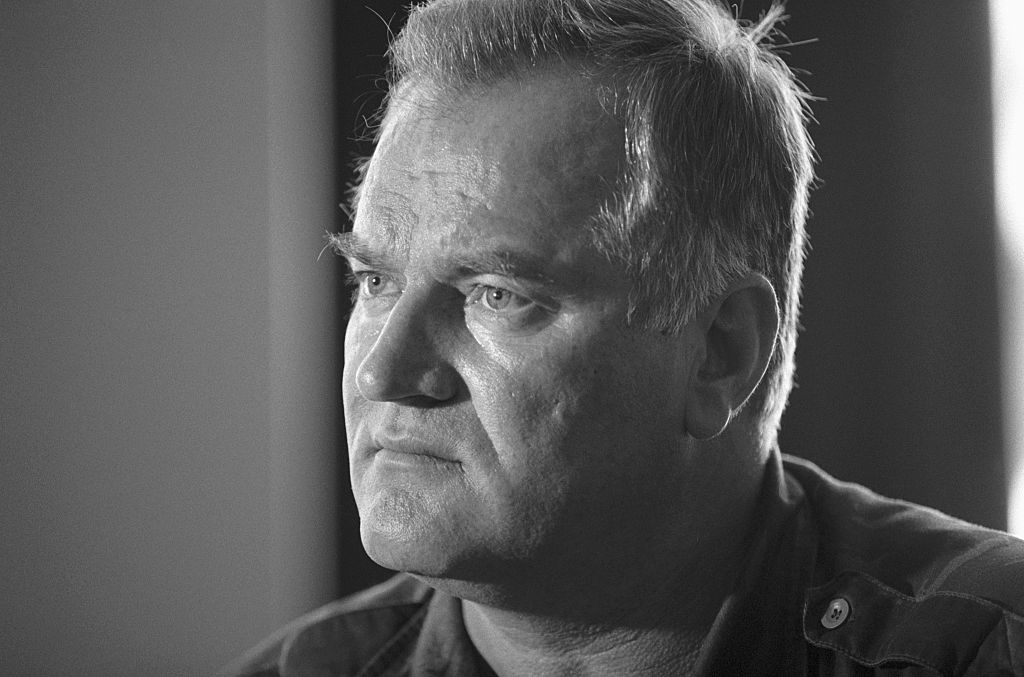
Serbian Commander Ratko Mladic, photographed in 1995.

Last week, Serb General Ratko Mladić died in The Hague. While denial of his atrocities remains rampant in his homeland, some spoke out against the honoring of a war criminal. (David Turnley / Corbis / VCG via Getty Images)


When residents of a block in Belgrade’s city center woke up to the news last week, they were confronted with a mural celebrating a war criminal, painted overnight. Furious, they plotted a “night action” to destroy this latest tribute to Ratko Mladić with improvised defacement tactics. While the war criminal’s face is ever present across the Serbian capital, this was the first time a mural several meters long and about one meter high had appeared on the building surrounding their park.

The news of Mladić’s death, while in detention at The Hague, came in the middle of a campaign for parliamentary elections that have not yet been called but according to President Aleksandar Vučić are expected any day now. What a popular slogan calls the “students who are winning” (after a series of recent mass protests) are campaigning for the vote, as are the current head of state Vučić and his SNS (the Serbian Progressive Party, in name only). The justice minister hastily announced that “the protocols are known” and that Mladić, being a general, would be buried accordingly, with military and state honors. Still, Vučić, the all-powerful president, backed away while pointing to “family wishes” and suggesting there might be no state-sponsored funeral.

A few opposition leaders issued statements firmly distancing themselves from Mladić’s legacy and emphasizing the need not to forget or relativize the truth about his victims and the genocide. The European Commission, which is not exactly a moral or political authority here, said there is no room for an EU candidate country to celebrate a convicted war criminal. In Republika Srpska — the Bosnian Serb entity within neighboring Bosnia and Herzegovina, where Mladić commanded atrocities — numerous vigils were held, often featuring well-known football hooligan iconography. In a professionally produced video, students from Republika Srpska in Belgrade held up a huge poster over the Branko Bridge depicting Mladić, bearing the words “From your struggle, our freedom lives.”

Survivors and victims’ associations from the genocide site at Srebrenica and across Bosnia were once again shocked at such reactions. While approving of Mladić’s sentence and imprisonment, they pointed out that his death changes nothing. It does not bring the dead back or erase the mass graves.

Myth-Building Amid the Breakup of Yugoslavia

Ratko Mladić was born in eastern Bosnia in 1942. He joined the Yugoslav People’s Army (JNA) in 1965, when it was still a widely respected institution of socialist Yugoslavia. He climbed steadily through its ranks, eventually becoming a general. Yet his real ascent began with the breakup of Yugoslavia at the turn of the 1990s. He started building his reputation in Knin, where he was sent to fight the forces of newly independent Croatia. When the JNA decided to officially withdraw from Bosnia and the Army of Republika Srpska was formed in 1992, he was appointed commander of its Main Staff, inheriting much of the JNA local infrastructure, including personnel, weaponry, and other resources.

Media-savvy and always ready for the camera, Mladić switched his ideological allegiances — from defender of socialist Yugoslavia to an ethnically attuned defender of Serbs and their land. His wartime legacy in Bosnia included the siege of Sarajevo, the genocide in Srebrenica, and war crimes and crimes against humanity across different parts of Bosnia and Herzegovina. After the Dayton Peace Agreement in 1995 marked the end of the war in Bosnia, he was indicted by the United Nations’ International Criminal Tribunal for the former Yugoslavia (ICTY). Avoiding trial, he came to Belgrade and lived fairly openly under Slobodan Milošević’s protection until his patron fell in October 2000. He spent the following years in hiding — first aided by a network of former military officers and later by relatives, vanishing from public view entirely by 2008. He was finally captured in 2011 in a village in northern Serbia and extradited to The Hague. He died this August 27 in a prison hospital.

No matter what his physical location or his administrative or carceral status, Mladić was present in Serbia all along, as a ready-made poster, mural, slogan, T-shirt icon, overarching symbol, or historical and narrative arc, to be used and reused in endless political and (social) media campaigns. He was ready to serve, dead or alive. He remains a crucial part of government-linked street and hooligan groups’ mass-scale visual campaigns, regularly performed across Belgrade.

Tanja Marković, an activist involved in peace and antifascist initiatives since the 1990s, told me: “The state maintains no distance whatsoever. We remember how it guarded the Ratko Mladić mural in Njegoševa, in an organized fashion, and how long it took for that mural to be removed.” Some of the most enduring slogans are those related to genocide: “The only genocide in the Balkans was against the Serbs,” read a huge piece of graffiti, in English, on a building in the city’s main avenue, just across from the Belgrade Cultural Center. Then there are those depicting Mladić, usually featured in close-up, wearing an army hat or, in the case of graffiti, there is simply his name accompanied by an “appropriate” slogan. These murals and slogans often provoke rage among other citizens and peace and youth activists, who throw eggs or try covering them with white paint, only for the murals to resurface again.

In nationalist myth, Mladić serves as a defender, preventing a new genocide against the Serbs, within a historical arc that connects the slaughter of Serbs in World War II with the real and threatened ethnic cleansing of Serbs during the Yugoslav Wars. He not only defended Serbs from domestic enemies, such as Croats and Muslims, but from imperialist forces too. Anti-NATO is always a great story hook, especially in Serbia, which was later depleted by sanctions and subjected to the highly controversial NATO bombing campaign (precedent for which were air strikes against Mladić’s forces in 1995). With a quasi-socialist pivot at first, then transitioning to ethnonationalism with an anti-imperialist flavor, the myth resolves complex histories and some real grievances into a murderous, single-hero story that plays well within a wider narrative framework centered on ancient ethnic wounds and hatred. This framework explains not only the war but also how and why socialist Yugoslavia broke up. Contrary to all the data on mass impoverishment, we did not lose a class war but simply so terribly and murderously hated each other.

Genocide Denial to Stay in Power

There are only two questions that every contender for political power in Serbia has to answer: Was there a genocide in Srebrenica, and is Kosovo Serbia?

Whoever the challenger and whatever they really think, you can always see them being grilled in those TV debate chairs, playing an impossible game rigged to ensure any myth-busters will lose the part that matters: i.e., the elections. For an outsider, both questions could appear not only morally corrupt but intellectually delusional. Kosovo, with or without asterisks (Kosovo*, as it is sometimes styled in the official international documents), does exist. And the genocide in Srebrenica did happen; we could hardly miss the bones of the thousands of victims, brushed clean by forensic experts as they were recovered and identified from mass graves, including the secondary ones, where bodies had been moved and scattered in an attempt to cover up the crime.

There were times in Serbia’s recent history when it seemed that society was ready to confront its past and begin rebuilding relations with its neighbors. When rereading the articles and rewatching TV, it is obvious that even Radio Television of Serbia, the public broadcaster, though always under the strong grip of whichever party was in power, did in multiple programs offer its viewers insight into the scale of the atrocities and the burden that this legacy places on those living. In 2010, the Serbian parliament adopted a declaration condemning the crime in Srebrenica, offering an apology and condolences to the families of the victims for the failure to prevent the tragedy. Vučić himself went to Srebrenica for the twentieth-anniversary commemoration in 2015, marking a shift toward reconciliation compared to his earlier political stance.

Why then, does the myth persist? Who benefits from it? Who is keeping it alive? Who can break it down and introduce a new myth?

In 2024, the UN General Assembly adopted a resolution commemorating the Srebrenica genocide, explicitly condemning genocide denial and the glorification of those convicted for war crimes. On the day of the vote, Vučić was at the UN, wrapped in a Serbian flag, his posture as if in prayer for Serbia not to be charged with genocide. During the evening, a skyscraper that is part of a highly dubious urbanistic mega project, Belgrade Waterfront, which also serves as a visual campaign booth, fluorescently flashed the words “We are not genocidal people” to different parts of Belgrade. The resolution explicitly states that criminal accountability for genocide is a responsibility that weighs on certain individuals; the “collective guilt” framing was instead manufactured, in the lobbying campaign that preceded the vote, by Vučić and Milorad Dodik (leader of Republika Srpska) themselves. After the UN vote backed the resolution, Vučić, as if the chief doppelgänger of a parallel reality, announced a moral victory based on the sixty-eight abstentions, and he continued campaigning in ongoing local elections.

The myth, deployed as a technology of staying in power, always intensifies when there are problems, elections, or challengers to power. The historical arc, the narrative, the explanatory frame was set long ago and is state sponsored at all times, in war and peace alike. Regime members are an integral part of it, either as real characters in concrete historical events, as with Vučić, who served as minister of information during the last phase of Milošević’s rule, or as political actors who benefit materially and politically from keeping the myth alive. To stay in power, it was crucial not to let citizens question their newly found capitalist “paradise” but to keep everybody hostage in this imagined community of war crimes and war thugs; complicit through membership in the same ethnic community, complicit through widespread feelings of loss, guilt, and shame that are being worked out through ethnic drama while covering up mass economic and social losses.

Students Win, but With Baggage

There were also those who challenged the destructive myth. But they, too, sometimes fell into a collective-guilt framing, screaming nationalism where they could have screamed class. In a rather bizarre string of historical permutations, the German model of postwar reckoning with Nazism, Vergangenheitsbewältigung, or “dealing with the past,” was adopted in the local nongovernmental organization (NGO) lexicon and practice. The concept sat well with the tradition of political liberalism in Serbia, while neglecting the economic workings of the breakup of Yugoslavia and dismissing local histories as possible sources of peace and justice. Still, as Marković points out:

We would be completely in the dark related to war crimes if it wasn’t for them. It is also true that war crimes concealed the economic crime called privatization and the disenfranchisement of the broad masses of the people. People close to those in power easily got their hands on those former factories for very little money and cemented their wealth. And now, there’s practically nothing we can do about them.

Ingenious tricksters on the political right spotted the weaknesses of the model and invented the charge of auto-chauvinism (the self-hating Serb), which played well on the divide between the urban-educated, culturally snobbish on one side and the rest of the country on the other. This is how the narrative and explanatory framework became squared and closed from all sides. The charge of auto-chauvinism, while never in mass usage, has been repeatedly deployed against the current student movement, transformed into clickbait: students have been called “Ustaše” (supporters of the Nazi-collaborationist regime in Croatia during World War II) and accused of being part of a “color revolution” and of working against Serbs and Serbia.

The student-led mass social movement in Serbia began at the end of 2024, sparked by the collapse of a railway station canopy in second city Novi Sad. The students and their electoral list, which will not feature students but their supporters from different sectors and walks of life, are the main challengers to Vučić’s power and the biggest to date. The country, or at least its rebellious part, keeps pushing for political reforms and what is perceived as a never-finished democratization. The socioeconomic agenda, once again, does not feature prominently, although there have been certain changes compared with previous protest mobilizations. Students kept silent about Mladić. Supporters are somewhat understanding, with hopes that a change of government will open up the possibility for these issues to be discussed anew.

And there are different approaches and alternative histories to the one in which Mladić, the defender of Serbs, is the central character.

There are the many people who crossed identitarian and ethnic lines to help those on the other side. Some died while doing so, killed by people of their own ethnic group. Others resisted, to their own detriment, interethnic pressure and involvement in crimes. There are also alternative histories of the breakup that do not fit neatly into the story of primordial ethnic hatred.

One day, there will be no murals of Ratko Mladić in Belgrade. Not because of lonely acts of resistance, but because there will be no political force in power interested in keeping that myth alive. But for the Mladić story to fully lose its grip, the larger narrative framework that sustains it also needs to go. We need to explain to ourselves why not enough people understood that a war was a massive project of collective dispossession. And we need to direct the current social movement to take some of that possession back.