Socialists Should Be Champions of Government Efficiency

The Right has long owned ideas of government efficiency and cutting red tape, using them to carry out austerity. With the Commission on Government Efficiency (yes, COGE), Zohran Mamdani is attempting to claim the cause of good government for the Left.
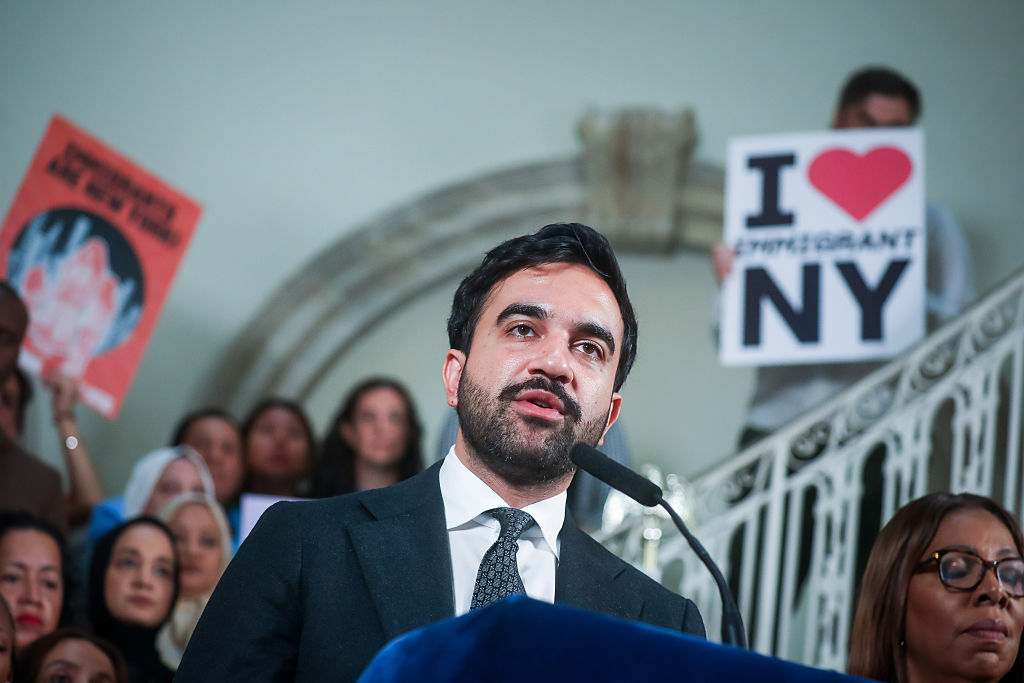
Zohran Mamdani, mayor of New York, during a news conference at City Hall in New York, US, on Monday, Sept. 14, 2026.

Socialists can’t expect voters’ trust on massively transformative change in their lives if they associate government with bloat, waste, and inefficiency. (Michael Nagle / Bloomberg via Getty Images)


Early this week, Mayor Zohran Mamdani, speaking at the Urban 20 (U20) Mayors Summit, bemoaned that government “efficiency has been taken on as a right-wing concern,” with Elon Musk’s Department of Government Efficiency (DOGE) being a particularly vile example. As with the phrase “quality of life,” the mayor observed, “there has been a sense that if you admit to an interest in those things, then you are assisting the Right.”

On the contrary, the mayor said: “If you ignore these things,” that’s actually assisting the Right. Government efficiency is “incredibly important,” something “we have to deliver”; he stressed that we can’t let the Right have an “ideological monopoly on it.”

The remarks were consistent with a broader effort in the Mamdani administration, which has a charter commission called the Commission on Government Efficiency (COGE), a cheeky reference to Musk’s DOGE. The charter amendments, which will be on the ballot in November, were crafted with consultation — including ten public hearings all over the city — with city workers, small business owners, and other members of the public; they aim to shore up the city’s rainy day fund (its backup savings in case of a crisis) and to lessen red tape in new construction, city procurements, the use of city properties, improvements to street safety, and many other areas.

This is a lane that the Left should have long occupied. Government efficiency should be a socialist priority, because socialist governments are asking the public to trust them to do more rather than less. To buy into that project, the public must have confidence that government can deliver and deliver well. Every public dollar wasted on inefficiencies and red tape, or on corrupt middlemen looking to make a buck on the public’s dime, is a dollar that could have gone toward making average people’s lives better and rebuilding people’s trust in government’s ability to act in their interests.

Mamdani is not the first socialist mayor to make this case. Bernie Sanders, as mayor of Burlington, Vermont, was successful and popular in part because he balanced budgets and emphasized government efficiency. After Sanders won reelection in 1982, he reflected on his success speaking at a conference in New York City. He noted that many Republicans supported him “because we are now running — as any city government should run — an honest, efficient government,” with centralized purchasing and other sensible reforms.

As for COGE, not everyone on the Left has been thrilled with the name, reflecting unease with the project itself. In an online briefing on Tuesday, one question submitted from a member of the public was: Why use the name COGE, given that DOGE has “caused so much harm. People lost their jobs and important services were cut. Is that what COGE is?”

“I like this question,” said Susan Kang, a member of the commission and a professor of political science at John Jay College at the City University of New York. She encounters versions of this skepticism a lot. The name, she says, reflects the administration’s belief that “government efficiency is not a right-wing thing. It doesn’t mean a loss of services.” Instead, she said, it should mean “a government that delivers quickly and in a way that uses the labor of city workers well, and that makes our citizens feel heard, respected, and treated in the way they deserve.”

Kang also pointed out that the COGE name has succeeded in drawing interest: “If we just called it a ‘charter commission,’” the project would not have made “such a splash. This has become international news.”

COGE is part of a series of visible good-government initiatives by this administration. Last spring, Mamdani appointed a chief savings officer to each city agency to identify waste and streamline services and announced reforms to make it easier to deliver affordable housing faster. This summer, he unveiled more than fifty reforms to “slash red tape” for small businesses and created a team of technologists to make city services easier for New Yorkers to access.

To execute on more of his agenda, Mamdani will at some point need to ask more of the citizenry. Ray Horton, former president of the Citizens Budget Commission and a retired Columbia Business School professor who has written books about New York City government and its fiscal problems, says demonstrating government efficiency is particularly crucial since Mamdani will need to raise taxes, certainly on the superrich but probably also on single-family homes, which are vastly undertaxed in New York City.

If Mamdani “is able to make a case that he is improving the quality of municipal services,” says Horton, a democratic socialist, the argument for higher taxes will be much easier to make.

Still, Horton notes that not all the issues addressed by COGE are of earth-shattering importance. He laughingly points out that there is an entire amendment simplifying the permitting for outdoor dining, whereas there are hundreds of pages in the municipal contracts that can complicate the delivery of more crucial services like education. (None of that can be addressed until union contract bargaining next year, a situation that is likely to be fraught as the socialist mayor steps into the role of the boss in bargaining with the unions — a tricky dynamic that has already emerged in his negotiations with the city’s main teachers’ union.)

Some of the COGE amendments do touch on big issues like traffic safety. But for those leading this effort, the granularity is also part of the point. As Mamdani put it in his U20 remarks, “The smallest concerns are oftentimes the most important concerns, because that is where you can build those early blocks of trust with a constituent that this government can somehow be different than those which have preceded them.”

In contrast to DOGE, which treated government workers as the enemy of the public good, COGE emphasizes that those workers are partners in efficiency, the best experts to guide this process, and stresses how much city workers have to gain from a more functional government.

Ann Cheng, executive director of COGE, says she has been drawn to solving these problems partly because she has worked in government in many different capacities; she was a public-school teacher before she went into policy. When you work for the city, Cheng says, you expect the “hard things to be hard, but your easy things are also hard.” Her husband, a teacher, breaks up fights at school — hard work, to be sure — but often gets even more frustrated that it takes six weeks to replace a child’s lost MetroCard.

Cheng says city employees understand that it is hard work to dig a water tunnel or plow the city after a snowstorm. But, she asks, “Why is it so hard to get the paperwork signed off?”

The charter amendments risk being overlooked, given they aren’t exactly hot-button issues, nor are they overtly ideological. But Kang feels that the Left needs to get more engaged in this fight. Speaking after the briefing Tuesday, in her personal capacity, Kang worried that many on the Left “don’t understand the political importance of the success of these ballot measures.” She hopes that those who support Mamdani’s affordability agenda will grasp the stakes: “The success of these ballot measures,” she says, “is going to be seen as a measure of his ability to be effective in government.” Positioning a left-wing mayor as fiscally responsible, Kang argues, “is an important part of the left governance project.”