Zohran: The Budget Crisis Is Real. Workers Won’t Pay for It.
Facing a massive budgetary crisis, Zohran Mamdani is breaking with technocratic norms to openly explain the deficit while reiterating his pledges to oppose austerity and tax the rich — which means walking a political tightrope with Gov. Kathy Hochul.
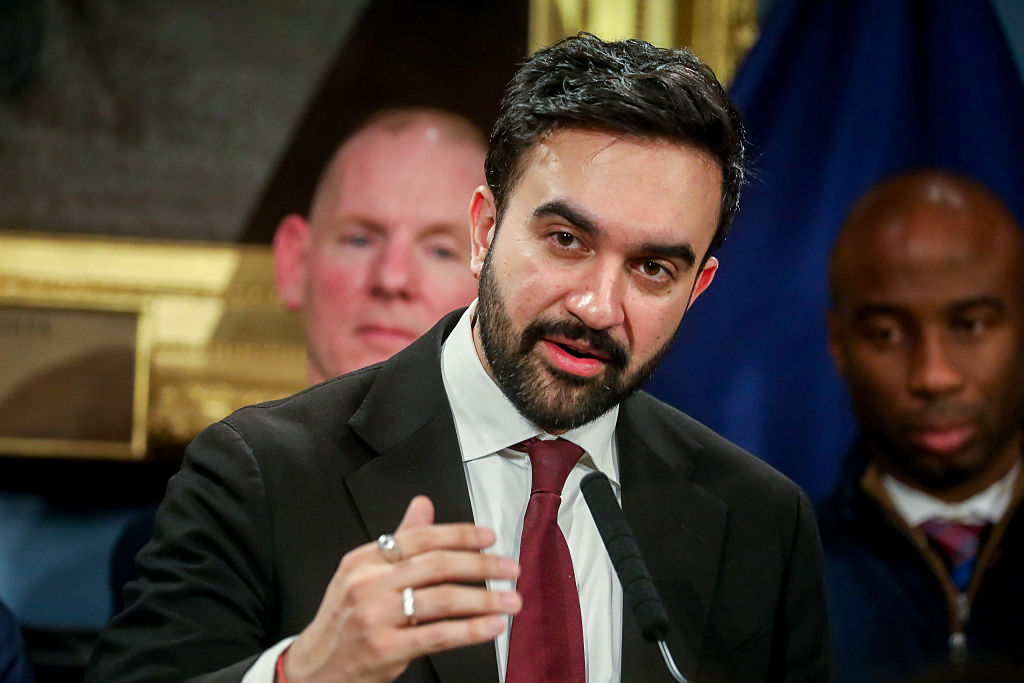
Zohran Mamdani is refusing to make New Yorkers foot the bill for holes in the city budget. (Michael Nagle / Bloomberg via Getty Images)
Zohran Mamdani surely never thought that being mayor of New York City would be easy. Still, in his first month in office alone, he has had to confront daunting challenges, in addition to the usual harassment from mainstream media and the right-wing tabloids. Not long after being inaugurated, the new mayor has had to contend with a deadly winter storm, a historic nurses strike at some of the city’s biggest private sector hospitals, and a national political crisis generated by the Trump administration’s lawless immigration police.
In a press conference yesterday, Mayor Mamdani revealed another major challenge: Eric Adams’s administration had left the city with a $12 billion budget hole for the next two fiscal years. So in addition to trying to raise revenue to fund his already ambitious campaign promises, Zohran must find a way to plug the giant, already-existing gap in the city’s finances.
Even just in his initial messaging around the issue, though, the new mayor is tackling the budget problem with admirable transparency rather than pretending it doesn’t exist and making a commitment to raising working-class people’s expectations rather than calling for austerity. Whereas politicians often use vague predictions of fiscal calamity as a pretext to defund public services and gut welfare programs, Mamdani is attempting to explain clearly to the public what is happening with the city budget and what he intends to do about it.
In openly communicating the fiscal problems to ordinary New Yorkers, Zohran is further developing the populist communication style that he honed on the campaign trail. That makes for a striking contrast with both the style of typical Democratic politicians, who see the nuts and bolts of government budgets as something to be worked out by technocrats behind closed doors, and the mendacious demagoguery that President Donald Trump and former mayor Adams traffic in.
So, who did cause the current crisis? In his remarks yesterday, Zohran laid the responsibility squarely at the feet of the Adams administration, which he said intentionally and systematically underestimated expenses in order to falsely claim that the budget was balanced for fiscal year 2026. Adams budgeted, for instance,
$860 million for cash assistance this fiscal year, but current estimates are $1.625 billion, nearly double what he had accounted for. He budgeted $1.47 billion for shelter costs this fiscal year, but current estimates reflected an additional, unaccounted for, $500 million.
Yet the new mayor also reserved some blame for former governor Andrew Cuomo, who Zohran charges with establishing an extractive relationship between the state government and New York City. The mayor charges that, during his tenure as governor, Cuomo used revenue from the city to plug holes in the state budget “while withholding from the city what it was owed.” As a result, the mayor says, New York City now contributes 54.5 percent of the state’s total revenue yet only gets 40.5 percent of it back. This imbalance is contributing to what Mamdani described as a budget crisis worse than the one the city faced at the height of the Great Recession.
Zohran outlined a three-prong plan to address the shortfalls. First, in line with his campaign trail promises to improve the city’s procurement system, his administration would attempt to find “savings and efficiencies” in municipal expenditures. Second, he reiterated the need to raise taxes on corporations and the wealthy. Third, he pledged to work with Gov. Kathy Hochul and the state legislature to rebalance the fiscal relationship between the city and the state, getting a greater share of revenue returned to New York City from Albany.
“We will meet this crisis with the bold solutions it demands. That means recalibrating the broken fiscal relationship between the state and the city,” Zohran said. “And it means that the time has come to tax the richest New Yorkers and most profitable corporations.”
Mamdani notably didn’t assign any blame to Hochul for the city’s current financial woes, despite the fact that she has occupied the governor’s mansion for the last five years. This is no doubt a piece of realpolitik on the part of the mayor, who will need Hochul’s cooperation in navigating out of the fiscal crisis. By letting her save face, Zohran may be hoping that she will be more willing to play ball — as she has shown herself willing to do in endorsing his campaign and helping him make good, in part, on his promise of universal childcare. Mayor Mamdani’s relationship with the governor thus reflects his continued effort to thread the needle between conciliation and confrontation with the Democratic establishment, attempting to forge productive relationships with politicians like Hochul without backing off of his core demands.
It would have been natural for Zohran, upon learning of the deficit Adams left him, to reorient his agenda and lower supporters’ expectations. It is remarkable that he is refusing to do so, instead articulating a clear plan to solve its fiscal crisis without balancing the budget on the backs of New York’s working class.
Doing that is much easier said than done. Hochul continues to oppose raising taxes on the rich, and her sign-off will be necessary to make it happen. And she and many Albany legislators will, despite Zohran’s friendly approach, likely resist giving more revenue to the city. Winning concessions from the state government on these issues will therefore require putting pressure on the governor and moderate lawmakers in the form of public mobilization and electoral challenges against politicians who oppose Zohran’s agenda. But Our Time and New York City Democratic Socialists of America (NYC-DSA) are already engaged in a grassroots campaign to grow support for taxing the rich, and a spate of democratic socialist campaigns for state assembly will, if successful, build momentum for the push in Albany.
In clearly explaining to the public the fiscal constraints his administration is facing and committing to solving the problem without imposing austerity — and betting that he and the movement behind him can convince establishment leaders like Hochul to support him — Zohran is attempting to walk a political tightrope. Time will tell whether he succeeds. But his initial approach to the budget crisis offers a promising glimpse of what an honest, ambitious democratic socialist mayor might achieve.