Camp Miasma Is More Theory-Head Satire Than Horror

The new slasher film Teenage Sex and Death at Camp Miasma promises “a frenzy of psychosexual mania.” What director Jane Schoenbrun delivers is tamer but considerably funnier.
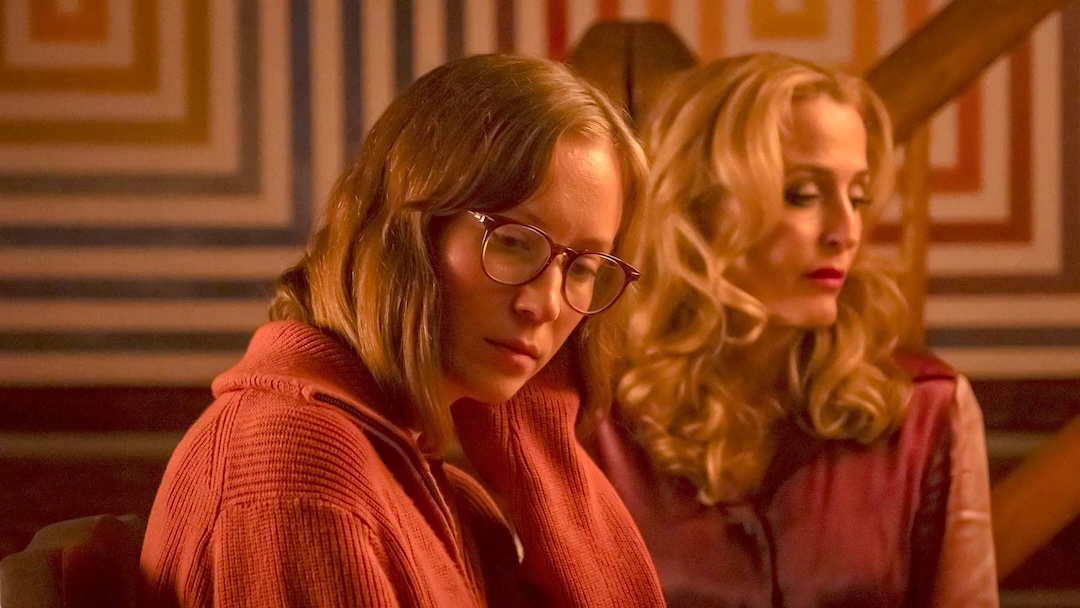
Hannah Einbinder and Gillian Anderson in "Teenage Sex and Death at Camp Miasma."

Jane Schoenbrun keeps getting bigger budgets and wider releases and keeps proving they deserve them. Teenage Sex and Death at Camp Miasma is the third piece of evidence. (Mubi)


For those in the know, cinematically, Teenage Sex and Death at Camp Miasma is an event film, though a small, arty one defying the odds by getting a mainstream release. Writer-director Jane Schoenbrun had a cult-film phenomenon with her last horror film, I Saw the TV Glow (2024), and her next horror outing was keenly anticipated by those who seek out adventurous new auteurs. I could tell by the youthful audience attending the first wide-release screening with me — all a little unusual and, with the exception of one Goth couple, sitting strictly alone — that we’d all heard the jungle drums announcing an offbeat, must-see release. I was by far the oldest person there.

Brilliantly cast, Teenage Sex and Death at Camp Miasma stars Hannah Einbinder, stand-up comedian and star of Hacks, as Kris Williams, a nerdy, academically trained writer-director who’s been hired to reboot a moribund slasher film franchise that got its popular start back in the 1980s under the title Camp Miasma. As part of her research and intense fandom, she seeks out the reclusive star of the first Camp Miasma film, Billy Presley, played by Gillian Anderson, movie goddess and former lead in the beloved 1990s series The X-Files. Together at Billy’s wintry home in the mountains where that first low-budget Camp Miasma gore fest was set and shot, Kris and Billy begin a collaboration on the rebooted franchise film by exploring the meaning and impact of the Camp Miasma films through their own increasingly intimate and erotically charged relationship.

Jouissance and the Final Girl

Kris is very much inclined to intellectualize and deploy grad-school terminology in her initial meeting with the languid and mysterious Billy Presley, automatically throwing out Jacques Lacan’s psychoanalytic concept of “jouissance” and Carol Clover’s film studies argument about the slasher film genre’s Final Girl character. While watching the first Camp Miasma film together, screened in Billy’s own unlikely movie house in the woods, Kris also has a knee-jerk tendency to announce “That’s the transphobic part” at the start of the scene when the camp counselor (Zach Cherry) describes to the teenage campers the backstory of the undead slasher-killer Little Death (Jack Haven), who was raised by two luridly disturbed hermaphrodite parents to be “a different gender every day.”

Billy’s response to Kris’s interruption is to shush her. And she later explains in her extravagant Blanche DuBois Southern drawl that the first Camp Miasma movie — and the only one Billy starred in, withdrawing from the world immediately afterward — “isn’t about all that. . . .  It’s about flesh and fluid.”

So the stage is set for a sexually charged tutorial in which Billy teaches the repressed Kris to acknowledge the visceral thrills that are the basis for her obsession since preadolescence with the Camp Miasma films. In short, Kris finds them to be a huge turn-on, mediated through the processes of film spectatorship. She identifies in excitingly taboo ways with “the victim, the slut” who is invariably half-dressed and nubile. “Don’t forget nubile!” says Kris with sly glee once she gets into the spirit of things.

Hilarious shots of Kris stripped down to panties and a tight T-shirt running in slo-mo through the woods in an exaggeratedly camp-erotic, breast-bobbing way, pursued by the spear-wielding Little Death, are part of the cocreated slasher film imagined by Kris and Billy. Kris also identifies with Little Death, as well as with the Final Girl, as played by sensitive, virginal young Billy Presley (Amanda Fix), whose first sexual experience in character is filmed in a deliriously complex set of shots alternating her own point of view with that of the approaching killer, Little Death. Little Death’s view of the sexually engaged about-to-be-victims is conflated with the camera POV as they approach the cot with phallic spear raised. Also intercut are increasingly probing close-up shots of “the look in her eye” that fascinates Kris, which includes the miniature reflection of the approaching killer in her pupil, as Final Girl/Billy and the teenage boy on top of her are about to be penetrated by the spear of Little Death.

And I suppose I have to note here that “the little death,” that is “la petite mort,” is a French term for orgasm. Judging by agitated online commentary, I gather this comes as thrilling news to a lot of young viewers.

A Scarred Veteran of Film Theory

I’ve got to admit, a little of this kind of thing goes a long way with me, and I found the film rather wearing over the course of its running time. But then, I’m a scarred veteran of grad school myself, and the old wounds still hurt in rainy weather. My film studies dissertation advisor was Carol Clover, who literally wrote the book on the slasher film. She’s the author of Men, Women, and Chain Saws: Gender in the Modern Horror Film, the first academic analysis of the subgenre and the one who introduced the term “the Final Girl” that’s now in common usage. During the interlude following its publication, when Clover achieved remarkable fame for a professor, I was sitting in her office trying to get useful dissertation advice while she took calls from reporters around the world who wanted to interview her about The Texas Chain Saw Massacre, Friday the 13th, Halloween, A Nightmare on Elm Street, and all the well-known slasher film classics.

Most viewers aren’t going to have this survivor-of-academia problem with the film — lucky them — and I hope most will have a more accurate idea of the tone of the film than the one I went in with. I was expecting a different movie entirely. Teenage Sex and Death at Camp Miasma, which is both a study and a parody of slasher horror, is never scary. The geysers of blood are played for camp laughs. It’s a funnier film than I expected, with a satirical approach to Hollywood filmmaking that no doubt reflects Schoenbrun’s own insider experiences, including ludicrous Zoom calls with multiple producers. But the film is also considerably less wild than I anticipated. The promised “flesh and fluid” scenes, hyped in promo material that describes Kris and Billy descending into “a frenzy of psychosexual mania,” never really materialize. Sex scenes are mostly nurturing and, it must be said, quite tame, as the focus of the film remains on Kris’s remote, intellectualized, and heavily mediated route to sexual satisfaction.

Jane Schoenbrun, who uses they/them pronouns, seems to have a great affection for vintage film theory of the 1980s–’90s. Though clearly, they also have a humorously critical take on it, given that theory-damaged Kris is its representative. Kris, after all, solemnly describes her first breakthrough film, which was well-received at the Sundance Film Festival, as a remake of Psycho “from the point of view of the shower curtain.”

Schoenbrun has a much-discussed auteur’s investment in their films in terms of their own self-identification as trans and nonbinary and as a queer filmmaker. They’ve explored the experience of gender transition and dysphoria in their three films, We’re All Going to the World’s Fair (2021), I Saw the TV Glow, and Teenage Sex and Death at Camp Miasma. In interviews, Schoenbrun says, “I’ve been treating my own gender transition as my muse” in films dealing allegorically with “getting to the place where you’re ready to transition and the coming-out process” and “speaking to the joy and horror of coming into your own body and self.”

Their investment in media, the obsessive film and TV show viewing that helped get Schoenbrun and so many other alienated souls — myself included — through the torments of maturation in the United States, is manifest in Teenage Sex and Death at Camp Miasma in innumerable ways through evocations of such multigenerational classics as Sunset Boulevard, Psycho, The Shining, and Videodrome. There are constant references to slasher films of yore, including the obscure Sleepaway Camp (1983), which is the clearest inspiration for the Camp Miasma film-within-a-film.

The Enticement of Cinema

Schoenbrun has an excellent cinematic eye, a real flair for striking and evocative imagery, including a love of lush color schemes, which does a lot to jolt Teenage Sex and Death at Camp Miasma with energy whenever it threatens to bog down. For example, Kris and Billy walk casually from a realistically wintry forest into the alternate old-time cinematic world represented by a gorgeous matte painting of snowy trees behind them. There are sudden insertions of irradiated-looking negative imagery in vivid montages. The “split diopter” shot reverently identified by Kris during the Camp Miasma screening pays tribute to a popular technique of 1970s filmmaking that created a sense of depth in an image by holding two different areas on different planes in sharp focus simultaneously, with a slight blurring of the planes between them. Once Kris “goes into” the rebooted Camp Miasma film, she’s contained within the split diopter shots, and the penultimate shot of the overall film shows Kris and Billy together in split diopter, one near, one far, in equally sharp focus, exulting in the Final Girl’s quoted lines about Little Death from Camp Miasma: “He’s still down there, you know, at the bottom of the lake. He’s still hungry. Can you feel it? He’ll be back soon to feed again.”

And Gillian Anderson’s Billy Presley character, with her delightfully exaggerated Southern drawl, her red lipstick and glamorous long blond tresses, and the rhinestone-bedazzled turban she dons to evoke the spirit of Norma Desmond in Sunset Boulevard, indicates the way she represents the enticement of cinema itself.

In short, Schoenbrun keeps confirming in steadily higher-budgeted, wider-released, and more extravagant films that they’re an arresting new talent on the rise. For that reason alone, any cinephile should already be headed to the movies to see their latest.