Puerto Rico’s Water Crisis Is Also a Debt Crisis
This summer’s water crisis in Puerto Rico is the latest example of the slow violence of the Puerto Rican debt crisis, exacerbated by patterns of remilitarization in the archipelago.
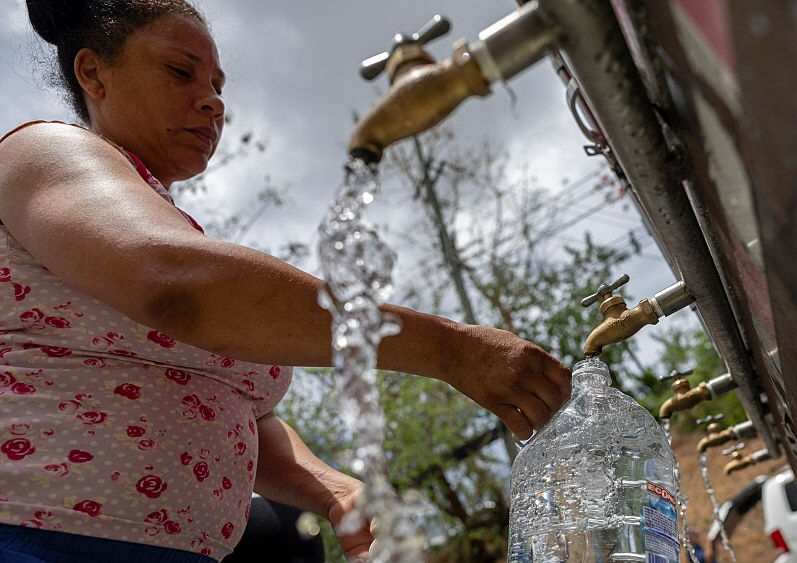
Control over Puerto Rico’s water by Puerto Ricans themselves is diminishing — the result of colonial control that undermines Puerto Rican sovereignty and self-determination. (Ricardo Arduengo / AFP via Getty Images)
This summer, hundreds of thousands of Puerto Ricans are experiencing widespread service interruptions, inconsistent flow, low-pressure, and a lack of access to clean and safe potable water. The search for water oases or cistern trucks has become a daily household task for many, as more than 150,000 residents across seven municipalities face the imposition of strict water rationing periods.
This latest water emergency is partially the result of long-standing maintenance neglect and major breaks in the superacueducto, the superaqueduct, a problem-and-controversy-plagued seventy-two-inch water line that brings potable water to the San Juan metropolitan area. In addition to the rupture of the superacueducto, a summer marked by the Atlantic hurricane season, extreme heat, drought conditions drying up the reservoirs, a strong El Niño, and Sahara Dust, the huge cloud of dust and air that blows from Africa’s Sahara Desert across the Atlantic Ocean to the Caribbean and parts of the southeastern United States, have also negatively impacted water resources and supply.
In response, the governor, Jenniffer González, activated the National Guard to help with water distribution and called for consumers to be “prudent” with water use, indicating that Puerto Ricans would be dealing with low water supplies for some time to come. Throughout August, hundreds have taken to the streets in marches organized by the Coalición Exigimos Agua, La Colectiva Feminista en Construcción, and others demanding urgent solutions so that Puerto Ricans can reliably access the most basic life necessity. In an archipelago used to dealing with frequent blackouts and destructive power surges, dry taps are now frustratingly common.
As many Puerto Ricans were scrambling to find water for drinking, cleaning, and bathing, the archipelago marked a perverse milestone: the tenth anniversary of PROMESA. In response to Puerto Rico’s deepening debt crisis, President Barack Obama signed the Puerto Rico Oversight, Management, and Economic Stability Act (PROMESA) bill into law on June 30, 2016. PROMESA created a federally appointed fiscal control board to oversee the archipelago’s finances.
La junta, as the fiscal control board is colloquially known, is empowered through PROMESA to override the commonwealth government and implement austerity measures in order to service the debt. The unelected members of la junta are either imbricated within the networks of Puerto Rico’s criollo elites or are part of the international finance sector with zero ties to the archipelago whatsoever. While PROMESA promised to bring relief to Puerto Ricans suffering under conditions of financial precarity, there is no doubt that things have only gotten worse for the average Puerto Rican since its passage.

These two markers of the summer of 2026 in Puerto Rico, a far-reaching water crisis and ten years of colonial debt management, are part of an intertwined history. Puerto Rico’s current water emergency is a long time in the making, shaped by the climate crisis as well as conditions of colonial governance and financial extraction that both predate and characterize the PROMESA era.
Climate change and the summer drought are not unilaterally producing water scarcity in Puerto Rico, however. Research shows that rising temperatures, prolonged drought, and more variable precipitation are increasing stress on water systems whose resilience has already been weakened by decades of deferred maintenance, fiscal austerity, and uneven infrastructural investment. This summer’s water crisis is not just an effect of extreme heat and severe drought. It is the latest example of the slow violence of the Puerto Rican debt crisis, most recently exacerbated by patterns of remilitarization in the archipelago that broadly threaten waterways.
Infrastructures of Debt
In 1994, Puerto Rico was in the grips of a devastating drought that severely impacted water resources. In response to the lack of reliable access to water that the drought caused for many Puerto Ricans, especially in the densely populated San Juan metropolitan area, the administration of Governor Pedro Rosselló proposed a water pipeline that would bring water from the main island’s mountainous interior to the metro area and northeast.
As the project was being proposed and initially discussed, significant portions of the population, especially in the metro area, were in favor of the superacueducto (or supertubo, as it was also called), because the drought of 1994 was an apex of decades of intense water insecurity. Critics, however, noted that the project would be detrimental to the environment, unnecessarily costly, and incredibly difficult to repair given the enormous size of the pipeline.
The superaueducto debate also dovetailed with a major turning point in Puerto Rico’s colonial relationship with the United States that highlights the mutual constitution of economic and environmental decline. In 1996, President Bill Clinton signed legislation to sunset Section 936 of the tax code, a set of tax incentives that had propped up the colonial economic development model during the late twentieth century. The repeal of Section 936, which was then phased out from 1996 to 2006, led to massive job loss in the manufacturing sector, capital flight, and government revenue shortfalls that increased the government’s deficit spending vis-à-vis triple-tax-exempt bonds. Triple-tax-exempt bonds are municipal bonds that exempt interest payments from federal, state, and local taxes, making Puerto Rico’s bonds attractive to hedge fund investors and muni-market portfolios.
In the midst of economic recession and rising public debt, the superacueducto was almost immediately plagued with problems, including delays and legal challenges. As construction moved forward, accusations of corruption swirled regarding everything from contracts to the use of substandard materials. When the superacueducto was finally completed in 2000 at a cost of $585 million (nearly double the initial estimates), it became a hallmark of the kinds of large-scale infrastructural projects undertaken by the Rosselló administration.
In addition to the superacueducto, the Rosselló administration also oversaw the construction of the Tren Urbano, the Puerto Rico Convention Center, and the Coliseum of Puerto Rico (“el choli”), not to mention major roadway expansion and upgrades across the main island. These infrastructural projects required massive state financing through debt and were plagued by accusations of corruption. By 2016, it was abundantly clear that projects like the superacueducto, were a key generator of the financial crises that would test Puerto Rico during the aughts and 2010s, eventually creating a justification for PROMESA.

The three key ruptures in the superacueducto discovered on June 10, 2026, prompted this latest water crisis and are the result of decades of deferred maintenance that has only worsened in the years following the passage of PROMESA. Almost as soon as the last tube of the superacueducto was laid, the Autoridad de Acueductos y Alcantarillados (Puerto Rico Aqueduct and Sewer Authority, or AAA) was stymied by efforts to privatize the public utility and slash its operational costs. Starved of resources and long marked by institutional corruption and politicking, the AAA failed to perform necessary maintenance and upgrades on the superacueducto as well as the rest of the archipelago’s aging water infrastructure.
The interruptions to service, rationing, and limited access to potable water experienced this summer, while particularly dire, have actually been recurrent over the past two decades, intensifying as the passage of PROMESA required even greater austerity of public utility companies in order to reduce the archipelago’s debt and pay back investors.
Puerto Rico experienced a historic drought from 2014 to 2016 that left hundreds of thousands without regular access to water as the government imposed extreme water rationing that cut off water for two to three days at a time. Coinciding with the passage of PROMESA, this drought made painfully clear the inability of the public water authority to provide safe and reliable potable water to the population. Yet after 2016, public utilities like the AAA — which were, in many ways, already cut to the bone — would be subjected to greater demands for austerity, while consumers were expected to pay higher bills for worse service.
The devastation of Hurricane Maria in 2017 showcased the fragility of the archipelago’s water infrastructure as well as the deadly consequences of austerity and state inaction. The historic monthslong blackout caused by the storm left water pumps and water filtration systems inoperable, while some ground wells were contaminated by storm runoff. Together, the storm’s aftermath produced intense water scarcities throughout the archipelago. The failures of both the local and federal governments to distribute disaster relief supplies, such as bottled water, or set up water oases around the archipelago in a quick and efficient manner, led people to bathe, wash, and drink from contaminated bodies of water. As a result, dozens of people died from water-borne bacterial infection, including leptospirosis.
The archipelago’s water infrastructure never fully recovered after Hurricane Maria. Instead, Puerto Ricans became more accustomed to the unreliability of the water supply and other public utilities. Indeed, the dictates of the fiscal control board as well as insufficient federal disaster recovery funds means that the archipelago’s public infrastructure continues to deteriorate, making it more susceptible to repeated and prolonged crises. The gap between federal recovery funds promised post Hurricane Maria and what has actually been distributed to Puerto Rico exacerbates the ongoing infrastructural decline.
According to Puerto Rico’s Central Office for Reconstruction, Recovery, and Resiliency, of the $42.6 billion allocated across all recovery programs, only about $13 billion has been distributed. When Hurricane Fiona struck in 2022, for example, about half a million Puerto Ricans were left for days without access to safe drinking water. That same year, Puerto Rico ranked sixth in the Climate Risk Index of countries most impacted by the climate crisis. Nearby Caribbean islands, meanwhile, have proven much more resilient to atmospheric weather events, highlighting the ways that water insecurity in Puerto Rico is primarily a product of colonial governance and austerity as opposed to “natural” forces.
The push to privatize public utilities as part of Puerto Rico’s debt restructuring deal has created a feedback loop between the AAA and the Puerto Rico Electric Power Authority, where the failures of the privatized electrical grid directly and negatively impact access to potable water for millions due to the power grid’s interdependence with other essential utilities. After Hurricane Maria, in January 2018, Governor Ricardo Rosselló announced that his administration would privatize the electrical grid in an effort to modernize it and reduce the insolvent electrical authority’s approximately $9 billion debt.
On June 22, 2020, the commonwealth government signed a fifteen-year contract with LUMA Energy, a joint partnership between Houston-based Quanta Energy Services and Calgary-based ATCO, to take over all of the non-generation aspects of the grid, such as transmission, distribution, power dispatch, customer service, and billing. After LUMA took over operations on June 1, 2021, residents experienced an almost immediate decline in the reliability of the power grid. In particular, customers complained of longer and more frequent outages and severe energy fluctuations that damage electrical equipment.
The archipelago’s water system, especially at the distribution and filtration points, is dependent upon a stable and steady supply of electricity to function. For instance, water pumps, which are used to distribute water from the mountainous areas of the main island, require electricity. All of this has been exacerbated by a slow trickle of recovery funds. A recent Government Accountability Office report notes that while the Federal Emergency Management Agency obligated $11.1 billion for the electric grid’s recovery and modernization since 2017, only about $2.7 billion has been dispersed.
Frequent blackouts and the fragile electrical grid’s impact on water access have created a state of everyday disaster with no foreseeable end in sight. Puerto Ricans are forced to live with uncertainty and extremity as part of their quotidian existence. After all, who knows when you may wake up to find that nothing happens when you flip your light switch or turn on your faucet?
Water insecurity also reveals the layers of inequality at work in Puerto Rico. For instance, accessing the public water oases requires one to first locate where they are by calling the municipality, finding accurate information on social media or television, or by chance catching the truck on a nearby street. Filling and carrying gallons and buckets of water requires time, physical ability, and mobility to transport procured water.
Similar to the domestic solar market to mitigate power insecurity, the water crisis has increased demand for personal cisterns to store water when it flows — another example of private solutions to public crises that are cost-prohibitive for the average resident or small business. Some residents with more resources contract private companies to fill cisterns, which can cost upward of $500 for 150 gallons. Yet even those with access to private cisterns are at the mercy of the government’s lack of preparedness for a crisis that has been unfolding for months, if not years.
For instance, when one of the coauthors of this piece contacted the municipality of San Juan in June to request a cistern fill for her apartment building, she was told that she could be added to a list of twelve thousand individual requests and would have to wait about two weeks for the cistern truck. As the Guardian recently reported, some feel that it is “as if a hurricane had passed.” But the disaster to blame when Puerto Ricans don’t have electricity or water on a random sunny Tuesday is debt colonialism.
The Cost of Constructing a Tropical Paradise
According to estimates, the AAA loses anywhere from 40 to 65 percent of water due to leaks, ruptures, and spills resulting from overflow. This significant water loss is happening at every point in the process as a result of deteriorating infrastructure, from the pipes to reservoirs to filtration centers. As the scholar and activist Manuel Rodríguez Banchs has pointed out, the problem of sedimentation has reduced reservoir capacity and created serious problems at filtration plants. Tellingly, this sedimentation has two key causes: erosion and particulate matter originating from construction projects. This too is where the water crisis and debt crisis meet.
As the Puerto Rican government has imposed austerity measures on public utilities and social services, it has lost crucial monitoring services and loosened environmental regulations aimed at protecting coastal lands and waterways. In 2016, at the onset of growing concern around the debt crisis, the US Geological Survey cut water monitoring at 177 hydrologic stations due to a $2 million debt, impacting the monitoring of water quality, potable water supplies, and aquifer levels. More recently, the government has sought to facilitate megaconstruction projects aimed at attracting luxury tourism and foreign capital in an attempt to offset the belt-tightening measures dictated by Wall Street and Washington and implemented by la junta.
The proposed “Esencia” megaproject in the southwestern municipality of Cabo Rojo lays bare the contradictions at the heart of Puerto Rico’s water crisis. Planned across two thousand acres in one of the archipelago’s driest and most biodiverse regions, the proposed $2 billion luxury development with nearly $498 million approved in tax credits is slated to include hotels, residences, golf courses, a private school, a private medical center, and other high-end amenities in a municipality where residents have long experienced persistent water shortages.
As a water-insecure future unfolds, and AAA acknowledges that it lacks the capacity to supply the development, Esencia advances a “closed-loop” model where the developers envision water access — estimated at 1.25 million gallons per day at full operation — to be secured mostly through private infrastructure (groundwater extraction, rainwater collection, wastewater treatment). However, despite the area’s chronic water insecurity, the project proposes to retain connection to the public system as a potential emergency source and will draw on the same regional hydrological system, raising concerns for residents and agriculturalists.
The developers also propose a fully solar- powered community and boast of generating enough energy to share with the local community if needed. In these ways, the developers claim to follow “strict environmental standards in every phase” — even as Esencia depends on the establishment of new laws, such as Law 82, which overrides established environmental standards and stipulations around land usage.
The controversy surrounding Esencia is also about the struggle over access to coastal landscapes and who bears the socio-ecological harms of development. Community organizations, scientists, and environmental advocates have argued that the project threatens ecologically sensitive wetlands, groundwater resources, and public access to the coast while accelerating a broader pattern of coastal privatization, real estate speculation, and displacement. As Tourism Deputy Director Jorge Pérez González warned in a letter to the Office of Permit Management in March 2025, “The project includes a broad coastal strip of ecological resources, including the maritime-terrestrial zone, mangrove areas and wetlands associated with Caño Boquerón, native dry forest, and land classified for preservation.” These ecological areas play a crucial role in protecting Puerto Rico’s natural water resources and their destruction would worsen the archipelago’s recurrent water crises.
Further, the construction debris from the project threatens existing public water supplies by increasing sediment entering water reserves and thereby reducing storage capacity and clogging filtration systems. In this way, Esencia’s “closed-loop” construction contributes to the destruction of the public water infrastructure that it purports to solve through privatized solutions for those who can opt out of Puerto Rico’s debt-ridden and unreliable public utilities.
In late July 2026, as the drought worsened and the government enacted emergency measures to manage the water crisis, Puerto Rico’s Office of Permit Management approved the consulta de ubicación (location permit) for Esencia, authorizing the project to move into its next phase of development. The decision’s irony was not lost on Puerto Ricans and immediately drew criticism from the Defiende a Cabo Rojo coalition and other advocates, who argue that the permitting process failed to adequately address concerns over water resources and coastal ecosystems, and did not include meaningful public participation.
In this sense, water becomes a lens into competing visions of Puerto Rico’s future: one organized around luxury megadevelopments and exclusive autonomous enclaves (coastal bunkering for the rich), the other around the protection of shared ecological commons and the right to remain and thrive in place.
Remilitarization and the Threat to Water Sovereignty
As Puerto Ricans face a water crisis without end and luxury developments threatening to divert water supplies to exclusive enclaves, the US military has rapidly reoccupied large swaths of the archipelago, further threatening waterways. Puerto Rico is central to the Trump administration’s unrelenting plan to dominate the western hemisphere and possess its resources. This imperialist pursuit is justified through Trump’s revival of the Monroe Doctrine and his development of the Shield of the Americas, which reaffirm Latin America and the Caribbean as part of the United States’ purview and justify military operations to dismantle transnational drug cartels, curb mass illegal migration, and counter foreign influence. Top military brass as well as Puerto Rican officials have indicated that the troops, tanks, submarines, planes, and aircraft carriers positioned in and around the archipelago are not leaving any time soon.
Puerto Ricans are familiar with the toll of militarization on the environment, their communities, and on their bodies. Vieques and Culebra, island municipalities of Puerto Rico, were occupied by the US military for bombing practices for decades during the twentieth century, until 1975 in Culebra and 2003 in Vieques. All US interventions after World War II were practiced in Vieques and Culebra. The islands were bombarded with napalm, Agent Orange, depleted uranium, and other toxic chemicals and heavy metals. In Vieques, active bombing ceased in 2003 after Viequenses’ long battle against the occupation, where they organized protests, coordinated direct actions on occupied land, produced newspapers and analysis, and mobilized the international community in solidarity.
Still today, Viequenses bear the health impacts of militarization: high levels of heavy metals in their blood and cancer rates disproportionately higher than the rest of the archipelago. With the current wave of military buildup, Viequenses have expressed this as opening up old wounds, and they fear new generations are being exposed to cycles of pain and violence.
However, militarization is typically framed as development and a needed economic boost during the debt crisis. The reactivation of military bases in Puerto Rico began in July 2024, when the federal government allocated $325.9 million in military construction funds through the National Defense Authorization Act for military infrastructure in Puerto Rico to strengthen and modernize sites such as Fort Buchanan in Guaynabo, the Ramey Base in Aguadilla, Camp Santiago in Salinas, and the former Roosevelt Roads Naval Station in Ceiba.
As the Center for Investigative Journalism reported, “According to the Puerto Rico Planning Board, the strategy would inject more than $898.4 million into the local economy over the long term through construction, administrative and service jobs, as well as tax withholdings and excise revenues for the municipalities where the main military bases are located.” However, historical experience is leading many to question who will benefit from remilitarization.
Like luxury enclaves, military bases operate as self-contained communities, concentrating economic investment among private contractors and benefiting those who live and work within their boundaries. Rather than infusing the local economy, the remilitarization of Puerto Rico represents a form of economic warfare that concentrates wealth among military-linked industries and threatens to continue underdeveloping the archipelago.
As Puerto Ricans encounter more and more military personnel around the archipelago, including most recently at water distribution points throughout the metropolitan area, it is important to remember that the machinery of war and military bases require immense resources to operate. In addition to being the world’s single largest consumer of oil and a top greenhouse gas emitter, the US Department of Defense also uses tremendous amounts of water. Previous waves of militarization in Puerto Rico have proven detrimental to the archipelago’s water infrastructure, not only sucking up water but also contaminating water sources used for drinking, fishing, and leisure.
The military has yet to complete its required remediation of the environmental contamination in and around Vieques. While US and Puerto Rican elites promise that Puerto Rico’s remilitarization will bring economic prosperity, it is more likely that increased military presence in the archipelago will only put more strain on water resources.
While so many Puerto Ricans find themselves waterless, control over the waterways that surround their archipelago is also diminishing – and both are the result of enduring forms of colonial control that undermine Puerto Rican sovereignty and self-determination. The recent military buildup has turned Puerto Rico into a launching pad for US operations in Latin America and the Caribbean. Puerto Rico serves as a staging ground for the US campaign against alleged narcotrafficking that has targeted fishing boats and claimed over two hundred lives in extrajudicial executions.
Puerto Rico also provided important logistical and infrastructural support for the capture of Venezuelan President Nicolás Maduro and First Lady Cilia Flores in January 2026, an operation that killed nearly a hundred people. Further, in the United States’ genocidal blockade of Cuba, Puerto Rico is key for ongoing surveillance and contingency operations. The archipelago also operates as a US base for Immigration and Customs Enforcement (ICE) detention and criminalization of migrants who are escaping conditions of destabilization often created by the United States and its allies. Since January, ICE agents in Puerto Rico have detained nearly two thousand migrants, a majority of them coming from our neighboring island of the Dominican Republic. Puerto Rico’s colonial status allows the United States to harness its waters for imperial ends and turn the archipelago into both a playground for tourists and investors, and a “natural aircraft carrier” for military operations.
Under a debt regime, not only do Puerto Ricans’ quality of life and access to basic necessities deteriorate, but they are also increasingly conscripted into advancing US military power in the region as a form of economic development. US colonial control over Puerto Rico has not only curtailed the archipelago’s sovereignty over its economy, culminating in the passage of PROMESA and the installation of the fiscal control board, but also over its waterways. Colonialism has curtailed Puerto Ricans’ ability to make decisions about water resources, from how to deal with the effects of climate change and failing infrastructure to who can cross its coasts to who controls navigation throughout the Caribbean Sea.
In Puerto Rico and across the diaspora, many organizations are opposing this state of affairs. Madres Contra la Guerra and Vidas Viequenses Valen, for example, have challenged remilitarization, while an international coalition of organizations has called for the Americas to become a “Zone of Peace,” free from US military intervention. In the struggle against Esencia and other megaluxury developments, the Defiende a Cabo Rojo coalition based in the archipelago and the New York Contra Esencia coalition in the diaspora are organizing to halt these projects. Meanwhile, across Puerto Rico, communities are mobilizing around a simple demand: “Exigimos agua” (we demand water). Each of these struggles, though distinct, is ultimately a struggle for Puerto Rican sovereignty.
The current water emergency demonstrates that it is urgent for Puerto Ricans to consider how to steward and protect their waters and lands in ways that safeguard regional peace and ensure that everyone has access to fundamental, life-sustaining necessities, including clean water.