Why Puerto Rico Remains a Colony in All but Name

Cold War Puerto Rico by Steve Howell argues that Washington has long treated the island as giant aircraft carrier. The result has been severe: residents face economic strain while lacking many democratic rights and social protections.
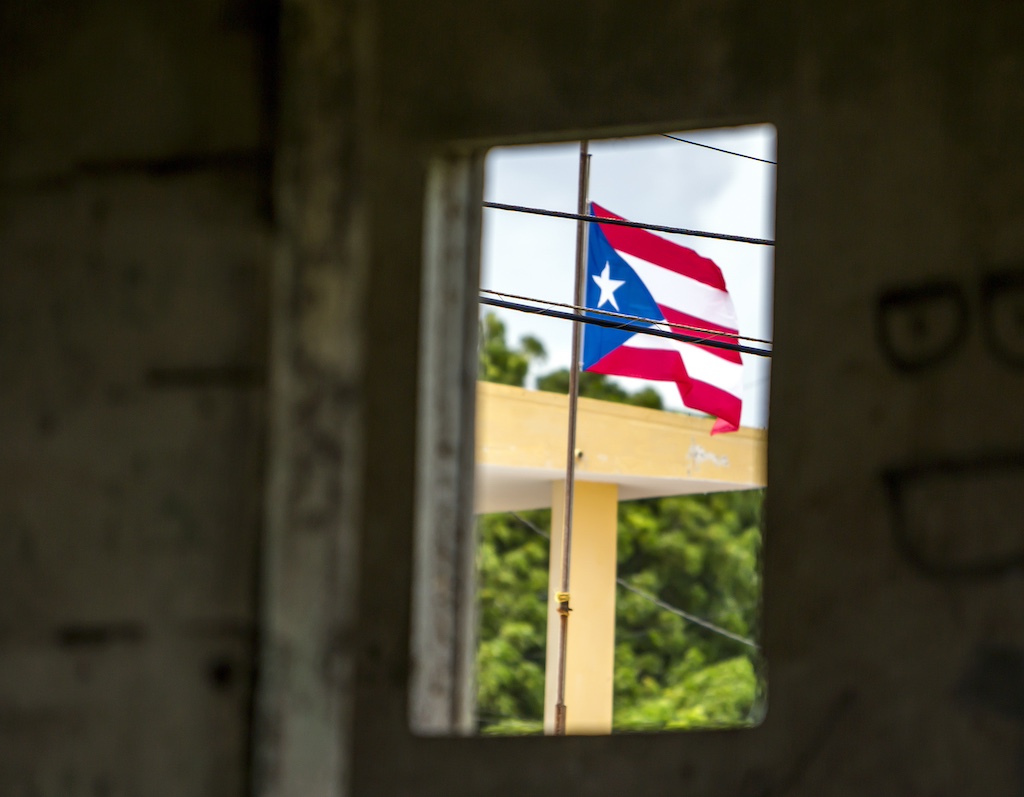
A Puerto Rican flag flies through a doorway in a cement wall.

For over a century, Puerto Rico’s military strategic importance has mattered more to the US than the will of its people. (Xavier Garcia / Bloomberg via Getty Images)


In December 1939, just a few months after the outbreak of World War II, the National Geographic reporter E. John Long caught a flight to Puerto Rico. As the Clipper seaplane buzzed over the island’s turquoise waters and densely forested hills, the copilot called Long’s attention to a map. “Now do you see? About 1,000 miles to the Panama Canal, 1,000 miles to Miami, 700 to Bermuda, 550 to Caracas on the mainland of South America, 650 to Trinidad. This is the hub of a wheel. Put enough planes here, and enough land forces to guard your bases, and Puerto Rico becomes the ‘Gibraltar of the West Indies,’ or the ‘Hawaii of the Atlantic.’”

Long’s cover story, titled “Puerto Rico: Watchdog of the Caribbean,” captured the attention of Americans at a time when concerns about foreign military encroachment and the security of the Panama Canal gripped Washington. As it appeared in print, engineers and convoys of troops and equipment poured onto the island to build and man new US military bases. With its central position and many miles of usable coastline, Puerto Rico came to be seen by US authorities as a kind of vast, terrestrial aircraft carrier.

But Western powers had taken stock of the island’s importance long before the outbreak of World War II or the construction of the Panama Canal. As early as 1502, the Spanish clergyman Bartolomé de Las Casas was noting how many ships bound for the Americas relied on it as a crucial stopover; soon afterward, it was fortified by the Spanish as a key asset in protecting their trade routes from piracy. By the time the United States won the island from Spain — along with the Philippines, Guam, and Cuba — in 1898, its occupation was seen by President William McKinley as a “strategic necessity” because, in the words of one of his most senior generals, it was “the gateway to the Spanish possessions on the Western Hemisphere.”

More than eighty years after Long’s article, Puerto Rico has once again come to the forefront of US foreign policy. In the months leading up to the raid that extracted Venezuelan president Nicolás Maduro, 15,000 American military personnel were deployed across the Caribbean, with more than a third heading to Puerto Rico. Last November, F-35 fighter jets, combat helicopters, and Navy destroyers were reported massing across the island.

As early as August, Vieques island and the Roosevelt Roads Navy base — two crucial military sites that had been in operation since the 1940s but were closed in 2003 and 2004, respectively, following protests over US-inflicted civilian deaths — were reopened. As the current administration continues to extrajudicially strike boats alleged to be carrying narcotics and appears to threaten military intervention in nearby Cuba, Puerto Rico has once again emerged as a strategic center for projecting US power across the Caribbean basin.

Given Puerto Rico’s crucial regional importance, the question is not why the United States held onto it — long after conceding independence to the Philippines — but how it did so. Journalist Steve Howell’s new book, Cold War Puerto Rico: Anti-Communism in Washington’s Caribbean Colony, offers both a comprehensive and deeply personal answer. The son of an exiled American architect who came to the island to work for the New Deal governor Rexford Tugwell, Howell only began earnestly digging into his father’s past after his death. What he uncovered, and presents capably in this rich and informative work, is the story of Puerto Rico’s struggle for autonomy and the American repression that repeatedly smothered it, all while claiming to uphold the principles of international self-determination.

Meeting in Placentia Bay, Newfoundland, amid an escalating war effort, Franklin D. Roosevelt and Winston Churchill signed the Atlantic Charter, which laid out a vision for a postwar order that would bind the Allies in a web of international cooperation, ensuring freedom of the seas, disarmament, and an end to territorial expansion. It also promised the right of all peoples to choose their form of government, giving people in Puerto Rico, then an “unincorporated territory” of the United States, grounds to hope they might break free. In inaugurating this new and profoundly moral vision of a postwar order, Washington created a predicament: how to hold onto what was effectively a colonial possession while publicly championing self-determination.

The history Howell tells shows, first, how Washington responded to this challenge by nominally changing the terms of rule and incorporating elements of consent to create the illusion of a compact. In 1952, against the backdrop of widespread suppression, strikes, and a violent nationalist insurrection on the island, Public Law 600 — the so-called Gag Law — was passed by the Puerto Rican legislature, giving the island Commonwealth status and the right to draft its own constitution.

Abroad, American officials presented this as a way to placate the United Nations and secure Puerto Rico’s removal from the list of non-self-governing territories. In Puerto Rico, however, they unilaterally altered the constitution — removing a bill of social and economic rights — while retaining near-total control over the island’s defense, currency, and trade.

The parallel, and more comprehensive, story Howell tells is of the United States’ shifting strategies of intimidation and repression, which drove his family from the island to the United Kingdom and continued to haunt their lives even there. The first phase saw the imposition of the Gag Law, which criminalized even the hypothetical advocacy of independence and gave the state license to surveil and then round up thousands of suspected nationalists and critics of the proposed Commonwealth.

When local prosecutions failed to stabilize the island, the FBI under J. Edgar Hoover intervened directly, using tools later associated with McCarthyism. FBI agents infiltrated local politics, tracked suspected Communists and independentistas, and drew up secret and illegal “custodial detention” lists of individuals to be rounded up in times of unrest. As Howell shows, Red Scare tactics — and the Smith Act specifically, a piece of legislation used to prosecute and bully suspected enemies of the state — were deployed in Puerto Rico more extensively than almost anywhere in the continental United States, effectively neutering meaningful political opposition to American hegemony.

When a 1958 US Supreme Court ruling drastically curtailed the scope of Smith Act prosecutions of political speech, the government switched strategies again. This time, the infamous House Un-American Activities Committee, headed by Gordon Scherer and William Tuck, arrived on the island to investigate “Communist activities among Puerto Ricans.” Islanders of all political stripes, however, flooded the streets and surrounded the courthouse, insisting that the committee had no legal authority to operate in Puerto Rico.

The exhaustion of “legal” methods of repression, however, did not deter Hoover and his agents. In 1960, the FBI began shifting to covert and illegal action through COINTELPRO, a program that included all manner of harassment — from poison-pen letters meant to break up marriages to the encouragement of gang warfare and violence, including falsely outing gang members as police informers — in order to sow division and chaos among the organizations that threatened American hegemony in the lead-up to a landmark 1967 vote that affirmed the Commonwealth option.

That political arrangement has persisted to this day, leaving Puerto Rico less a self-governing polity than a modern vassal of the United States: a captive economy in which roughly 85 percent of consumed goods are imported, while enormous amounts of locally generated wealth are siphoned off the island each year in profits, dividends, and other payments to external investors. This was not, as Howell notes, the natural product of development but the result of an economic order built above all around attracting US capital.

By the late twentieth century, the gap between Puerto Rico’s output and the income actually retained by Puerto Ricans had grown dramatically, such that now, roughly a third of the island’s GDP leaves annually in payments to nonresidents.

The result is a quasi-colonial status that remains starkly tangible for islanders: though they carry US passports, Puerto Ricans on the island still cannot vote for president; they send no voting members to Congress — electing only a resident commissioner without a final vote — and appoint no electors to the Electoral College; their political status remains subject to Congress’s plenary authority, meaning ultimate control rests in Washington; their referendums are nonbinding; and their fiscal life is overseen by a president-appointed control board with the power to review laws, police contracts, and impose budgets.

They are excluded from the Affordable Care Act Marketplace, receive capped Medicaid and block-grant food assistance rather than the federal programs available in the states, cannot receive Supplemental Security Income while living in Puerto Rico — and yet, like other US citizens, young men there must still register with the Selective Service System.

Howell’s story of state surveillance and suppression — and of the costs Washington is willing to incur to hold a Caribbean stronghold — is more instructive now than ever. Not only is the island being militarized as a modern corollary to the Monroe Doctrine, revived as the United States tries to consolidate control over the Americas; Howell’s account of Hoover’s rogue FBI — its intimidation, interference, and visa denials — also strongly echoes the tactics of the current administration. As Puerto Rico is once again enlisted in the service of American power, Howell’s book makes clear how little the underlying terms of that relationship have changed.