Trump Wants Puerto Rico to Be the US’s Aircraft Carrier
Donald Trump is aiming to restore US supremacy in the western hemisphere through presidential will, military power, and emergency authority, unconstrained by Congress or international law — a strategic reorientation that runs through Puerto Rico.
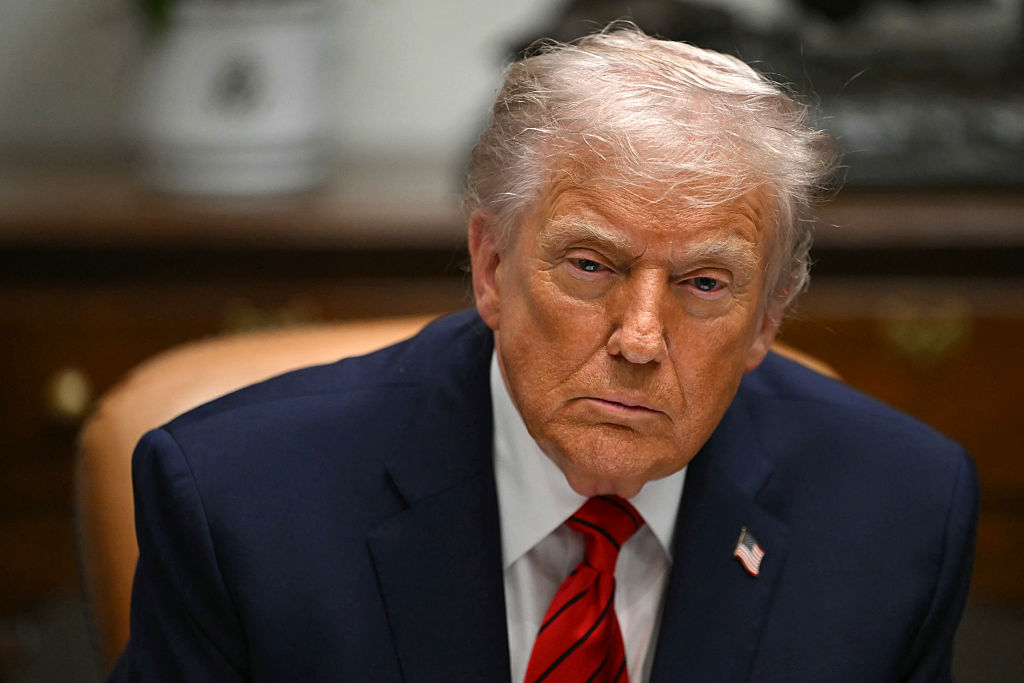
In a presidential message marking the 250th anniversary of the Monroe Doctrine, Donald Trump announced that the United States would once again assert uncontested leadership in the western hemisphere. (Andrew Caballero-Reynolds / AFP via Getty Images)
President Donald Trump recently announced on Truth Social that the airspace “above and around Venezuela” was now closed in its entirety. The declaration was legally puzzling, as a US president cannot unilaterally shut down the airspace of a sovereign nation. Yet politically, it was the clearest expression of the new hemispheric doctrine emerging from Washington: a “Trump Corollary” to the Monroe Doctrine that claims unilateral authority over Latin America and the Caribbean.
Just days earlier, in a presidential message marking the 250th anniversary of the Monroe Doctrine, Trump announced that the United States would once again assert uncontested leadership in the western hemisphere. This declaration was also included in the new National Security Strategy, in which the Trump administration recast the Caribbean and Latin America as a zone where “the American people, not foreign nations nor globalist institutions, control their own destiny.” The message is unmistakable: the US supremacy in the hemisphere is to be restored through presidential will, military power, and emergency authority, unconstrained by Congress or international law.
This declaration arrives amid a dramatic military buildup in the Caribbean, in which the United States has quietly transformed Puerto Rico into the forward platform for Operation Southern Spear. Under the banner of counternarcotics, the Pentagon has deployed an armada of warships, including the aircraft carrier USS Gerald R. Ford and at least 15,000 troops, a mobilization described by analysts as the region’s largest since the Cuban Missile Crisis and the invasion of Panama in 1989. Satellite imagery shows US cruisers and destroyers consistently positioned fifty to one hundred miles off Venezuela’s coast, far from the primary drug-smuggling corridors the administration claims to be targeting.
The shift became unmistakable after the Trump administration decided to designate President Nicolás Maduro and the “Cartel de los Soles” as a foreign terrorist organization, a move that took effect on November 24 that experts overwhelmingly reject as inaccurate or misleading. To be sure, the cartel is not a coherent group, but the designation unlocks powerful authorities. It allows the Trump administration to treat Venezuela’s government as a terrorist regime, creating the legal cover for escalations without congressional approval, a way to transform foreign policy into an extension of presidential emergency powers.
Under this logic, the Trump administration has already carried out more than twenty lethal boat strikes, killing over eighty people, actions described by the United Nations and human rights organizations as extrajudicial executions. Britain has stopped sharing maritime intelligence with Washington over concerns it would be complicit in illegal killings. Yet the attacks continue, justified through an expansive reading of executive power and a newly declared “armed conflict” with drug cartels. The legal threshold for violence is being lowered in real time, prompting some lawmakers and commentators to describe these attacks as war crimes.
Puerto Rico sits at the center of this shift. Military officials now refer to the archipelago as a natural aircraft carrier, a colonial territory strategically located just a few hundred miles from Caracas, governed by the United States but denied political rights. In Ceiba, the massive Cold War–era base at Roosevelt Roads, closed in 2004 after the historic Vieques struggle, is undergoing rapid reactivation. Satellite photos show resurfaced taxiways, expanded logistics zones, and a new presence of F-35 fighter jets, among the most advanced in the US arsenal.
Likewise, when Trump announced that the CIA had been authorized to conduct operations inside Venezuela, one may wonder what role Puerto Rico is playing in these actions. As Michelle Ellner notes, this is not the first time that US bases in Puerto Rico have served as logistical hubs for interventions across the hemisphere, from the US invasion of the Dominican Republic in 1965, to Grenada in 1983, and Panama in 1989.
Meanwhile, Marines are conducting amphibious landing drills along Puerto Rico’s southern coast. National Guard units are supporting operations from Aguadilla and Isla Grande, and the Federal Aviation Administration (FAA) has issued emergency airspace warnings asking civilian pilots to “exercise extreme caution” due to heightened military activity. What Washington calls training is experienced locally as an occupation.
For Vieques, in particular, this moment is a painful return to the past. Vieques endured sixty years of military training, which involved bombings, contamination, unexploded ordnance, and health crises that continue to this day. Residents who grew up diving under their beds during training exercises now watch their children flinch at the same noise. Many still recall relatives lost to cancers linked to toxic exposure. Bombing ended in Vieques in 2003, but the health crisis never did. After two decades of federal cleanup efforts that are incomplete and ongoing, hearing military aircraft again feels like history repeating itself.
The buildup also deepens long-standing patterns of environmental racism. Communities in the southeast, such as Salinas, Guayama, and Arroyo, already live near toxic coal ash from power plants, methane gas infrastructure, and the fragile, privatized grid that collapses even during near-miss storms. Military expansions in these areas threaten aquifers and wetlands and increase flooding risks in municipalities still recovering from hurricanes Maria and Fiona. Militarization adds another layer of vulnerability to regions already pushed to the edge by colonial policy and climate change.
There is also a gendered dimension. In places as distant as Okinawa, Colombia, and Guam, the arrival of US troops has correlated with surges in sexual exploitation and violence. In Vieques, activists report that soldiers have already begun asking local businesses about sex workers, an early sign of the patterns of gendered harm that follow military deployments worldwide.
Supporters of the military buildup in Puerto Rico frame it as economic development. Puerto Rico has heard this before. The jobs are precarious; the federal contracts flow overwhelmingly to defense corporations; the long-term costs, contamination, displacement, and trauma remain for local communities long after the troops leave. Military presence has never brought economic sovereignty to Puerto Rico; if we are serious about security in the Caribbean, we must begin by demilitarizing it.
Puerto Ricans have no vote in Congress, no representation in the Electoral College, and no power to challenge the militarization of their homeland. Now the archipelago finds itself being used as an unaccountable platform for policies that could trigger conflict in the Caribbean and Latin America. Decisions made in Washington could plunge the region into crisis, while its residents, who would bear the consequences, remain politically disenfranchised.
What is unfolding in Puerto Rico and the wider Caribbean is part of a broader reorientation of US foreign policy in Latin America and the Caribbean, one that treats emergency powers as the primary instrument of governance. The designation of the Cartel de los Soles, the lethal boat strikes, the reactivation of bases in Puerto Rico, and the bypassing of Congress are all components of a doctrine that views the hemisphere not as a community of nations but as a zone to be governed through emergency powers. Alas, Trump’s hemispheric presidency.
As Washington debates whether to escalate against Venezuela, the story is larger than the fate of a single government; it is about the Venezuelan and the Caribbean people. The Caribbean is not an empty buffer between Washington and Caracas. It is filled with communities, from Grenada to Panama, Puerto Rico to Trinidad, Aruba to Curaçao, who have lived through the consequences of US militarism before and who now face the prospect of a next wave of imperial interventionism.