Volunteers Were the Key to NYC-DSA’s Socialist Sweep

Lost in conversations about New York socialists’ charisma or social media prowess in recent electoral victories is something simple: boots on the ground. New York City DSA mobilized thousands of volunteers and is poised to do so again in the future.
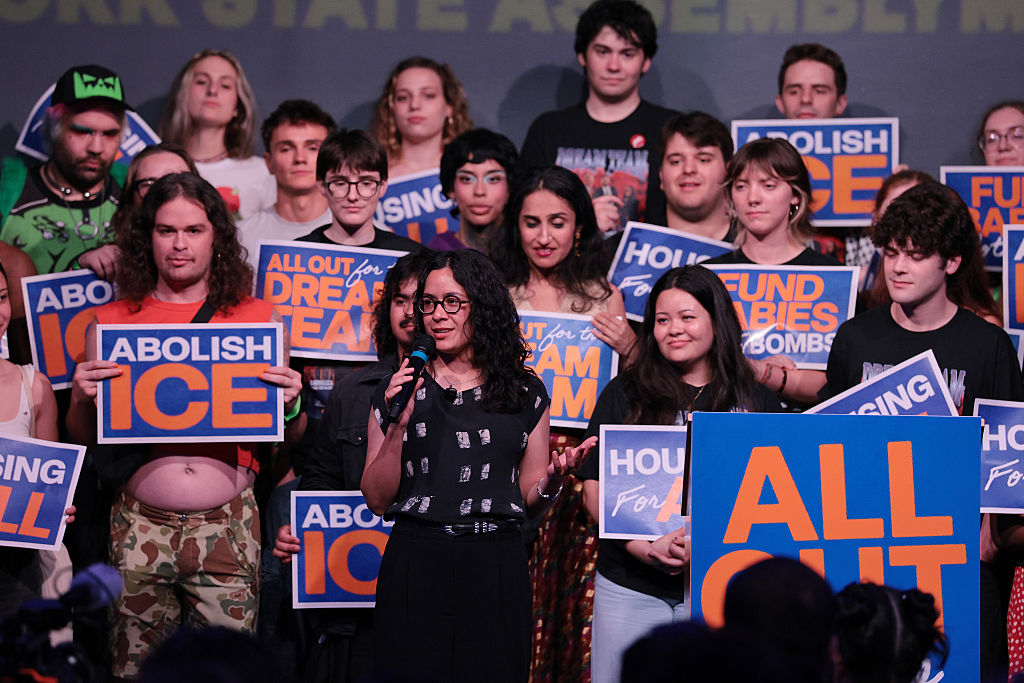
Democratic congressional candidate Claire Valdez speaks during an election eve rally at Silo on June 22, 2026, in the East Williamsburg neighborhood of the Brooklyn borough in New York City.

You can’t understand how the New York City Democratic Socialists of America have become a major force in New York politics without understanding their massive volunteer canvassing operations. (Michael M. Santiago / Getty Images)


Since the Democratic Socialists of America (DSA) swept the New York primaries in June, conservative and liberal media alike have tried to make sense of DSA’s meteoric rise by tying them to ascendant New York City Mayor Zohran Mamdani and his “kingmaking” abilities. Beyond a cursory nod to the army of volunteers knocking doors and making phone calls, far less has been made of the why behind the volunteer effort that propelled these candidates to victory.

Across NYC-DSA’s slate of endorsed candidates, roughly 8,500 volunteers showed up to knock more than 750,000 doors, with over 810,000 attempted door knocks — for an off-year electoral cycle. Many of these volunteers were part of Mamdani’s 100,000-strong volunteer base, who, still electrified from last year’s win, rolled right into volunteer work for the slate’s ten state-level campaigns.

“I canvassed for the slate in general because I was super excited to capitalize on the momentum from last year with the Zohran primary and general win. That’s how I got started in electoral work in the first place,” said Caroline Hill, a field lead for Samantha Kattan.

But it wasn’t just Mamdani’s previous volunteers who showed up to knock doors and make phone calls. New volunteers inspired by both Mamdani’s successful campaign for mayor and this new slate of candidates grew its ranks. By May, the largest source of new volunteers came from those who were neither DSA members nor previous Mamdani volunteers.

Jacobin spoke with some of the most prolific door-knockers and most highly engaged volunteers from NYC-DSA’s slate of endorsed candidates to find out why they continued to show up for their chosen candidates and how they think we can keep the wins coming.

People Power

The two highest-profile races for NYC-DSA were for congressional seats: Claire Valdez’s run for Nydia Velázquez’s vacated seat in New York’s Seventh Congressional District (NY-7) and Darializa Avila Chevalier’s run against incumbent Adriano Espaillat in the Thirteenth District (NY-13).

In NY-7, Valdez brought out a whopping four thousand volunteers for her race — nearly half the total number of volunteers that showed up for the whole slate.

“Something we kept telling our canvassers, the establishment wants everyone to believe that Zohran was a moment — just a flash in the pan, viral social media, charismatic personality — and not about the substance and the politics and the policy,” said Christian Long, a field lead for Valdez. “This was our statement to say, no, this is for real. This is a movement, and we’re growing — and this is the next step.”

Across the river in NY-13, with one full-time field staffer, Avila Chevalier’s campaign organized 3,500 volunteer shifts with over a thousand canvassers, averaging three shifts each — roughly a quarter of whom were not previously affiliated with DSA.

“There was a sense on this campaign that the volunteers were the ones who were driving it, were the ones who are crafting the strategy, who were ultimately responsible for its success,” said Andrew Basta, a volunteer for Avila Chevalier’s congressional race. “I think I took a lot of ownership as well as many, many other people on the campaign to say that this has to be a success.”

During the campaign’s final four days of get out the vote (GOTV) alone, volunteers knocked over 155,000 doors and made roughly 250,000 calls — a level of grassroots mobilization more typically associated with statewide or presidential campaigns than a single House primary. For perspective, during the last weekend of October before the 2024 general election, Kamala Harris’s campaign reported knocking one hundred thousand doors across the entire state of Georgia.

“We relied heavily on what makes NYC-DSA campaigns so impactful: a mass volunteer-led apparatus,” said Sebastian Leon Martinez, the sole field staffer for Avila Chevalier’s campaign. “It was the field program that benefited from trusting volunteer leaders with new responsibilities.”

These volunteers weren’t only knocking doors and making calls. For Avila Chevalier’s campaign, a dozen regular volunteers fulfilled responsibilities typically doled out to staff like training field leads who assigned turf to canvassers, handling peer fundraising, reviewing campaign data, working on video production, serving as points of contacts for other volunteers, and creating campaign merchandise.

“That layer of leadership was the strongest I’ve seen in a campaign beside Zohran’s and builds up the confidence to take ownership of projects that lead to potential future staffers,” Leon Martinez said.

For downballot races, these campaigns were drawing in hundreds to thousands of volunteers — rivaling, and in some cases exceeding, some of the best-known insurgent campaigns of the past decade. Archival records suggest Alexandria Ocasio-Cortez’s 2018 congressional campaign involved roughly 500 active volunteers, 103 of whom were Queens DSA members.

Aber Kawas’s campaign for state senate alone mobilized more than 1,100 volunteers to knock over 104,000 doors. Christian Celeste Tate’s campaign for state assembly drew in roughly 315 volunteers who knocked nearly 45,000 doors in his district.

In the “Commie Corridor,” a moniker coined by political writer Michael Lange to designate the zones of Queens and Brooklyn that came out the strongest for Mamdani during the mayoral race, multiple DSA-backed candidates were running in overlapping or adjacent districts. Claire Valdez was running at the top of the ticket, while Kawas, Samantha Kattan, David Orkin, and Tate were running downballot races, alongside Diana Moreno’s campaign for reelection in Mamdani’s old assembly seat.

Organizational emphasis on ushering in a socialist bloc up and down the ballot — rather than electing individual candidates — helped turn out volunteers to canvass for multiple candidates at once and pool resources.

“Just the idea that we can elect an entire slate that is unified in our goals to make our society work better for the masses — that was an opportunity that I think we all knew we couldn’t let that slip by,” said Sara Abiboutros, an attorney and field lead for the “Sunny Slate” in Sunnyside, Queens.

That the candidates were running on nearly identical platforms made it easier to say to perspective voters, “If you like Valdez, you’ll like Kawas and Kattan, too.” The trust by association that came with Valdez running at the top of the ticket — in the same way an endorsement extends trust from current electeds to candidates — proved an advantage at the doors.

“There was a lot of joint canvassing happening. And it just felt like coming off of Zohran’s win, it was the perfect opportunity to carry that momentum, and this would be the next step, the next phase of the movement,” Abiboutros said.

Part-Time Door-Knockers

When it came to knocking doors, some of these volunteers spent more time on their turf than the candidates themselves. Bao, a volunteer for Illapa Sairutupac’s campaign for state assembly and resident of an adjacent district, knocked roughly 1,450 doors — surpassing Sairutupac himself. Despite coming out two to three times a week for six months to canvass, Bao, who asked to be referred to by his first name only, said this came as a surprise: “I always assumed that I was one of the least active volunteers.”

Jon Williams, a volunteer for Christian Celeste Tate’s campaign knocked over 1,500 doors, behind only Tate himself. Working from home, Williams saw the additional benefit to canvassing as an excuse to get his daily steps in. “I think I need new shoes, though,” he added. “I’ve totally burned through them.”

For field leads, the commitment extended beyond knocking doors and making calls. “It’s not just the time that goes into the canvass itself, but prepping for the canvass,” said Abiboutros.

Hill, a twenty-five-year-old stationery printer, commuted an hour and fifteen minutes each way from her home in Sunset Park to Ridgewood, where she worked her field lead shifts for Kattan. She spent her commute reading David Foster Wallace’s Infinite Jest.

“It just became easier for me to stay in Queens and pick up a double shift instead of going back home at, I don’t know, four in the afternoon and not getting home until nearly dinner time.” She said “the best day of her life” was when she got to a volunteer shift in less than an hour.

Many of these volunteers reported time commitments closer to a part-time job than volunteer work, with some saying they worked twenty hours a week or more.

Basta reported spending between twenty and thirty hours each week on Avila Chevalier’s campaign. “It was a big commitment. I think it was probably the hardest I’ve ever worked on a campaign,” he said.

Hasan Piker at a canvass for Claire Valdez.
Hasan Piker at a canvass for Claire Valdez. (Claire Valdez for Congress / X)

Christian Long, a field lead for Valdez, said his initial commitment of one shift every other week quickly became two to four shifts per week.

“If you told me two years ago, ‘You’re volunteering twenty hours a week,’ I would say, ‘You’re crazy, that’s so much time.’ But it doesn’t feel like work.” said Long. “You don’t want to miss that rally where 200 people came out because Zohran was there or the rally where everyone got a bandana — that’s a signifier that you were there.” As the campaign went on, Long said that feeling of not wanting to miss out on the defining moments of each campaign only increased.

What Brought the Volunteers Out

While the number of doors knocked and volunteer hours worked explains how DSA swept the primaries, it does not explain why working people were willing to give so much of their time to seeing their candidates across the finish line.

“It just felt like a generational opportunity to have a seat like this open up,” said Long, in reference to Valdez’s race to fill long-time congressional Representative Nydia Velázquez’s seat.

NY-7 is one of the most left-leaning districts in the country, and Mamdani carried it with 67 percent of the vote, his strongest performance in any district. “It just felt like such an urgent opportunity to put a socialist in this seat versus just a regular Democrat.”

Hill attended Kattan’s campaign launch in February and says she was struck by the level of excitement she was generating so early in an off-year election. “I centered all my focus on Ridgewood, because even though I was pretty certain that she was going to win in that district, one thing that people were talking about with the slate, especially with ‘safe races’ like hers, is that we’re not taking the voters for granted. That’s one of the ‘DSA difference’ things.”

Beyond ideological commitment to building a bloc of socialist legislators, the affordability crisis proved highly motivating for volunteers.

“If we’re focusing on just Samantha,” said Abiboutros, “she was a tenant’s rights organizer for over ten years. And I feel like that’s something that’s lacking in a perspective in the state legislature. We have such an affordability crisis right now, and she can really speak to that.” Adding, “We just got a rent freeze, but it’s because of people like Samantha who have been organizing for that for so long.”

Miriam Bensman, sixty-eight, a veteran of the electoral movement and the most prolific door-knocker on David Orkin’s campaign, also expressed economic precarity as motivation for volunteering her time. Though concern over the cost of living was focused more on her adult children.

“My kids feel like they can barely afford to live in New York,” said Bensman, whose daughter lives in East Harlem. “She got a tiny little room in a two-bedroom that was turned into a three-bedroom for close to $1,000 a month, and that takes a lot out of her,” she said. “I want them to — my kids and everybody’s kids — to be able to have decent wages and a nice, dignified job, and home. . . .  I feel like we’re leaving them a terrible world, and this was not what we wanted to do.”

According to volunteers, economic insecurity emerged as a top concern for voters at the doors too. “What I heard repeatedly was affordable housing. I think people are realizing that yeah, rent is just too high. And unfortunately, when you’re a renter, you’re either beholden to infinite rent hikes in the future or you eventually get priced out. Because the costs always go up, but your income doesn’t,” said Bao.

Taxing the rich proved another policy with popular support at the doors. “People are sick and tired of all these tax cuts that they’ve been getting,” said Bao. “They’re sick and tired that the wealthy keep getting richer, while everyone else’s quality of life has gone down.”

Sean Liam, a founding member of the affinity group Labor for Claire, shared similar experiences with voters. “People are struggling to make ends meet, and they want fighters in the halls of power to make their lives easier.”

Labor for Claire was established shortly after Valdez announced her campaign as a way to foster and organize labor support. “You could see her at almost every picket line in New York City,” said Sean Liam, who first met Valdez at an event for federal workers. “Claire showing up constantly — I mean, you heard it with ‘Claire was there, Claire was there, Claire was there’ — it’s not just a slogan, it’s a reality, and it pays off.”

Valdez and Kattan aren’t the only candidates who had “organizer” featured prominently on their resumes. All of DSA’s candidates have come from diverse organizing backgrounds. For volunteers, these organizing bona fides were essential experience for a candidate.

“They’re all organizers at heart. That’s what they were doing previously, and that’s going to be their perspective when they govern,” said Abiboutros. “They actually made connections with people, and because people trust them, people were able to look at their message, speak to them one-on-one, and say I actually believe that Samantha believes in A, B, C. I believe that Aber cares about this. I believe that Claire is truthful when she says she wants to revive the labor movement.”

At the Doors: Palestine, ICE, and Trump 2.0

If organizing experience was critical for volunteers’ support, those issues candidates organized around proved equally determinative. Support for Palestine was more than a bonus check in the green column but instead another absolute prerequisite for support.

“I still think Palestine is the litmus test, whether one believes in a collective project of humanity, and I think she passes with flying colors,” said Basta, who cites Palestine as the issue that radicalized him over a decade ago. “Seeing someone who for her whole life has been kind of shaped by that issue, has really been a leader on the campuses — both as a student and as an alumna — just threw open the possibility of what she can do in Congress.”

At the doors, volunteers say the shift in public sentiment on Palestine — and antiwar messaging more broadly — was clearer than ever. “When you say money should be going to working families here in NY-7 and other districts where people were canvassing, not destroying working families abroad, that argument resonated far beyond what I thought, and where I thought, it would work,” said Liam. “It’s a unifying issue that I did not expect to be quite as unifying, but it definitely gave me a lot of hope for the future.”

Alex Nappier, a volunteer for Kawas, saw a similar shift in voters. During the last six weeks of the campaign, he says, voters increasingly saw DSA campaigns as opportunities to send a message to Albany that working people want their tax dollars funding programs in their communities — not sent “overseas to genocide.”

Fighting to abolish Immigration and Customs Enforcement (ICE) was also viewed by volunteers as a winning issue, particularly in a city where immigrants make up roughly 40 percent of the population.

Darializa Avila Chevalier and Conrad Blackburn canvassing with supporters.
Darializa Avila Chevalier and Conrad Blackburn canvassing with supporters. (Darializa for Congress / X)

“We have the army in the street, hunting down people just because they were born in a different country or appear to have been born in a different country. And Claire’s district has to be one of the most diverse in the country — people who were born in every country imaginable, people whose parents were born in every country you can think of,” said Liam. “People are in a very activist, agitating mood, and Claire really met the moment.”

“I think a lot of people — like me, as an immigrant — we kind of see America, at least [we did] in the past, as this bastion of a place where you can come and make something better of yourself or become an American. With the recent administration, it’s very difficult for a lot of immigrants to see that weaponized against them,” said Bao. “I really want us to be back in a place where we’re really proud of this aspect of our culture, and I really want someone in the state assembly to fight for us there.”

One of the hallmarks of the Trump 2.0 era is the growing disaffection by voters with both establishment parties, as is a desire to be brought back into the political process.

Nappier recalled several conversations with voters who described feeling disenfranchised by parties they felt no longer represented their interests. He described canvassing one “friendly” voter who explained he had become so disillusioned with the Democratic Party he had lost faith in the system altogether.

If people knew organizers were having the same conversations with their neighbors, sometimes just one door over, says Nappier, we might all have “a very, very different perspective on what the state of this country and the state of this world is than you would see on social media.”

Working a Queens poll site on Election Day, Nappier similarly recalled being at the end of a long line of volunteers from different campaigns passing out flyers. He watched one man, holding his child, turn down the line of flyers, telling volunteers he voted early and was just walking in this direction. “When he walked up to me, with the big picture of Aber and Zohran signs, he goes, ‘Hey, I just lied to all of them. I haven’t done my research. Who am I voting for in this?’”

“The voters can tell when you’re talking to them and when you’re BSing them, or when you actually believe in what you’re saying. And I think we just have that, like, magic sauce with our candidates that they truly believe in these things,” said Abiboutros.

Authenticity, coupled with canvassers and staffers’ high-level understanding of the candidates’ policies, she says, helps to build trust among voters. Abiboutros believes that if socialists want to do more than merely win but govern effectively, that necessitates gaining the trust of working people — and making them feel like they have a stake in the movement. “And that’s the goal, right? To get more people involved.”

“What Else Are You Going to Do on a Sunday Morning?”

When so much of our social lives and communities have moved online, volunteers expressed difficulty in making connections and building community in real life. One of the most overlooked rewards of giving their time to these campaigns, said several of the volunteers, were the connections they made with other volunteers.

“Everything has been kind of commodified. So, all your interests cost money. Having a personality costs money, right?” said Bao, a software engineer in his early thirties. “One of the beautiful things about being a part of a political movement is that you have a shared sense of values with a lot of the people that you meet.”

Bao says that he’s become good friends with many of the people he volunteered on Sairutupac’s campaign with. “Honestly, what else are you going to do on a Sunday morning?”

Long had a similar experience volunteering for Valdez. “A lot of these people, a lot of the field leads in the canvasses, were people I was meeting for the first time, and a lot of us are friends now. There are bonds that are formed, and we kind of became a crew through it all.”

“As someone who’s kind of introverted, the idea of canvassing was so mortifying, and I’ve come around to being a huge field evangelist,” said Long, who graduated from casual Mamdani canvasser to field lead for Valdez’s race. Long added that Valdez, like many volunteers who move up the ranks, was a reluctant candidate, that “the movement called her.” Pulling people into the community while encouraging them to learn new skills and achieve those things they never thought were within reach, Long says, is one of the main tenants of organizing.

“Everyone’s got a role to play; everyone’s got their own strengths when it comes to making change. Not everyone can be the face of a movement or have the charisma to be a politician or a head of state.” said Bao. “I think part of this process is that you learn more about how you can contribute your strengths to help make change.”

Maintaining Electoral Momentum

While the general elections still loom ahead, one of the biggest questions for the movement as we look beyond the gains of the last two years, is how to maintain the momentum from our electoral successes and grow the movement that made these wins possible.

“People keep asking, what are you going to do now that the campaign’s over? You’re free,” said Long. “I’m like, no — there are dozens of projects that DSA is working on that I want to be involved in.”

Long, a member of the NYC-DSA antiwar working group, finds the lessons of the Obama years instructive. “[Barack] Obama won, and everyone was so excited, and everyone went back to brunch. . . .  And then eight years later, we got [Donald] Trump. With Zohran’s win, and with these wins, the answer is you keep organizing.”

Liam shared a similar sentiment. “Politics doesn’t stop at the ballot box. Politics is everywhere. Each industry, each local, each shop floor — it’s an opportunity to get involved politically.” He hopes to see the energy from these primary wins carry over into fighting for the expansion of labor rights from the shop floor to the halls of power in Congress. “I would encourage people to get involved in their unions, get involved in local community groups — whether that’s DSA, whether that’s something else, and really work on building power where power needs to be built.”

Moving forward for Abiboutros means building a mass movement to support our legislative goals. “Whenever these candidates are trying to push a bill through Albany or they’re rallying around a certain issue, we have to support them and back them up, so that it gives them cover as legislators to say, ‘My constituents want this, and I’m going to go to bat for them,’” said Abiboutros. “We really can’t do that without a mass movement. I think that’s what the mayoral victory showed us, and I think that we’re going to continue that.”

And Hill issued a reminder. “It is really true that last year’s field leads are this year’s candidates, are next year’s electeds,” she said in reference to recently surfaced photos of Avila Chevalier working as a field lead for Mamdani last year.

“There are people we worked with who one day might be running for office, and so everybody, no matter what they’re doing, should always be keeping an eye out for the people that they work with to organize because when we work together, we win, and when we win, we can have more power to actually make New York a place that we can live in and enjoy and love.”