What Multilateralism Looks Like After US Decline
The current crisis in the world order isn’t just about Donald Trump ignoring multilateral institutions. The US has long broken the rules — the real change is that Washington is losing its ability to lay down the law to other states.
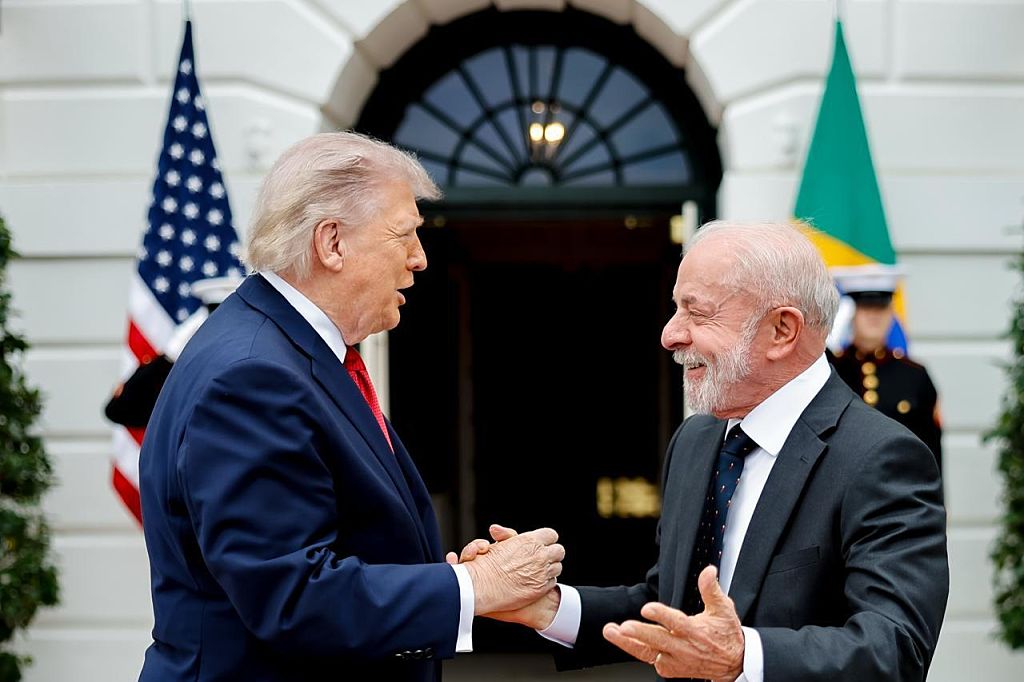
The hefty US tariffs on Brazilian exports are another sign of Washington’s will to punish its political adversaries. But resisting such moves will take more than appeals to the spirit of multilateralism. (Ricardo Stuckert / Handout / Anadolu via Getty Images)
Brazil’s President Luiz Inácio Lula da Silva responded with justified defiance to recent confirmation that the United States government would impose a 25 percent tariff on Brazilian exports. Among the “acts, policies, and practices” that the Office of the United States Trade Representative deemed “unreasonable or discriminatory” and worthy of formal investigation, it cited Brazilian electronic payment services. The Trump administration has frequently denounced Pix, an instant payment mechanism maintained by Brazilian banks without intermediation by US firms such as Visa and Mastercard. However, the imposition of these tariffs is also one of a growing number of measures aimed at undermining Lula’s government ahead of elections in October, as the United States seeks privileged access to Brazil’s abundant source of rare earth elements. A spokesperson for the Brazilian president questioned the legitimacy of the investigation, stating that it was “not based on multilateral trade rules.”
But there is a bigger problem. While national governments still invoke such rules in defense of their sovereignty, the conditions that enabled the expansion of multilateralism in the twentieth century no longer exist. Though the Trump administration’s brazen disregard of international norms and institutions might intuitively be identified as evidence of this, it is not the most important indicator: after all, it is the prerogative of hegemonic power to circumvent universal rules while policing others’ adherence to them. Of more consequence is the United States’ apparent inability to reshape these rules in accordance with its own evolving geostrategy. And as Washington has eschewed multilateralism, its global preeminence in the exercise of coercion has also waned. Given the effective absence of the United States from existing multilateral institutions, attempts to give them new meaning – not least by revisionist states such as China and Russia – have been used to undermine American hegemony itself. But as Donald Trump paints the world with new targets, adversaries of circumstance as well as systemic rivals are also responding in kind.
Economic Warfare
Particularly indicative, in this regard, are changes in the conduct of economic warfare. The US dollar has been the global currency of reference since the Bretton Woods Agreement of 1944, allowing Washington unique control over international flows of capital and commodities. Through the imposition of distinct forms of “blockade,” from sanctions to tariffs to maritime sieges, the United States has conditioned economic relations in a manner that, for a time, served to produce a system of consent to its imperial power. However, such measures have forced actions that have ultimately contributed to the erosion of its global hegemony. Under the strain of American sanctions, for example, Russia, Iran, and Venezuela have pursued de-dollarization strategies, settling trade in other currencies, yuan in particular. Yet as noted recently by historian Nicholas Mulder, many states have responded to growing coercion from Washington by developing “not just evasion routes but economic counter-weapons of their own.”
The threat of reciprocal tariffs has been the most common recourse among states targeted by the second Trump administration’s economic coercion. The most dramatic consequence of this approach was the de facto mutual trade embargo maintained between the United States and China for a month in mid-2025, after Chinese President Xi Jinping repeatedly matched Trump in escalating tariffs. In response to the recent announcement of tariffs on Brazilian exports, Lula’s spokesperson invoked Brazil’s Economic Reciprocity Law, which permits the government to respond proportionately to measures by other states that undermine its competitiveness. But he nonetheless reaffirmed the government’s commitment to multilateralism by promising to pursue redress through the World Trade Organization’s dispute-settlement mechanism.
But if trade protections have regained international legitimacy as a means of defending national sovereignty, the use of physical barriers to trade as an economic “counter-weapon” has threatened more immediate and generalized consequences. For decades, energy-security analysts and foreign-policy strategists had studied the possibility that Iran might effectively block the Strait of Hormuz. The materialization of this possibility, and the introduction by Iran of a toll on the passage of ships through the strait, should have been less surprising than Trump’s short-lived determination to do the same. However, Iran’s defensive actions, in response to the war launched upon it by the United States and Israel, are far more remarkable for their systemic implications.
In his acclaimed account of the Great Depression, historian Charles Kindleberger contended that the stability of the world economy depended upon the existence of a single hegemonic state able to lead through the provision of international public goods. By 1973, when The World in Depression was published, the United States had long since consolidated its global hegemony, touting its protection for freedom of the seas as one such public good even as it exercised its hegemonic prerogative to control the flow of trade through international waterways. If Iran’s closure of the Strait of Hormuz and its request for Houthi allies to close the Bab al-Mandeb Strait pose a direct challenge to freedom of the seas, the failure of the United States to ensure adherence to this principle is a further indication of the collapse of its hegemony.
In a world after the hegemonic order of the United States, multilateral institutions, not least those of the United Nations, are losing political currency. They are becoming less effective in imposing constraints on national interests. These institutions in general were enabled and sustained within the system of consent of American hegemony. Though they will continue to serve as sites of defensive appeal against imperial impositions and hypocrisy, great-power dominance is likely to engender more direct, coercive responses. However, for middle powers in particular, multilateralism provides opportunity for their own relative influence to be exercised in the construction of collective endeavors that better protect their interests. Indeed, middle powers were instrumental in the definition of many UN institutions.
Middle Powers
In his speech to the World Economic Forum this January, Canadian Prime Minister Mark Carney called upon middle powers to “build a new order that encompasses our values, such as respect for human rights, sustainable development, solidarity, sovereignty, and territorial integrity of the various states.” But for all his moral posturing, it was recognition of his country’s limited sway, and thus its interest in combining forces with others in a similar position, that stimulated Carney to assume leadership in the promotion of middle-power coalitions. Indeed, he made it clear that upholding these values was not of primary concern a couple of months later, when he announced his support for the US-Israeli bombardment of Iran.
Without the consolidation of a new global hegemonic order, new modes of multilateral engagement will emerge. Regional and bloc formations, already on the rise in the first quarter of the twenty-first century, are likely to play a more prominent role. But, so far, the global import of middle-power initiatives has been limited. The current US government seems keen to contain their influence. In mid-July, the United States Under Secretary of War for Policy, Elbridge Colby, posted a thread on X about collective strategy among middle powers, in which he argued that it was based on “a faulty understanding of international relations.” “‘Middle powers’ don’t have a coherent basis for alignment,” he added.
However, the strategic convergence of middle powers will not be determined primarily by the ideological inclinations of their governments. Rather, middle powers will be compelled to cultivate diplomatic innovations — even when coalition-building is not viable or preferable — as a consequence of their position in relation to imperial powers. Lula’s positioning of Brazil as an international mediator is indicative. Consonant with Brazil’s own foreign-policy tradition, its role, alongside Turkey, in previous negotiations regarding Iran’s nuclear program demonstrated a willingness to perform this systemic function amid earlier signs of relative American decline. Lula’s offers to mediate peace talks between Ukraine and Russia, and between Venezuela and the United States, serve as more recent examples. And yet, such diplomacy will not provide immediate defense against the coercion of the Trump administration. Economic countermeasures, playing on China’s rivalry to the United States, will then also become increasingly central to Brazilian efforts to assert national sovereignty.
The end of order does not necessarily imply the end of multilateralism. The major structural transformations of our time will produce new channels for international cooperation, based on shared interests. The extent to which these channels of cooperation might constrain great-power dominance will depend on the middle powers’ subsequent investment in expanding them.