The Hague Group’s Insurgent Multilateralism
The US claims to uphold a rules-based global order while letting Israel commit brutal crimes with impunity. Into that breach has stepped a coalition of states, the Hague Group, willing to act on the basic principles of morality abandoned by the old system.
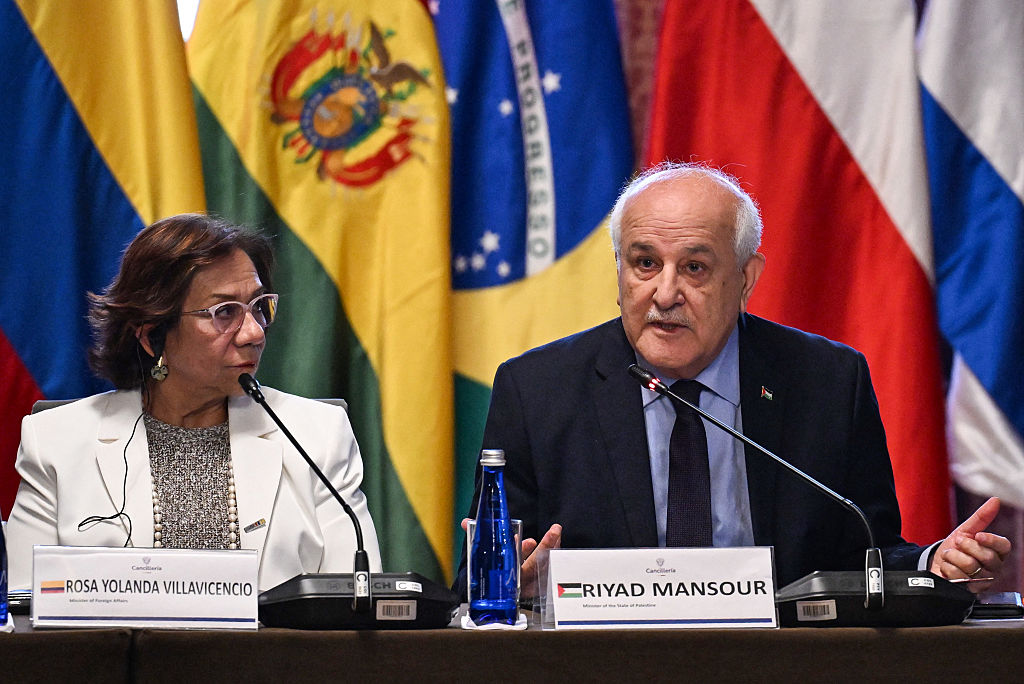
A new terrain has been opened by the Hague Group — one in which legal obligations can be enforced collectively. (Luis Acosta / AFP via Getty Images)
On November 17, the United Nations Security Council voted for a brazenly colonial plan for Gaza. The vote crystallized a truth long evident to much of the Global South: the multilateral system, dominated by Western power, cannot restrain Western-backed impunity. For the past year, the Hague Group has begun to chart another path — one grounded not in geopolitical hierarchy but in collective action, legal principle, and political courage.
For decades, the dominant forces in the West have treated Israel as a frontier outpost on hostile terrain. After the Cold War, they wrapped their authority in the language of democracy and a rules-based order, even as they placed the Palestinian people beneath international law and the Israeli state above it. Like all forms of racism, this divide rests on hierarchical ideas about who counts as human — ideas that sustain Palestinian oppression and the global order that enables it.
There was a time when multilateral institutions could still act against the grain of this racial order. In 1978, the Security Council passed Resolution 435, building the framework for Namibia’s transition to independence and affirming the illegality of South Africa’s occupation. It demanded the withdrawal of apartheid forces and eventually established a UN-supervised process in which Namibians could freely elect their government.
But the balance of forces that made such action possible has not survived into the present. With the consolidation of Western revanchism — symbolized by Donald Trump’s return to the White House — that era has, for now, passed. On November 17, the Security Council adopted Resolution 2083, a US-Israeli proposal that revives the Trump–Netanyahu blueprint for Gaza and installs a system of overt colonial control: whoever governs Gaza must be approved by Israel; political leadership and security arrangements must be vetted for compliance with Israeli demands. The logic mirrors the League of Nations mandate that authorized South Africa to govern Namibia. Submission is presented as the price of Palestinian survival.
The Western powers have now made clear that the UN will not restrain Israel’s domination. When South Africa charged Israel with genocide at the International Court of Justice on December 29, 2023, it tore open a central contradiction of the contemporary order: Western states claimed to uphold a rules-based system while shielding a state accused of its gravest crime. Into that breach stepped a coalition of states willing to act on principles long abandoned by the old multilateral system.
Formally established on January 31, 2025, days after Trump reentered the White House, the founding members of the Hague Group — Bolivia, Colombia, Cuba, Honduras, Malaysia, Namibia, Senegal, and South Africa — declared that when the Security Council refuses to uphold international law, states are not absolved of their obligations. “The choice before every government is clear: complicity or compliance,” their founding statement read.
Since then, the group has expanded, with more than thirty states participating in its emergency high-level summit in Bogotá in July 2025, convened by South Africa and Colombia. Thirteen of them formally adopted six coordinated measures: halting arms transfers to Israel, blocking and de-flagging ships carrying weapons, auditing public contracts with companies complicit in the occupation, enforcing universal jurisdiction, and developing national mechanisms for accountability.
“Together,” declared Colombia’s president, Gustavo Petro, “we have begun the work of ending the era of impunity.” Varsha Gandikota-Nellutla, the group’s executive secretary, put it more sharply: “We believe in protagonism, not supplication.”
A third high-level meeting in New York in September 2025 — held as Prime Minister Benjamin Netanyahu addressed the General Assembly — gathered more than thirty states. These gatherings were not only about practical steps to enforce international law. Amid years of obfuscation and moral theater from the Western powers, the signal in New York was unmistakable: when the institutions of multilateralism fail, states must act independently and collectively to enforce international law themselves.
The Hague Group is not a new Bandung or a revival of the Non-Aligned Movement. But it has opened an insurgent diplomatic space at a moment when the old multilateral system is wholly complicit in Palestinian dispossession. That states outside the Western bloc are now willing to confront Israel and its backers, including the United States, is a significant deepening of the breach opened by South Africa at the International Court of Justice.
This breach has not been without consequences. South Africa has been punished in multiple ways: intense diplomatic hostility from Washington; pressure from Western-aligned civil society and media at home; and open aggression from Trump, who has revived deranged far-right fantasies of a “white genocide” in South Africa to justify punitive measures and grant white South Africans asylum. But the formation of the Hague Group has meant, among other things, that South Africa is not isolated.
Multilateral resolutions only gain force when articulated to real shifts in power. Resolution 435 took effect not simply because it was passed but because it aligned with decisive material changes: the defeat of apartheid forces at Cuito Cuanavale, Angola, in 1988; the rise of a powerful trade union movement after the Durban strikes of 1973; the urban revolt ignited by the Soweto uprising of 1976; and a global solidarity movement that steadily eroded the regime’s legitimacy.
The Hague Group is a breakthrough, opening diplomatic ground that had seemed closed for decades. Yet state action is only one front. Movements remain essential. Although some activists are fatigued or disoriented by Western narratives of a fictitious “cease-fire,” many remain committed to escalation, disruption, and the intensification of the campaign to boycott, divest from, and sanction Israel.
The global movement for Palestine has often surpassed the anti-apartheid movement in scale and intensity. It has generated moments of extraordinary clarity and courage: the campus occupations across the United States, the Global Sumud Flotilla challenging the siege directly, and the dockworkers’ strike in Genoa, to name a few. These acts — often undertaken at significant personal cost — express a global reservoir of solidarity that will be indispensable in the struggles ahead.
The failure of the UN need not mean the failure of multilateralism. A new terrain has been opened by the Hague Group — one in which legal obligations can be enforced collectively, outside the constraints of an order that has lost both moral legitimacy and political purpose. Its insurgent multilateralism, aligned with a global movement refusing to abandon the Palestinian people or accept a world in which law applies only to the powerful, offers a glimpse of a different internationalism struggling to be born.