Jonathan Demme’s Wild, Humanist Cinema Deserves a Reappraisal
The Criterion Channel’s new Jonathan Demme retrospective is a chance to look beyond The Silence of the Lambs and rediscover one of America’s most adventurous, surprising, and charming filmmakers.
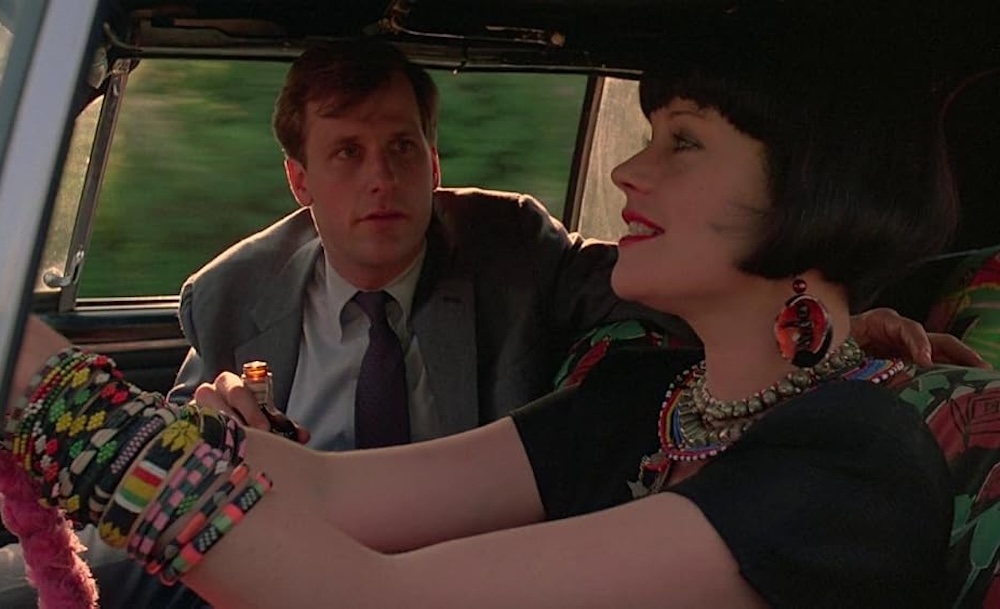
Jonathan Demme’s best movies are strange, funny, kinetic, unpredictable, and deeply interested in actors. A new Criterion Channel retrospective makes the case for looking at his career again. (Orion Pictures)
There’s a Criterion Channel series paying tribute to director Jonathan Demme that, as short as it is, makes clear that Demme is due for a major reappraisal. It includes only four films — Something Wild (1986), Married to the Mob (1988), The Silence of the Lambs (1991), and Rachel Getting Married (2008) — but each demonstrate both his confidence in mixing genre elements freely as well as his commitment to centering his films on engrossing characters and the actors who play them. This means his early movies especially seem loose and rangy but also kinetic and exciting.
Much like his peers Peter Bogdanovich, Francis Ford Coppola, and Martin Scorsese, Demme started his career shooting exploitation movies like Caged Heat (1974) and Crazy Mama (1975) for producer Roger Corman. He found an early champion in critic Pauline Kael, who began the trend of defining Demme as a “humanist” director in the mold of Jean Renoir (The Rules of the Game), one who tended to portray a wide range of characters of various classes, races, and backgrounds without condescension, appreciating their struggles and idiosyncrasies. Demme, who died in 2017, soon broke out of the exploitation underground and had a long career with a major influence on contemporary filmmakers. Paul Thomas Anderson was once asked during a Criterion Channel interview what filmmakers had influenced him the most, and he named as his model and hero “Jonathan Demme, Jonathan Demme, and Jonathan Demme.”
Even while omitting a few of Demme’s greatest works, such as Melvin and Howard (1980) and the Talking Heads concert film Stop Making Sense (1984), Criterion’s series attests to boldly creative qualities Demme had that seem to be in short supply in recent Hollywood cinema.
Demme’s Big Prestige Detour
It can be argued that The Silence of the Lambs, Demme’s biggest hit and the film he’s best known for, plus his other Oscar winner Philadelphia (1993), overshadow his livelier, more inventive work. More than one critic has argued that Demme lost his way after this period, with one offering a startling explanation: that Demme the proud progressive was so distressed by LGBTQ-advocacy groups’ protests over Silence of the Lamb’s cross-dressing serial killer Jame Gumb that he spent years anxiously trying to shore up his progressive bona fides. His attempts to “atone” included Philadelphia, featuring Tom Hanks as an attorney with AIDS. A “passionate liberal Hollywood drama” seemingly designed to win awards, Philadelphia is a well-made film that “never quite transcended the message movie category.” Demme also made a “stilted and overly ‘poetic’” adaptation of Toni Morrison’s Beloved (1998), which bombed even with Oprah Winfrey in the lead.
Both films are more “classic” prestige studio projects, reining in Demme’s freewheeling tendencies. Though even when filming in a chillier, more controlled style, Demme and longtime cinematographer Tak Fujimoto created memorable imagery, such as an inventive variation on Demme’s “signature shot” in which characters speak directly into the camera:
The subjective close-up, where a character addresses the other person in a scene while staring straight into the lens [is] a rarely deployed piece of film grammar, thanks to its disruptive, fourth wall–smashing qualities. But Demme employs the technique to quite the opposite effect: he uses it to create intimacy.
This shot was used most powerfully in The Silence of the Lambs, where it transforms the encounters between Jodie Foster’s Clarice Starling and Anthony Hopkins’s Hannibal Lecter:
They share barely ten minutes together on screen, but so intense are their conversations, and so close is the camera to the actors’ faces, that it feels half the movie is just them talking.
Demme’s Pre-Silence Genius
To get a bead on Demme’s more adventurous filmmaking pre–Silence of the Lambs, it helps to go back to one of his earlier breakout films, such as Something Wild. An astutely reconceived screwball comedy with a bopping rhythm keeping time with the infectious and liberatory reggae score, Something Wild is about the transformative impact on a repressed corporate cog named Charlie Driggs (Jeff Daniels) when he meets a free spirit with a dramatic Louise Brooks bob who calls herself Lulu (Melanie Griffith). Almost immediately, he gets pulled along in her sexy, lawless, adventuresome wake.
This includes constant shifts in identity and appearance typical of screwball comedy, a genre in which spontaneous role-playing is both a way to revive people who’ve been leading deadened lives and a way to zigzag through the fast-paced, obstacle-filled, deeply insane modern world. Lulu has the endearing zaniness and spontaneity of a “madcap heiress” type such as Carole Lombard in My Man Godfrey or Katharine Hepburn in Bringing Up Baby, but Demme brings her down to earth by giving her working-class roots, a realistically troubled past when she was actually named Audrey, and a dangerous ex-con ex-husband named Ray Sinclair who’s obsessed with her (Ray Liotta).
This was Liotta’s first major role and practically steals the film with his electrifying turn as Ray, a menace with a sharklike smile who once shared an edgy outlaw life with then wife Lulu/Audrey. Meeting Ray at Lulu/Audrey’s high school reunion, Charlie picks exactly the wrong time to commit himself to wild Lulu-like ad-libbing, spinning fantastical tales about his new romance that Ray knows are lies. The tension ratchets up to excruciating levels as Ray circles the oblivious, nattering Charlie, radiating lethal vibes, and the screwball-comedy-turned-road-movie shifts into scary thriller terrain.
Demme’s political consciousness was reflected in his view of what Something Wild was really about after he read the refreshing E. Max Frye script:
It kept surprising you at every twist and turn, and there was this theme of the flipside of putting on your neat suits and committing a certain kind of financial violence as a successful yuppie in a corporation. The dark side of that is a guy like Ray Liotta, who resorts to a more fundamental kind of violence to solve his problems and to get ahead. I liked this collision and I liked what the script said about violence.
Something Wild helped to salvage Demme’s career after the disastrous production of Swing Shift (1984) threatened to bring its momentum to a complete halt. With Swing Shift, Demme went up against entrenched star power in the form of Goldie Hawn — still hot off her own daffy hit Private Benjamin (1980) — and lost. According to most accounts, Hawn — who was also producing the film, which costarred her longtime life partner Kurt Russell — watched Demme’s initial cut of the film and hated it. So did the studio executives at Warner Brothers.
The film was completely recut and some reshoots were ordered to put the focus more squarely on the narrative arc of Hawn’s character, Kay Walsh. Ironically, this weakened what had been closer to an ensemble film, with several major characters — played by a marvelous cast including Christine Lahti, Holly Hunter, and Fred Ward — caught up in a familiar historical development of World War II: women entering factory jobs to replace the men who had gone off to fight and discovering, through the highest-paying work they had ever done, the joys and challenges of financial and personal independence. When the war ended, those same women were pushed out of their jobs as part of a national campaign insisting that their patriotic duty was to return to the domestic sphere and make way for the returning GIs.
The studio cut also sanitized the importance of Kay’s affair with a trumpeter in a local band (Kurt Russell) and its impact on her marriage to a GI (Ed Harris). The new emphasis was on Kay’s remorse and her return to her husband, rather than on how much she has grown as a person — and how that growth suggests she has outgrown him. Hawn insisted that the changes she and the studio wanted were simply meant to clarify the main storyline, but it’s hard not to see a second motive: protecting her star image and her “likability” with audiences who might view Kay’s affair as simply immoral.
This drastically reedited version bombed with both critics and the public.
Demme’s cut, which is still not available through any official channels, has been declared a masterpiece by the few who’ve seen it. Accounts of its intricately interwoven plot strands, with several characters influencing and shaping one another’s stories, fit with Demme’s broader tendencies as a filmmaker. He had a particular gift for bringing colorful characters to the foreground, whether in small but brilliantly cast pivotal roles or even brief bits, until audiences felt they could follow almost any of them into a completely different but equally engrossing film.
Demme’s Improvisational Genius
You can see this kind of multicharacter narrative edited in 2008’s Rachel Getting Married, when Demme turbocharged his earlier filmmaking tendencies by borrowing some of the methods and raw aesthetics of the Danish avant-garde movement known as Dogme 95. Shooting in sequence without a preplanned shot list, Demme filmed a multiday family gathering with such a commitment to realism, Rachel Getting Married was described as a “beautiful home movie” that just so happened to be an actual movie starring Anne Hathaway.
Of course, the very first Dogme 95 film, The Celebration (1998), directed by Thomas Vinterberg, felt more like a very unbeautiful home movie. Vinterberg’s film is about a traumatic family gathering to celebrate the sixtieth birthday of the rich patriarch who gets accused by his son of sexually abusing his own children. The plot of Rachel Getting Married also swirls around family trauma, involving the Buchmans, an affluent clan headed by a music industry mogul and devoted family man played by Bill Irwin, the Cyclops from Christopher Nolan’s The Odyssey. The whole clan is triggered by the arrival of one erratic, resentful, guilt-ridden, drug-addicted family member — ex-model Kym (Anne Hathaway). She’s let out of rehab just long enough to attend the wedding of her sister Rachel (Rosemarie DeWitt), who’s the beloved family favorite.

After the shoot, the actors all marveled at how much making Rachel Getting Married felt like attending an actual wedding, wearing mics and staying in character throughout, laughing, chatting, drinking, dancing to the live music of various musicians drawn from Demme’s vast music world connections like Robyn Hitchcock from the Soft Boys and TV on the Radio’s Tunde Adebimpe, who plays Sidney Williams, the groom. Meanwhile Demme’s multiple cameras prowled around among them all getting long takes of their often totally unscripted and unrehearsed interactions. This kind of improvisation was definitely central to the project — even the real-life musicians were improvising the score on the spot. They played so incessantly that Anne Hathaway complained about the noise during an intense scene of family confrontation. In the spirit of the project, Demme told her to have her character Kym do something about it. Hathaway then ad-libbed a snappish line to the actor playing her father: “Can you tell them to knock it off?”
This kind of risk-taking by a major, established director is a rare thing, especially today, and Demme’s approach generally produced great performances, sometimes career bests. Hathaway, for instance, has never again created so raw, intense, and nerve-wracking a character as Kym. Every one knows how Anthony Hopkins reached a late-career peak of stardom with his indelible Hannibal Lecter, but just look at the work Jason Robards did under Demme’s direction, with his portrayal of a wild-haired and deeply strange but oddly likable Howard Hughes in Melvin and Howard, perhaps his very best performance. And then later, in just a few scenes, as the elderly senior partner in a top law firm in Philadelphia where Robards is terrifically powerful and concentrated, conveying the phony bonhomie and sick-souled malice underneath it all.
The Women of Demme’s Cinema
Demme had a special talent for working with women, and he repeatedly brought out the best in such actors as Melanie Griffith, Jodie Foster, and Michelle Pfeiffer. He acknowledged that one of his primary drives as a director was an unusual one — making women-centered films:
Ever since my days of working with Roger Corman, and perhaps before that, I’ve been a sucker for a woman’s picture. A film with a woman protagonist at the forefront. A woman in jeopardy. A woman on a mission. These are themes that have tremendous appeal to me as a moviegoer and also as a director.
I still remember seeing Pfeiffer playing the lead in Demme’s zany gangster comedy Married to the Mob, and — being no fan of Pfeiffer at that point — feeling startled at how charming and funny she was. Playing Angela De Marco, she’s the only big-haired mob wife of the whole Long Island bunch who’s miserable about her seemingly luxurious life because “everything we own fell off the back of a truck” and it’s all, of course, tainted with blood. She’s married to Frankie “the Cucumber” De Marco (Alec Baldwin), the handsomest of the goons working for the local don, Tony “the Tiger” Russo (Dean Stockwell). A perpetual horndog whose only real fear is his jealous wife, Connie (Mercedes Ruehl), Tony murders Frankie when he catches him with one of his girlfriends. Immediately after that, at the funeral, he’s making aggressive passes at newly widowed Angela, who rebuffs him and tries to strike out on her own, free of the mob. At one point, she tells her neighbor Mike Downey (Matthew Modine), who’s actually an undercover FBI agent trying to bring Tony to justice, about her travails, especially being relentlessly pursued by Tony.
She says, “I guess he’s been trying to screw me ever since,” and at the word “screw” Pfeiffer crossed her eyes, an endearing way of conveying Angela’s embarrassment, disgust, and incredulity at the madness of her own situation.

“Now I see why she’s a star,” I thought then. And that wasn’t the only time. Melanie Griffith’s star qualities — the matter-of-fact sense of vast sexual experience, the strange, raspy little voice — were perfectly showcased in Something Wild and rarely if ever presented as effectively again.
There’s one moment demonstrating Demme’s devotion to actors and performance that sums up all the rest. At the end of Married to the Mob, he includes a series of shots of actors performing in character that, for whatever reason, didn’t make the final cut of the film. But Demme clearly wanted these moments to be seen and appreciated anyway. My favorite one shows Dean Stockwell, as ever-stylish, impeccably dressed, and egocentric mob boss Tony Russo, in the simple act of getting out of a car. Stockwell, always an inspired actor, gets out, pauses, and does a little flourish with his hand, as if Tony is presenting himself to the world with a visual “ta-da!”
It encapsulates a quality of Tony’s that’s always been there, except when he’s being terrorized by his formidable wife, Connie: he’s always playacting an exaggerated version of the Mafia don. He’s a little overdressed for the part, forever adding some extra flourish of menace or unctuous elegance to his behavior, the perpetual star of his own private movie playing in his head.
Demme’s films are full of these moments that crystallize characters, making them startlingly alive. And because, at his best, he let his characters lead the way through offbeat, unpredictable, adventurous plots, his movies remain fresh and vivid in ways that some of our more ponderous filmmakers could learn a great deal from.