Capitalism Is Killing an American Cinema Renaissance
The Odyssey’s runaway success should green light more 70mm IMAX screens. But deindustrialization killed the skilled trades that built the projectors and the union jobs that ran them — so instead we’ll get resale markets and paywalled seats.
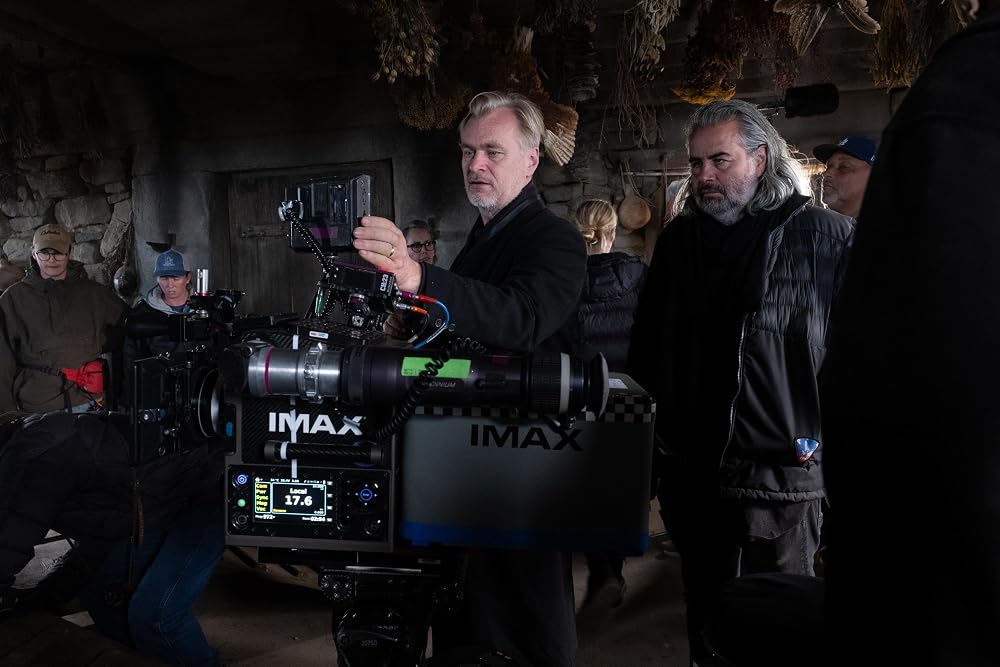
Director Christopher Nolan and cinematographer Hoyte van Hoytema work with an IMAX camera in a production still from The Odyssey. (Universal Pictures / Syncopy)
It’s been an exciting year to be a movie fan. After years of declining public interest in the art form, 2026 has brought the movies back in a big way. Just in the last few months, audiences turned their backs on the cookie-cutter, IP-fueled likes of Star Wars: The Mandalorian and Grogu, Moana, and Supergirl, while embracing original films by new voices like The Drama and Obsession. Simultaneously, the rise of repertory theaters has been a lifeline to embattled independent cinemas across the country, while introducing young moviegoers to the pleasures of classic and foreign cinema. On any given night in Los Angeles, James Cameron might show up to a 70mm screening of Aliens, or maybe Michael Mann will be at your local repertory to introduce a new cut of his 1986 classic thriller Manhunter.
And then there’s The Odyssey. Whether you love or hate Christopher Nolan’s three-hour blockbuster, it’s impossible for film nerds not to be stirred by the stories of this movie’s wide-ranging success. From sold-out 2 a.m. screenings to debates over the nuances of adaptation, The Odyssey has returned filmmaking to the center of pop culture in a way that few movies have been able to do in recent years.
The success of The Odyssey is also a success for IMAX. In the 1950s and ’60s, faced with the threat of television, movie studios turned to emerging technologies like VistaVision and CinemaScope to lure audiences back to theaters with the promise of sharper and bigger images. Today IMAX is serving the same function, promising a beautiful, massive, and clear picture that is far superior to what even the best 4K televisions can provide.
A large-scale literary adaptation, instead of a comic book or legacy sequel, whose biggest selling point is the name of the director, should be a positive omen for the future of filmmaking. But even as the industry gathers to celebrate the success of The Odyssey, there are troubling signs ahead.
Earlier this summer, the Wall Street Journal reported that IMAX was exploring a sale. Along with the ongoing drama around the Paramount-Warner Bros. merger, an ownership change at IMAX would threaten to disturb the delicate ecosystem of cinema’s resurgence, risking the shattering of a fragile moment that finds itself heavily leveraged in the future of the premier format. A mix of crazy demand, new ownership, and corporate greed could mean that we look back on this moment not as the first spark of a new age of moviegoing, but the last gasp of a dying industry.
How IMAX Conquered the Multiplex
IMAX was created in the 1960s as a new system for running 70mm film through a camera. The goal of the format was to expose more of the film’s surface area per frame to create a larger, higher-resolution picture. It first caught on for use in science documentaries like To Fly! (1976) for the Smithsonian’s National Air and Space Museum and The Dream Is Alive (1985) shot entirely by astronauts in zero gravity. Giant IMAX cameras traveled from the depths of the ocean to the peak of Mount Everest, resulting in a slew of forty-five-minute documentaries that were screened in science museums across the country. Even then, IMAX had their eyes on Hollywood, but it would take until the twenty-first century for the format to gain traction as a vehicle for mainstream narrative filmmaking.
In the 2000s, the rise of digital formats meant that filmmakers no longer had to shoot on heavyweight IMAX cameras that used very expensive 70mm film stock. The smaller digital cameras, with their convenient computerized storage systems, made them more cost-effective than any analogue format, let alone IMAX. At the same time, IMAX themselves changed their projection standards, reducing the size and aspect ratio of their screens to license the system out to multiplexes across the country. This led to the rise of what film nerds derisively refer to as “LieMax”: IMAX-branded screens that were nowhere near as large as what you would find in a classic science museum IMAX. These LieMAX screens also had a more standard wide-screen shape, instead of the square shape that was IMAX’s calling card.
The changes worked, turning IMAX from a curiosity for tourists and school groups into a central part of America’s cinema culture. Though the branding still focused on the size of the screen and the scale of the movies, the actual experience of IMAX became something closer to the best screen in your local multiplex than the enveloping, unique moviegoing experience you’d get at a Smithsonian or Kennedy Space Center IMAX theater.
A key figure in that rise was Christopher Nolan himself. Nolan was one of the first filmmakers to embrace IMAX, shooting sequences in The Dark Knight with the format, and continuing to use IMAX on every film after that. The Odyssey has made history by becoming the first movie shot entirely on 70mm IMAX cameras. It’s clear that Nolan’s use of IMAX has had a profound effect on his filmmaking style. Comparing his early movies to his more recent work, Nolan’s IMAX period has led to a greater mastery of how to stage and block action scenes, more vivid and impressionistic imagery, and an epic grandeur and sweep. Nolan might never have become the filmmaker he is today, capable of driving millions of people to go see a biopic about a theoretical physicist, without IMAX.
IMAX has been good for Nolan, and Nolan has been great for IMAX. The box office stats from The Odyssey are simply astonishing. Four weekends in, IMAX accounted for 43 percent of The Odyssey’s domestic box office, despite making up just four hundred of nearly four thousand screens the movie played on. The numbers are even crazier for 70mm IMAX, the ultra-premium format that Nolan prefers, where the movie has made $27.6 million on the mere forty-one venues capable of screening the format.
Tales from the 70mm IMAX screenings recall stories of seeing the Beatles live in 1964. People are traveling several hours, sneaking into screenings that have been sold out for months, and hauling themselves to the theater at 3 a.m. to see the movie in the best possible format.
Why American Cinema Can’t Capitalize on IMAX’s Promise
Viewers have spoken: they want to see big, original movies projected on film. Given the widespread demand for ultra-premium IMAX 70mm, the next steps should be obvious. Build more theaters — meet the demand by increasing supply. It’s clear that IMAX and their movie theater partners would stand to make a lot of money by opening more IMAX 70mm screens, and it would be great for film fans everywhere if more people had the opportunity to see big movies the way their filmmakers intended them to be seen.
And yet, according to the CEO of IMAX, it’s not possible to build enough screens to meet demand. The reason doesn’t have to do with the size of the theaters, or even the lack of upcoming movies that use the format. Instead, according to IMAX CEO Richard Gelfond, “The problem is they haven’t made new IMAX film projectors in about fifty years.”
The culprit turns out to be deindustrialization. The skilled labor required to make the specialized parts needed to run these complex machines simply doesn’t exist anymore, the kinds of jobs that have been offshored and automated away for decades. In laying off workers and closing factories, knowledge of how to build and maintain these machines has been lost to the point that, as the CEO confessed, no one knows how to make them anymore.
The same issues apply to the operation end. Showing a movie in 70mm IMAX requires trained projectionists, which used to be a good-paying, high-skill, unionized job. Today’s digital systems, in contrast, merely require someone to push a button. It may have juiced profits in the short term, but all this automation and digitization has led to a long-term decline in the health of moviegoing itself. In their haste to crush a unionized workforce, theaters degraded their own product to the point where most screens offer a substandard experience at an inflated price, expecting families to spend over $100 to watch fuzzy, underlit images projected onto broken screens.
To many, the true value of today’s IMAX experience comes in the company’s quality control. IMAX famously monitors every theater for picture and sound quality. Given that today most IMAX screens use digital projection for screens just slightly larger than the average theater, they effectively represent a surcharge on the parts of moviegoing that used to come for free: quality, clear image, and booming sound.
But while technical issues are holding back the movie industry’s ability to show big, original movies in the best format, surely nothing is stopping them from still making those big, original movies, right?
Unfortunately, even though this year’s box office is the result of a trend that has been growing for years, Hollywood remains terrified of originality. Large corporations, beholden to their shareholders, are forced to justify their big spends. It’s much easier for Wall Street to understand why a studio approved a Star Wars or DC Comics flop than an original one.
While Nolan is certainly the top director in Hollywood when it comes to commercial appeal, he’s far from the only A-lister. And yet everyone else still finds themselves forced to play along with the studios’ IP fixation. Greta Gerwig will follow Barbie with two Chronicles of Narnia films, Denis Villeneuve is making a Dune sequel and a new James Bond movie, and Ryan Coogler’s next movie is Black Panther 3. Despite the success of completely original movies like Sinners and Obsession, no one seems to be in a rush to give moviegoers more of what they’ve very clearly said they want: something they’ve never seen before.
The American Theatrical Experience Is Likely to Get Worse
So if giving customers what they actually want — more original movies in the best possible format — isn’t possible, how will everyone make money on this surge of interest? Here’s where things get dark, because if you can’t build more theaters, the industry will instead look to make more money off the theaters that already exist. Ideas floating around range from charging more for the best seats in a theater to increasing the upcharges for fancy formats to resale markets.
Taking them one at a time, AMC has already floated a proposal for putting the best seats in their theaters behind a paywall, something that would represent an unprecedented shift in tiering the movie theater experience. As for increasing the format upcharges, moviegoers already pay extra to see a movie in IMAX, but as the weeks of sold-out Odyssey screenings show, the choked-off supply has led to a clear demand crisis, one that IMAX and movie theaters will be eager to profit from.
Then there’s the question of resale. A year ago, as a publicity stunt, IMAX 70mm tickets went on sale for The Odyssey’s opening weekend. This was highly unusual; while movie presales are happening earlier and earlier, The Odyssey had not even finished production when the tickets went on sale. No one even had any idea how long the movie was going to be, let alone if they would be free to see it at 7 p.m. on Friday a year in advance.
The tickets sold out in seconds, and then many of them started appearing on eBay at inflated prices. Now with the movie in theaters, the process has been playing out again, as tickets go on sale, quickly sell out, and then appear on secondary resale sites.
This is certainly something the movie theaters have been paying attention to. As anyone who tried to get tickets to The Odyssey knows, movie theater ticket sites are not currently prepared to handle a big crush of users at once. Many people have found it more efficient to travel to the theater in person and buy tickets there than to do it online. So if a redesign and upgrade of the online ticketing portals is already needed, could resale be on the way? It’s not totally off the table, with industry and business publications taking notice of the active secondary market for Odyssey tickets. If someone’s already making hundreds of dollars off resale, why not the theaters?
The model for this sort of monetization already exists: just look at concert industry behemoth Live Nation Entertainment. Live Nation runs their own resale marketplace for concert tickets. They charge a fee for every transaction, meaning they receive a fee from a customer who buys a ticket, then another one when that customer sells the ticket to someone else.
The system incentivizes Live Nation to encourage resale; they make more money off a ticket that’s sold to a scalper who then resells the ticket than they do if someone simply buys a ticket and attends a show. And because they double dip on fees, ticket prices on the resale market must be sold at a higher price to break even, meaning even someone trying to resell their ticket in good faith must charge a higher price to recoup the initial cost.
Not coincidentally, Live Nation is one of the potential buyers for IMAX.
What an IMAX Sale Could Look Like
The success of The Odyssey has driven IMAX’s stock prices up at a very fortuitous moment. A few months ago, IMAX confirmed that they have been exploring a sale. To date, IMAX has been an independent company, meaning that every film studio and major theater chain has some kind of deal with IMAX. This hasn’t always been the case with Hollywood’s emerging technology. VistaVision, for example, was proprietary to Paramount while Dolby Cinemas, a LieMAX-style high-quality digital projection, are mostly in AMC cinemas in America.
An IMAX sale would threaten to completely upend this fragile system. Right now, IMAX’s independence allows them to act as a sort of middleman, managing the competing agendas of different movie theater chains and studios. They can opt to prioritize movies that present the best spectacle for IMAX. That’s why, last weekend, every IMAX theater continued to show The Odyssey, rather than switching out that film for Spider-Man: Brand New Day. Even though the Spider-Man movie was new and a big hit, The Odyssey was filmed for IMAX; it presented a better filmgoing experience and thus had access to the screens.
This could change under a new owner, especially given the simple logic of who would be interested in buying IMAX. A buyer would likely come from one of three places: a film studio, a theater chain, or private equity.
Among the likely buyers for IMAX would be a movie studio like Disney. But IMAX falling into the hands of a studio would almost certainly lead to that studio’s movies receiving favorable IMAX placement. Indeed, many financial analysts have suggested Disney would be a likely buyer, precisely because their new Spider-Man and Avengers movies lost out on IMAX screens to The Odyssey and Dune: Part Three. Instead of prioritizing movies that were shot on IMAX 70mm film, conceived for an experience only possible in those theaters, a Disney-owned IMAX would prioritize their own films. Instead of The Odyssey playing to sold-out theaters for months, they might have been able to squeeze in two weeks between Moana and Spider-Man, meaning that millions of film fans would be deprived of the experience of seeing the movie as the director intended.
A theater chain like AMC or Regal could purchase IMAX and preserve independence on this front, but that would lead to other issues. IMAX is currently a technology company whose tech is licensed by movie theaters. Virtually every major theater chain has some percentage of screens devoted to IMAX. If AMC bought IMAX, what would happen to all the other company’s IMAX screens? Currently, IMAX funds and assigns projectionists for major 70mm releases. Would an AMC-owned IMAX be as willing to help out a rival like Regal?
Not only that, but IMAX has far more brand recognition than any individual theater chain. There’s a reason why movie posters say “See it in IMAX,” often in a bigger font than the title of the film itself. Would a theater be tempted to rebrand their entire chain as IMAX? That would risk further diluting an already diluted brand, squandering the goodwill that the IMAX experience has built up over the years.
That leaves private equity, and the pages of Jacobin are littered with stories of what has happened to once-thriving businesses once they were acquired by private equity. Everything from increased ticket prices to pay-to-play to resale would be on the table, along with a gutting of the quality assurance at the heart of IMAX. That expensive process of monitoring every screen for quality simply wouldn’t fly with a cost-cutting mandate from a private equity firm.
As for solutions, they’re few and far between. Given its vital role at the center of film in America, maintaining IMAX’s independence should be a central goal of any sale or merger. But the government will simply never step in to prioritize the health of an art form over the cynical profit calculations of a business sale. A strong union could fight back, but as discussed, the switch from film to digital decimated the unionized workforce that used to keep movie theaters running.
The reality is that one technology company shouldn’t have this much control over the future of cinema. But there are options beyond IMAX and AMC. In addition to their IMAX screenings, The Odyssey, other major blockbusters like Sinners, and even prestige movies like Bugonia and The Brutalist have received releases in traditional 70mm and 35mm. While these formats don’t have the epic scale of a 70mm IMAX screening, they give the warm, vivid color and texture that comes with film projection. Most of these screenings take place in independent theaters, and all have a human projectionist monitoring the screening for quality control.
In the end, however, these opportunities are harder and harder to find outside of major cities. For decades, cinema has thrived as an art form because of its accessibility. Cheap prices, mass production, and wide distribution of a top-quality experience are the reasons why film survived the Great Depression, the rise of television, and the age of streaming. The threat here is not one of technology or creativity but greed. As we’ve seen in other film industry news, the future of cinema is at the mercy of a few oligarchs, and while some filmgoers choose to root for “good” ones over “bad” ones, the reality is that any consolidation will further degrade an already fragile system.