How Global Finance Drove Deindustrialization
Economist Ann Pettifor explains how America’s industrial decline has its roots in the dismantling of the international monetary system established at Bretton Woods and in the rise of a global financial system that prioritizes capital mobility over production.
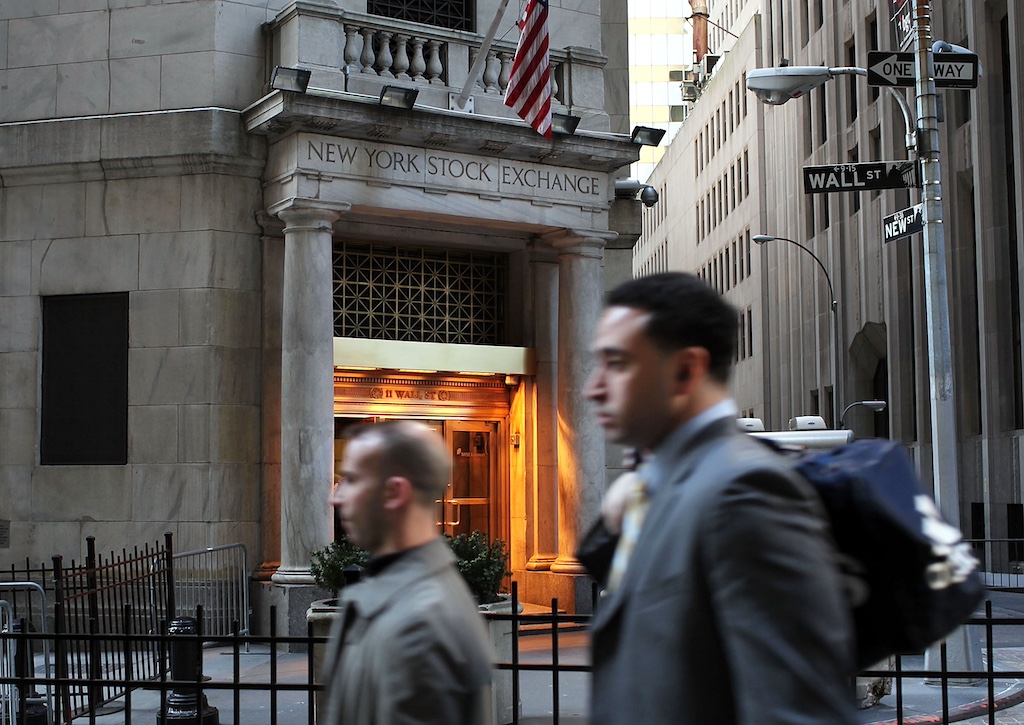
Americans are right to want to demand protection from global markets — but that would require that we restructure the international financial and trading systems. (Spencer Platt / Getty Images)
- Interview by
- Bartolomeo Sala
Economist Ann Pettifor is one of the world’s most authoritative and consequential voices on the themes of global finance, debt sovereignty, and sustainable economics. She is widely credited for having predicted the 2008 financial crisis in her book The Coming First World Debt Crisis (2006) as well as providing the main inspiration behind the Green New Deal. In 2000, she led the campaign Jubilee 2000, which resulted in the cancellation of $100 billion of debt for more than thirty of the world’s poorest countries.
In her latest book, The Global Casino: How Wall Street Gambles with People and the Planet, she takes on the global financial system, showing us how its currently deregulated, de-territorialized iteration is at the root of so many of our current crises — from the erosion of democracy and the appeal to strongmen to the cost of living essentials all the way to climate change. In an interview for Jacobin, Bartolomeo Sala asked her how this system originally came into being, how it currently works in practice, and, more importantly, what an alternative system which works for both people and the planet would look like.
Bartolomeo Sala
In your latest book, The Global Casino, you build a powerful case for the dismantling of the global financial system as it currently exists.
You show how unregulated capital flows and murky financial speculation happening in the “stratosphere” of the shadow banking system not only cause ever-frequent financial crises but are also at the root of the extractivist, export-led, imperialist orientation of most economies and the appeal of strongmen, whose ultimate promise is shelter from its volatility.
Could you tell us briefly what the bare bones of this system are? What is shadow banking? And why can it be so dangerous if left unchecked?
Ann Pettifor
Shadow banking is the manifestation of [Friedrich] Hayek’s utopian ideal of denationalizing money, the idea that money can and should be detached from regulatory democracy. As I argue in the book, it is a system that began in Chile with the privatization of pensions. What happened was that the combination of the privatization of pensions and the deregulation of capital flows — those two changes in policy that happened in the 1970s and 1980s — led to the funneling of the world’s pension savings into institutions, first pension funds and then asset management funds like BlackRock, which, with time, soaked up more and more of the world’s savings.
The problem with that is that eventually they accumulated funds at a scale that cannot be deposited in a high street bank or in a main street bank. If you’re managing a billion dollars, you cannot put it into a normal bank. Out of the creation of such institutional funds, you then get the creation of a market called the shadow banking system — a market in money that operates beyond regulation. Asset management funds, hedge funds, and other kinds of institutional funds still have to maintain the value of their assets.
They can’t hold it as cash because cash doesn’t earn interest. You are holding Mrs Jones’s savings, and you need to invest these money into something that will generate returns and that will enable you to pay her pension in thirty years’ time. In other words, you need to invest your cash into an asset that is interest-bearing.
Now, the best way to do that is to lend money to someone else who needs cash. A hedge fund thinks — or rather, a guy owning a hedge fund might think he wants to buy a new AI company that’s been set up in California somewhere. He needs billions, you know, at least $100 billion. That’s “big potatoes,” as Damon Runyon would have had it, are you familiar with his writing?
Bartolomeo Sala
No, I am not actually.
Ann Pettifor
I suggest you look him up; he writes stories about New York gangsters. Anyway, the point is, they need $100 billion. They go to the asset management, and the asset management says, “Yes, we will lend you $100 billion, but you are going to have to pay a rate of interest on that.” In other words, we will lend you $100 billion, but you’ve got to pay us back, I don’t know, $110, $120 billion. That’s how they create new money for themselves, essentially. The hedge fund promises to pay, and the asset management fund uses this promise to pay to leverage additional finance. It is a system based on very big-scale money and great risks, especially for individual pensioners.
What really bugs me, though, is that while this is the culmination of the Hayekian fantasy of a deregulated economy, it is at the same time tethered to the Federal Reserve, the Bank of England, the European Central Bank, and the Bank of Japan. So in the event of a crisis — as we saw back in 2007, but again in 2020 and again in the failure of Silicon Valley Bank and the failure of Credit Suisse — when the shadow banking system is in trouble, the Federal Reserve bails them out effectively. These guys are trying to have it both ways: they want to be beyond the reach of public authority but nevertheless be sycophantic in the case of losses.
It’s that injustice for me that is crucial, and it seems to me outrageous that the public doesn’t understand this. Now, having said that, I am also clear that the public do understand. They do know that the 1 percent get bailed out periodically and do very, very well, and that they, the 99 percent, have been doing very badly. The reason I wrote this book is I would like them to understand the mechanics a little better.
Bartolomeo Sala
In the second chapter of your book, you identify President [Richard] Nixon’s decision to break away from the financial architecture of the postwar years, Bretton Woods, as the ground zero of the current deregulated global financial system you just described.
This history is very striking, first because it shows how the financial system in its current form is not “natural” but that it is a relatively recent invention; and second, because it draws a direct line between Nixon’s decision and the election of Donald Trump fifty or so years later. It feels almost like a foregone conclusion.
Can you tell us why Nixon’s decision was so momentous? And how it did in effect give us Trump fifty-odd years later?
Ann Pettifor
You need to know that I am very influenced by Karl Polanyi and his book The Great Transformation, which explains that what happened in the 1920s and 1930s was effectively a response to government by markets.
When I first began understanding and talking about the Nixon shock in the 1980s and 1990s, economists tended to speak about it as a minor affair. They still do. They thought it had some impact on the American economy, but they didn’t regard it as a breakdown of the architecture of Bretton Woods as such. I am convinced that’s how we should understand it, because Nixon was incredibly reckless. But to understand why he was reckless, we have to go back to 1945.
The year 1945 is when they built a managed, regulated financial architecture — I like to use the term “architecture” because it is something that was built — and they did so in reaction to what happened in the 1920s and the 1930s. The men and women at Bretton Woods sat down and said we must never ever allow that to happen again, to have financial imbalances and trade imbalances explode in the way that they did in the 1930s. To do that, we have to manage exchange rates and trade balances, and so they began building this architecture. [John Maynard] Keynes, in particular, was very clear about this because he understood what J. A. Hobson, the famous economist and author of Imperialism, had explained in the early 1900s.
Bartolomeo Sala
Oh yes, this is the argument that export-led economies have a tendency to get into trade wars, which often turn into actual wars. . .
Ann Pettifor
Hobson had explained that Britain had industrialized and built up financial surplus in the City of London. However, when that surplus had grown to a certain amount, rather than investing it back into Britain, the City of London chose people like Cecil John Rhodes to invest it in a country like South Africa, where I was born, because there the capital gains you could make were simply much higher than what you could make at home by investing in Manchester.
Meanwhile, in Manchester, people’s wages were low, falling in real terms, or are stagnant, so they’re not able to consume all that is produced by the export sector. Because they don’t have enough income to do that, then that’s partly why Britain moves from exploiting South Africa to exploiting India and other markets. The consequence is that you get both overproduction and underconsumption at home. But above all you get imbalances, you get countries in surplus and countries in deficit.
That leads to the sort of tensions that Keynes and his colleagues were opposed to in 1945. Your standard economics, your traditional neoliberal economics, teaches that really all economies should be export-oriented, and should be earning hard currency. Now the problem with all of that is you also get inequality at home, which breeds political tensions and hatred. As Polanyi explained so clearly, the public realizes that the market is saying to ordinary people, “Sorry, but we can’t supply you with life’s essentials. We cannot afford a roof over your head. We cannot afford decent health care. We cannot afford for you to go to university,” and so on. Rather than being governed by politicians, you are being governed by markets.
I mean, we see this very clearly in Britain. When I was young, to be a politician was to exercise political power, because in those days the British government owned the water companies, the electricity energy companies, the broadcasting services. The politicians decided on the allocation of resources into those sectors. Today they don’t do any of that. That is all being done by markets, private markets. We’ve hollowed out our political institutions; they are powerless and we can see how weak and powerless they are.
All the public is doing is saying, “Give me a strongman to protect me from markets that strip me of the right to a decent roof over my head, food, education, health,” etc. This is a very natural response. However, as Polanyi also explains, by looking for a strongman, what the public does is make things worse. Meanwhile, centrist politicians don’t have an answer to what to do about the government by markets. They say, well, we’ve just got to put up with them. And that impotence of our political class is what makes us turn to strongmen, even if they ultimately make things much worse.
Bartolomeo Sala
In the book, you explain how Nixon’s decision of decoupling the dollar from gold initially caused a devaluation of the currency. With time, though, the dollar turned into a global reserve currency that directly impacted the US’s manufacturing and export capabilities. How does a strong dollar concretely lead to the destruction of the US’s industrial base? And how does this lead to Donald Trump?
Ann Pettifor
What Nixon does is to remove global regulation. Soon after the shock, they decided to lift exchange controls as well as controls over the cross-border mobility of capital, and that made it much easier for capitalists to move their money across the world effortlessly.
However, the key point about it is that for many years gold wasn’t used in the same way as it had been used under the gold standard. It was simply used as a kind of comparator for your currency. Your currency had to have a basic relationship to the price of gold, and you had to keep it within bands relative to the value of an ounce of gold. And that was simply a way of saying, you have to manage your economy so that your currency does not rise too high or too low. And that means you’ve got to be exporting, but you’ve also got to be importing. And you can’t overdo one and not the other.
One of the things that happened after Nixon is economists said, “No, no, we don’t have to manage trade, the market can manage the trade. Global markets, they will be able to sort out the trading system. We can trust the market, right?” And so now the situation is: China becomes an expert at building iPhones. It sells iPhones to the US economy and makes huge capital gains from that. Rather than taking that money and investing it in China and raising incomes in China, he invests it in US Treasury bills. Now, Treasury bills have become effectively the world’s gold standard.
And that led to, as I say, these massive imbalances. The United States becomes the world’s consumer of last resort and China becomes the world’s producer of last resort.
Bartolomeo Sala
And how does this concretely lead to the election of Trump?
Ann Pettifor
Trump’s advisor Stephen Moran — who’s on the board of the Federal Reserve now — has written a paper saying they want to limit the flow of capital into the United States. And there’s a think tank, American Compass, led by Oren Cass, which also argues for capital controls, inward controls effectively.
What they don’t say is that they have come up against Wall Street. Because while Trump might want to have to weaken the US dollar and increase and manage inward capital flows, Wall Street isn’t going to have it because Wall Street makes its money from the capital inflows that Trump and co. claim they want to restrict. Wall Street will not tolerate limits on capital inflows unless it has a government like that of President Roosevelt. And I don’t think Trump has the strength or the power or the intelligence that Roosevelt’s administration had.
Americans are right to want to demand protection from global markets — but that would require that we restructure the international financial and trading systems. However, in the world of free markets, the ideology of free trading markets is even more powerful than the ideology of free capital mobility. If you read the Financial Times, people who talk about managing trade are treated as mad Trotskyists. I dare not say it because I don’t want to be branded as a mad Trotskyist, I’m just a very moderate Keynesian, for God’s sake. But even my moderate views are considered extreme in the world of free markets. And how we overcome that ideology is the issue that we face.
Bartolomeo Sala
Far from a rarefied activity happening in some distant realm, global finance is ultimately tethered to the real economy.
Indeed, as you discuss very well in the body of the book, it has a parasitic tendency to find ways to commodify everything into assets on which it can bet and charge rents. I have in mind prediction markets apps such as Kalshi and Polymarket, whose unique selling proposition is that they can turn everything, even opinions, into tradable assets.
Can you tell us more about this relationship? Is this situation sustainable long term?
Ann Pettifor
The problem they face is there’s a finite amount of real assets. I have a chapter in which I talk about the importance of assets and, above all, the valuation of assets. The issue we face now is there’s so much debt leveraged against them. I never quite remember the numbers on this, but it’s $300 or $400 trillion out there in financial assets, while there’s $100 or $110 trillion real income from the real economy. Those financial assets have to find somewhere where they are being used to leverage additional debt, because quite a lot of those assets are also liabilities. They’re also debts, really.
Here is this finite economy called the world economy. It can shrink. It can get blown up by war. It can be wiped out by climate change. What then happens to this enormous amount of debt that’s out there? That’s the kind of cancer at the heart of today’s global financial system.
If you think about Elon Musk, he does not live on income. Musk simply takes out a loan against the value of Tesla. He says, “Look, I’ve got shares in Tesla and they’re worth, say, $30 billion. Give me $1 billion to spend on going on holiday or whatever.” He uses an existing asset to obtain income and then of course he doesn’t pay tax on it because it’s all debt. This is what’s so evil about the rich, it’s this debt-based economy that is unstable relative to the world’s income, but it’s also unstable relative to the real finance, the real assets of the real economy.
We have a very moving story in Suffolk at the moment where people who live near the sea are literally having their houses demolished because they’re being rushed away by the sea. These people are finding that the value of their homes is collapsing. They have borrowed huge sums of money to buy that house, they’ve got the debt, and now they’re losing the value of the asset. And that’s been eroded by climate breakdown, essentially. In a microform, this is what’s happening to the global economy as well.
Bartolomeo Sala
A central preoccupation of the book is how global finance acts as a powerful fetter to any chance of tackling climate change. You end the introduction, I think very provocatively, by saying that the idea of cutting greenhouse gas emissions and restoring climate stability is simply futile and delusional until we, the people, take back control, taming and subordinating the financial system to serve the interests of both the biosphere and humanity, not just, as at present, the interests of wealth.
This will sound heretical, not only to many economists but also to many well-meaning environmentalists who have bought into the neoliberal playbook and think that effective markets could act as a panacea for every crisis, including the climate. How does financial gambling exacerbate the climate crisis?
Ann Pettifor
I wanted to provoke the environmentalists and to challenge them on the fact that they live in a silo, which is called the ecosystem, the biosphere. I am perhaps being unfair because they do care about what’s happening in the economy. But this failure to see the financial system means that we can never really get around to doing what we need to do to curtail fossil emissions.
What I’m trying to argue in the book is that the financial system provides rocket fuel to the fossil fuel sector. They do so because fossil extraction is much more profitable than clean energy, but also for another reason, which is rate of interest. Now, the rate of interest, people think of it as something obscure, a percentage, which indeed it is. But the rate of interest is effectively the rate of return on an investment. Rather than simply a profit, it’s a capital gain, and it is something that rises mathematically. If you apply interest to a loan, that interest can rise exponentially over time.
What the rate of interest then requires is an exponential rate of extraction of the Earth’s finite assets to satisfy the interests of creditors. As I always explain, Brazil has to strip its forests, has to fish its seas, and has to degrade its land in order to raise the money it needs to repay its foreign debts. The same applies to ordinary people. In America, many of them are heavily indebted. They have to work very long hours and take up more than one job in order to repay mortgages or health bills or whatever. That rate of extraction concerns not just human labor but also green resources of the Earth.
What you have to do to stop the rate of extraction is to switch off the spigot. You have to turn off the tap and lower the rate of interest at which money is lent. If you’re going to invest in a green economy, you’ve got to transform your economy. You’ve got to retrofit housing. You’ve got to build flood defenses. That’s an awful lot of money and you shouldn’t expect to make massive capital gains from that. But you need to be able to do it all the same, and therefore you need to have low rates of interest. So, for me, there’s a line that goes between the economy, the financial system, and the ecosystem, which is called the rate of interest.
Bartolomeo Sala
In the last chapter of the book, you set out to provide a series of recipes for a world in which finance is not allowed to run wild on the biosphere and society. Some of these recipes, such as capital controls and a Tobin tax, are straightforward enough, if easier said than done.
What caught my attention, though, is the overall framework you are proposing. Basically, you are calling for a rolling back of globalization and a reshoring of economic activity within national boundaries as well as a general call to “living within your means,” which I take to mean a balance between imports and exports and a focus on domestic demand, as well as on ecology and climate.
Can you tell us why this is not some sort of nostalgic return to an era before globalization? And why do you see this return to sovereignty as the only guarantee for lasting democracy and peace?
Ann Pettifor
I think for me it’s mainly environmental. I begin with the view that, and I put it very crudely, in Britain we have to learn to grow our own green beans. In Britain, we expect to have fresh green beans on our tables every day of the year, and we expect to draw down Kenya’s water table and exploit its cheap labor so that we can have green beans every day of the year. That has to end. We’ve got to learn to grow our own green beans. We can’t prey upon the assets of others for our own economic well-being.
At the same time, I want to be very clear, I am not a nationalist. I believe it must be possible for a government to respond to its electorate and act in their interests. For me, that’s democracy. At the same time, I don’t believe we can achieve that degree of autonomy without internationalism. We can only do it by actually cooperating. I’m arguing that there must be a much greater emphasis on environmental self-sufficiency. However, that is not nationalism, that is internationalism in my view. That is saying that we want to cooperate with our friends and partners across the world. We don’t want to exploit and extract assets from them. It’s as simple as that.
What always strikes me about the great financial crisis of 2007–9 was that the Left didn’t know it was coming. I am very proud of having written The Coming First World Debt Crisis (2006), but the rest of the Left didn’t see it coming. People talked about globalization as if it was a given. And then when it blew up, there was no plan B. We didn’t even know it could happen. We were as stupid as the chair of the Federal Reserve, Alan Greenspan. The Left was as stupid as Greenspan, who said he didn’t believe it could happen.
Meanwhile, Wall Street couldn’t believe its luck because it then consolidated itself and became stronger than it had ever been. Before the financial crisis, it could go bust. Since the financial crisis, no Wall Street bank can go bust anymore. They are now guaranteed; they’re too big to fail. I think it was the failure of the Left not to have a plan B. So I’m offering a plan B. It might sound utopian to some, but let’s debate and let’s discuss. And has anybody else got any better ideas? If they do, I’d be really pleased to hear them.