Christopher Nolan’s The Odyssey: A Dissenter’s View
I know I’m in the minority here. I really did try to like it. But Christopher Nolan has taken the wiliest, most delightful hero in Western literature and turned him into one more Nolan sad sack, trudging guilt-stricken through a gray and godless world.
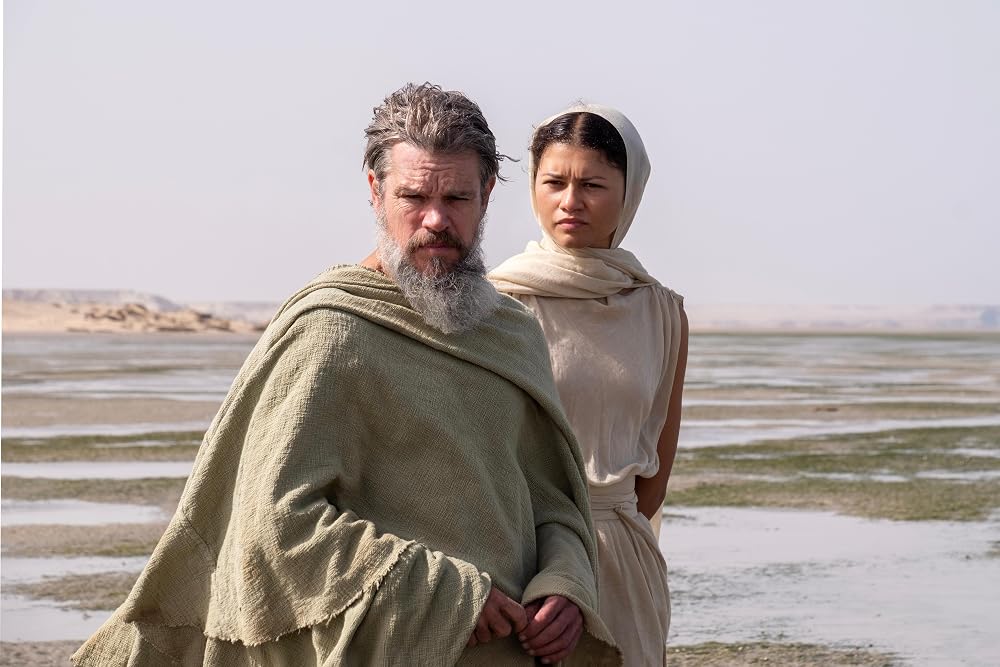
Nolan chose to adapt Homer’s foundational epic into the dull, depressing plod of a sad-sack everyman wandering through an almost entirely gods-free landscape — and a dull landscape at that. (Universal Pictures / Syncopy)
Should I lead off with how much I hate Christopher Nolan movies in general, or how much I hate Christopher Nolan’s The Odyssey in particular?
I’m so aware of my hatred for Christopher Nolan movies in general that I tried sincerely to suspend that hatred in order to watch The Odyssey. Partly because the advance word was so full of praise, even from certain scholars of ancient Greek vouching for the film’s greatness, that I thought maybe Nolan had finally found the right material for him.
But really, I tried to suspend hatred for my own sake — I don’t want to risk having a stroke from sheer rage, after all, because I know everything Nolan does makes insane amounts of money and wins awards, and everything I say about him is lost in the tidal waves of love for his godforsaken cinema. I had to suppress such thoughts in order to stay in my seat for three hours to witness his latest effort.
It was no use, of course. Typically, Nolan chose to adapt Homer’s foundational epic — that wild, fraught tale of the wily warrior Odysseus’s sensational ten-year trip home from the Trojan War, loaded with sex and violence and gods and goddesses and hubris and horror — into the dull, depressing plod of a sad-sack everyman (Matt Damon) wandering through an almost entirely gods-free landscape — and a dull landscape at that. The only god represented is Odysseus’s advocate Athena, and she’s played by Zendaya with all the drab ordinariness of a good-looking young woman in odd clothing sitting there waiting for the bus.
No Zeus, no Poseidon, no Hades. Nothing but a few lines from Athena about how the gods manifest themselves in the elements like fire, blood, storms. That could work too, if Nolan had any ability to capture the eerie expressivity and atavistic power of those elements. But he doesn’t. Show Nolan a storm-tossed ocean, and he can no more get a decently dramatic shot of it than fly to the moon.
A dreary realism is the rule of Nolan’s cinema. Nolan’s chromophobia is well known by now, and the rich, colorful world of the ancient Greeks is portrayed in bleak blues and browns. About a quarter of The Odyssey looks like it was shot on the flat, windy, sun-whitened beach in Santa Monica, with a wan-looking Charlize Theron as Calypso draped in the latest in resort wear for women of a certain age.
But those scenes were actually shot at White Dune, a beach near Dakhla, Western Sahara. You may have heard that this land has been brutally colonized by Morocco for the past fifty years, and that therefore Morocco’s sovereignty over it isn’t recognized by the UN or most other governments. It was only recognized by the US government in 2020, when Donald Trump decided to make such recognition a matter of quid pro quo, in exchange for Morocco’s “normalization of ties with Israel.” Nolan’s The Odyssey is the first Hollywood production to shoot there, which was protested in an open letter signed by film-industry leftists such as Javier Bardem and Pedro Almodóvar.
“This occupying force is practicing cultural genocide against the Sahrawi people, ethnic cleansing,” says María Carrión, the executive director of the Western Sahara International Film Festival. “By staying silent for one year and then using this footage, Nolan has basically become an accomplice to Moroccan occupation of Western Sahara.”
Before I plunge into the other distressing details of watching The Odyssey, one question: If you’re a leftist and a cinephile and a fan of Christopher Nolan, like many of my colleagues at Jacobin, why is that? It’s not as if he’s such a cinematic genius — an Andrei Tarkovsky, say, or Akira Kurosawa, or David Lynch, or Bong Joon Ho — that it would be truly painful to think badly of him or his work. Nolan’s a middling maker of huge-budget commercial popcorn movies who deludes himself that he’s got big ideas. Whatever Nolan’s personal politics might be, those ideas generally turn out to serve a viewpoint typical of right-wing conservatives. If you don’t think so, maybe rewatch The Dark Knight Rises (2012), Interstellar (2014), or Oppenheimer (2023) with your political conscience activated this time.
If you still can’t see the Tory that lurks within British-born Christopher Nolan, who’s adjusted to the worst of US culture all too well and knows how to feint toward “woke” attitudes only to settle back into reactionary smugness almost every time, I include my reviews of The Dark Knight Rises, Interstellar, and Oppenheimer here, here, and here.
As for The Odyssey, one of Nolan’s big ideas is that war is hell, and Odysseus always thought so. That’s why he seems to be trudging under a load of dread and guilt before he ever goes off to fight. Even an occasional Greek scholar-translator, such as Daniel Mendelsohn, got a bit dismayed by such a radically altered Odysseus:
“This tormented, guilt-ridden Odysseus, stripped of humor and wit, seductiveness and cleverness, is a sibling of Memento’s anguished amnesiac, of Batman, of Oppenheimer, men tormented by pasts they wrestle with in different ways,” wrote Mendelsohn, whose Odyssey translation came out in 2025. “Nolan has merely remade Homer’s hero in his own image.”
I wouldn’t care so much about the accuracy of the portrayal — I’m not going to join the online brigades who’ve all suddenly revealed themselves to be learned classicists in order to comment on this movie — if it didn’t turn the film into such a spiritless bummer. This Odysseus has just one moment of the damn-I’m-good glee of a celebrated warrior, when he first shoots the arrow through the lineup of axes. Otherwise, he’s so lacking in élan, mental sharpness, or charisma, it’s entirely expected when his men, steadily dwindling in number, start to rebel a bit. In fact, it seems amazing that they’ve followed him so long.
It’s worth recalling the broad aspects of Homer’s Odyssey if only to try to figure out, by grappling with Nolan’s strange interpretive choices, what on earth Nolan thinks he’s doing.
Nolan hammers away at “xenia,” for example, the ancient Greek concept of guest-friendship that’s a big deal in the Odyssey. It mandates welcoming strangers as warmly as if they were gods in disguise — which they might be. That’s the theme Nolan uses to give the film a topical angle. Obviously, the current immigration policies in the United States are anything but guest-friendly, and the dopey, deadly racism and xenophobia of the Trump administration are a national disgrace. In case you don’t get the topical allusions, Nolan has as a final scene Odysseus and his long-suffering wife Penelope (Anne Hathaway) gazing off at the horizon and exchanging somber statements predicting that “civilization will rise again” even after the Bronze Age is dead, killed by violations of xenia! Yet people in the future will make the same kind of mistakes, as literacy comes to an end!
Nolan expands the concept of xenia to the point that it begins to overlap with the war-is-hell thing, so that the waging of war becomes another violation of Zeus’s law. And you don’t have to be a scholar to feel that, surely, that can’t be anything an ancient Greek ever thought. Even high school memories of the Iliad and the Odyssey as assigned reading — that was in the old days, when tough reading got assigned routinely and nobody thought it was weird — plus the plentiful pop culture references to the Odyssey all over the place, are loaded with thrills, and among those thrills is winning gory battles through brilliant cunning. Odysseus’s Trojan Horse ploy is the most famous example of it.
But Nolan goes directly from the dire conditions within the Trojan Horse — which for some reason is half-buried in sand and surf, with Odysseus’s men on the lower levels drowning inside it, another example of not-so-cunning leadership — to the sacking of Troy. And during that, Odysseus is even sadder than he’s been through the whole movie, clinically depressed by this point, trudging through Troy in shallow focus while blurry mayhem goes on all around him. Very subdued mayhem, by the way. Anyone who’s seen images or read anything about the worst carnage of war could come up with more brutal, gruesome, and heartbreaking imagery than this, but Nolan has committed himself to a tamped-down aesthetic that must never, ever get too exciting or appalling.
There are a couple of good scenes in The Odyssey, though. The Cyclops sequence, which is perhaps the one everybody knows at least vaguely, starts off extremely well. All it takes is men trapped in a big dark cave, firelight flickering on the walls, and that gigantic terrifying one-eyed creature looming up at them. The design of the creature, and the way he’s enacted by Bill Irwin, is actually imaginative. But even that sequence is botched in various ways, such as the messily edited escape scene when the men half-rush out, then confusingly rush back in, then try it again in a way that drains away the suspense. Plus there’s that distractingly hilarious bit when the Cyclops — aka Polyphemus, son of Poseidon — lies down to go to sleep, poignantly folding his hands under his head like a child, when silence is of the utmost importance, and Odysseus announces to his men in a loud stage-whisper, “I think he’s asleep!”
There are a lot of unintentional laughs to be had, actually. For example, Nolan was clearly anxious that people wouldn’t get what’s going on in the land of the lotus-eaters — for good reason, actually, since there’s no indication that Calypso, whom Nolan incorporates into this episode though she occupies a separate one in the source material, has been deliberately drugging Odysseus for years in order to keep him there. Or that he’s drugged right now; he has the same dazed, woeful expression he wears through most of the film.
She has to tell him, and us, finally, what’s going on. Nolan has Calypso say sternly to Odysseus, “Stop eating lotus flower!”
And Odysseus, mid-gobble, mewls in the plaintive tone of Homer Simpson about to be deprived of his doughnut, “But I love it!”
The Circe sequence is effective the whole way through because Samantha Morton plays her with wonderfully lurid anger, and because out of nowhere, Nolan decides to portray in a visceral way men being turned into pigs under Circe’s hands, as she cruelly pulls their flesh into porcine shapes. All of a sudden we glimpse the sensational epic that might’ve been. If we don’t get the thrills of the earlier adventures, there’s no poignant contrast with the later sorrows and emotional pangs of loss and desolation when Odysseus returns home at last, disguised as an old beggar, his beloved home degraded by hard-partying suitors camping out, holding his family captive.
A good example of the blah effect of Odysseus’s homecoming in Nolan’s adaptation is the absolutely anticlimactic scene of his brief reunion with his dog Argos. So much Argos buildup through the movie, and then Nolan botches it with his strange tendency toward boring mid-range shooting, wrong camera angles, and chilly emotional remoteness. There’s the ancient Argos lying there, having lived years beyond his natural lifespan just in order to meet his beloved human once more on earth. There’s Odysseus, hooded and disguised and unrecognizable to everyone else, but known at once by his loving dog. How can this not be the most tear-jerking scene ever shot?
Well, Nolan has apparently never met a dog. So he has no ability to characterize a dog’s ecstasy at such a longed-for reunion, which would manifest itself everywhere on the dog’s face and body, even on an old, dying dog. How Argos would’ve struggled to lift his head, how his body would’ve trembled as he tried to get up! None of that happens, and Argos hardly even looks like a real dog anyway, making you wonder if this is one of the few CGI bits in a film touted for its practical effects. Nolan immediately cuts to the inert back of the dog so we can witness the tepid wag of Argos’s tail.
That’s it. That’s the whole scene.
But really, what’s the point of going on about it? Whereas I’m paralyzed by Nolan’s grand dullness, vast audiences rave about how exciting his films are. Where I see bewildering choices in adaptation, so many examples of ineptness in filmmaking, such an absolute inability to empathize with and then convey emotion or visceral effects, others laud his genius at everything. To me, Nolan’s a kind of Cecil B. DeMille variant of our times. Worshipped in his own day for his big, always-popular Oscar-winning spectacles, DeMille’s now generally considered a notoriously vicious right-winger and A-list Hollywood hack. And that Best Picture Oscar he won in 1953 for his dumb, lugubrious circus movie, The Greatest Show on Earth, is often noted as one of the most shameful awards ever given out by the Academy of Motion Picture Arts and Sciences.
Though to give him his due, at least DeMille was a showman unpretentious enough to know he was in the entertainment industry.
If humanity survives a few more decades, people may very well look back in amazement at the lasting popularity of, and excessive critical praise for, the many long, ponderous, enervating, ultimately enraging films of Christopher Nolan.