Class Traitors Are Welcome in the Socialist Movement

New York media has had a field day digging into the backgrounds of socialist leaders like NYC-DSA Cochair Gustavo Gordillo. But what exactly is the “gotcha” — that some people who lead comfortable, secure lives want security and comfort for everyone?
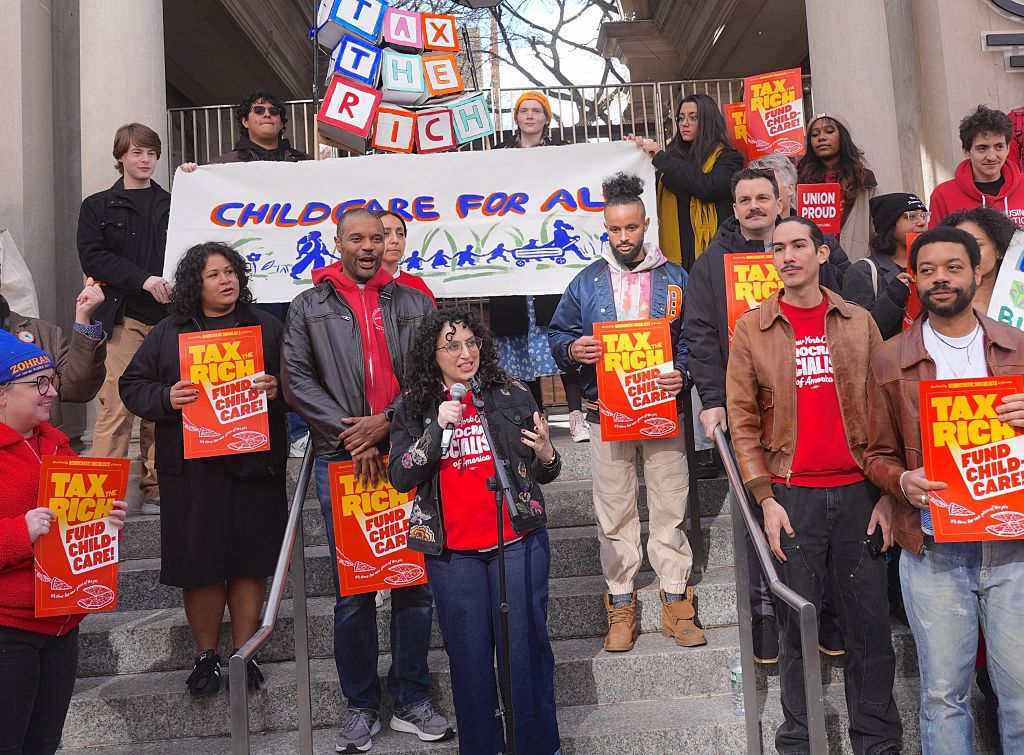
New York City Democratic Socialists of America hold a rally in Union Square marking the start of a campaign to tax the rich and win universal childcare on November 16, 2025, in New York City.

With the socialist movement on the rise in the United States, the media is getting desperate in its attempts to halt its momentum with absurd and nonsensical attacks on the background of individual socialist leaders like Gustavo Gordillo. (Selcuk Acar / Anadolu via Getty Images)


We are in a moment of particular fascination with the Democratic Socialists of America (DSA) across the nation. With the victory of congressional candidates like Claire Valdez, Darializa Avila Chevalier, Chris Rabb, and Melat Kiros, DSA has arrived on the political stage, proving that the election of Zohran Mamdani was not a fluke but a harbinger of a growing movement. Outlets like Fox News have seized on all sorts of DSA content, from interviewing cochairs and National Political Committee members to, for some reason, breathlessly reporting on a Y2K-themed prom fundraiser thrown in Los Angeles.

That coverage took a turn last week, with the press and pundits obsessing over Gustavo Gordillo, the democratically elected cochair of the New York City chapter of DSA, a thirty-eight-year-old former union electrician who has had his personal life suddenly put under a microscope as if he were Princess Diana. He’s not the first; it’s happened to other DSA leaders before him, such as Cea Weaver.

Over the past week, local and national media have desperately tried to get readers and viewers to care that Gordillo lives in a house purchased by his father. A New York Times profile quickly turned into a long investigative saga by multiple outlets; for some reason, the local public radio station’s outlet Gothamist trekked to an anarchist bookstore to ask patrons about the story. (Spoiler: turns out nobody there really cared.) Numerous column inches have been dedicated to this story; city council members have weighed in; journalists now are camping outside the Brooklyn row house. Maybe the paparazzi will be outside the next chapter meeting.

The intent here is to delegitimize DSA by “exposing” the “hypocrisy” of its leaders. But it’s not quite clear what the “gotcha” is supposed to be. The underlying message seems to be that Gordillo shouldn’t believe in and be organizing for a better, more equitable world because his father, like most parents who have worked hard throughout their lives, wanted to leave his children (Gordillo and his brother) with the economic stability that a house provides.

The home was, according to the Times’ reporting, purchased in 2019 at barely above the median home price in Brooklyn at the time — hardly the stuff of the ultrawealthy. Even with its appreciation since then, the house is less than a third of the threshold of Mayor Zohran Mamdani’s new pied-à-terre tax, on second homes worth over $5 million. (And, of course, the house is not a second home.) This is, unfortunately, just what homes tend to cost these days, which one would think the Times would know.

But even if we were talking about a 1 percenter here, what’s the upshot? That someone who is leading a relatively comfortable life has chosen not to zealously defend that wealth and selfishly bask in its splendor but rather to fight for a world where everyone is able to have their needs met? Sounds like a good thing to me.

Of course, from the New York Times to Rupert Murdoch’s press, these are institutions that largely express elite concerns, and elites are not happy about the rise of socialist politics in this country. They dress up these attacks in the language of “hypocrisy,” with the implication that because we are a socialist organization, we want to hunt down every moderately comfortable person with torches and pitchforks. Obviously that’s not true, and they know it; even the most ambitious DSA program advocates a world with an equitable, democratic economy. We advocate that those with means contribute more, and we’re happy to have anyone who believes in that goal of a better world participate in our project — even someone who, God forbid, owns a home.

If you asked me to psychoanalyze the reactionary commentariat, I’d say their guilty conscience is resurfacing as they’re forced to consider why someone who isn’t struggling themselves would have the audacity to want to help others. These people, many of whom are from far more privileged backgrounds, feel ashamed to think that they could be doing more with their class position — that they in fact owe it to others to do more. In response to such anxieties, they turn to retribution. Maybe an enterprising journalist should take up such questions with the authors of these pieces on Gordillo.

The Murdoch press love to facilitate this kind of pile-on. They have a particular obsession with whipping up a hate frenzy against particular DSA members to make examples of people fighting capital. For example, the New York Post recently attacked Grace Ryan, who has supported progressive New York congressional candidate Brad Lander and volunteered as a DSA organizer, for her father’s background as the owner of a chocolate company.

Socialists shouldn’t be fazed by these attacks. Many leaders on the broad left, from Marxists to liberals, emerged from a downwardly mobile professional class — some frustrated with a fragile class position, others perfectly comfortable in their wealth.

Vladimir Lenin, Maximilien Robespierre, Mahatma Gandhi, and Fidel Castro all studied law. Leon Trotsky was originally a mathematician and mechanical engineer. Simón Bolívar came from one of the wealthiest families in the Americas; Rosa Luxemburg came from a well-off family in Russian-occupied Poland. Che Guevara was a doctor. Giuseppi Garibaldi was a teacher; Giuseppe Mazzini was, you guessed it, a lawyer.

Even the earliest socialists were class traitors: Friedrich Engels came from a wealthy business family and used that wealth to support Karl Marx. And Marx’s father? Another lawyer.

We could go on and on. Franklin Delano Roosevelt came from a famously patrician family yet oversaw the greatest expansion of social welfare and other pro-worker policies in American history.

These figures took up progressive politics and organizing because they saw social injustices they wished to correct. Looking behind the curtain of their deeply unequal societies revealed to them the exploitative and brutal nature of the system, even if they were benefiting from it. Confronted by the failure of the institutions that once supported their class, they made a choice — a choice to fight on behalf of others.

These figures subsequently became part of mass movements composed of all class backgrounds, and that is what DSA represents today. Obviously Gordillo is not Simón Bolívar. (At least not yet — there’s always time!) But he is a representative of a fast-growing, mass movement, one of many leaders from various class backgrounds who form a bloc of diverse organizers.

I live in Los Angeles and organize with the DSA chapter here. I attended what may generously be called an “elite institution,” the University of Southern California, on scholarship. But I have comrades within the organization who have been undocumented or homeless. DSA’s elected officials come from all walks of life: our slate of DSA-LA electeds includes Hugo Soto-Martinez, a champion for workers and tenants who is the son of street vendors, a former union organizer, and the sole renter on city council.

It’s been a very long time since the United States saw a socialist movement of this size, and DSA is in its relative infancy. That this movement includes people of all stripes shows the breadth of the demand for societal change. The obsession with the class position of a few members pretends that the fight for socialism is simply an elite concern that ordinary people do not understand. Not only is this not true, it is backward: socialism is a concern for the shared humanity of everyone, a concern that those from “comfortable” walks of life can also come to grasp.

These ideas are increasingly understood by people of all walks of life. We know 58 percent of Democrats have a positive view of democratic socialism, and 46 percent of all Americans ages eighteen to thirty-four view democratic socialism positively. And democratic socialists are winning over voters of color: Claire Valdez won every age bracket and racial group in her district, Darializa Avila Chevalier decisively won black voters in her district, and incumbent democratic socialists like Alexandria Ocasio-Cortez and Rashida Tlaib have long represented majority-minority districts.

It is because of our growing power that the establishment is trying so hard to discredit this movement. From Los Angeles to New York, the same attacks are being recycled against the Left by a rotating group of talking heads. But socialism is growing because it’s rooted in the real, material struggles of peoples’ lives.

That movement has to have workers at its core. I also hope it includes socialist chocolate heiresses who want to knock doors and former sculpture Master of Fine Arts students. It’s a testament to the strength and appeal of the organization that we take all sorts, and it’s a testament to how out of touch the establishment is that these are the attacks they’re forced to trot out.

Gordillo may be living in a house his father bought him. But it’s DSA that’s living rent-free in our critics’ heads.