DSA’s Critics Are Missing the Point About the Working Class

In response to the Democratic Socialists of America’s big electoral wins, some are eager to write it off as a movement of elite professionals. These criticisms miss a lot about both DSA and the changing working class.
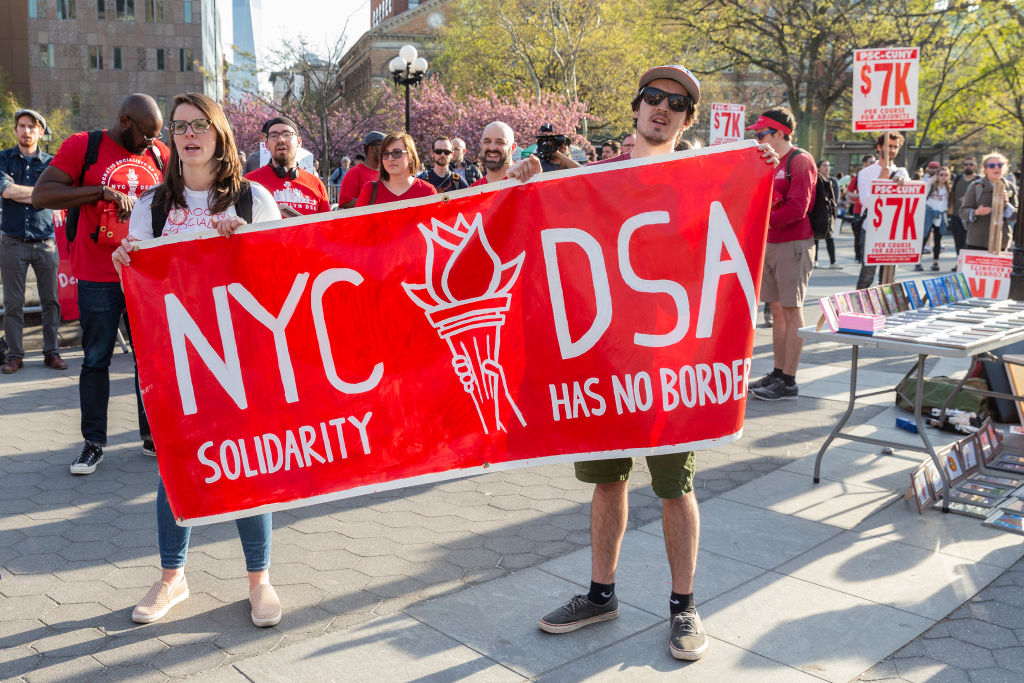
People protest during a 2018 May Day rally in Washington Square Park in New York City.

Critics are quick to dismiss the Democratic Socialists of America as a group of “over-credentialed college elites” playing at working-class politics. But in their haste to demean, these critics miss the real class dynamics at play in DSA’s growth. (Lev Radin / Pacific Press / LightRocket via Getty Images)


At this year’s Fourth of July celebration, marking the 250th anniversary of the Declaration of Independence, Donald Trump devoted part of his speech to an attack on “communism.” Sounding a note from an earlier era of the nation’s history, he hissed about the “communist menace,” which he called “a mortal threat to American liberty,” a “cancer” that needs to be “cut out,” and “the greatest threat to our country.”

Trump never explicitly said which “communists” posed this threat in 2026, but the context was obvious enough. A week and a half earlier, three self-described democratic socialists won congressional primaries in New York City. Two were members of the Democratic Socialists of America (DSA). In combination with several downballot victories the same night, and DSA victories in congressional primaries shortly before (in Philadelphia) and shortly afterward (in Denver), this created a palpable sense of socialist momentum.

Naturally, along with the denunciation from Trump, the socialist victories have led to a tsunami of anti-socialist opinion from conservative and centrist liberal pundits. At times this has been very strange and amusing. Writing in the Denver Gazette after the primary victory of DSA member Melat Kiros in Colorado’s 1st district, for example, Vince Bzdek bemoans that DSA’s recently adopted “Workers Deserve More” platform makes for “shocking reading” on “the 250th anniversary of our country,” because it “essentially calls for an end to the American experiment as we know it.” Bzdek then lists a number of anodyne and attractive provisions, such as lowering the workweek to thirty-two hours, abolishing the Electoral College so that presidential elections will be decided by popular vote, and guaranteeing health care as a right. Apparently, he takes it for granted that his readers will be as shocked as he is by the thought of expanding democracy and delivering material improvements for the working class.

A different line of attack, though, has also gained traction. This critique holds not that DSA’s platform is a scandalous threat, but that democratic socialists are best understood as a movement of middle-class professional types not aligned with the political preferences of working-class people. Rather than scaremongering, the goal here is delegitimization through accusations of hypocrisy and phoniness.

Writing in the New York Times, Thomas Edsall disputes what he calls “DSA’s claim to represent the working class” and says that “an elite made up of well-educated professionals dominates this insurgency.” Libertarian Robby Soave writes for the Hill that “[d]emocratic socialists like to stress that their movement is populist and working class,” but the reality is that “their adherents are disproportionately rich and credentialed.” Pro-Trump pundit Batya Ungar-Sargon says “DSA is running and winning with over-credentialed college elites, over the candidates chosen by the working class they pretend to represent.”

There is, as we’ll see, a genuine germ of truth in this critique. As impressive as some of its victories have been, DSA will need to expand its social base if it’s going to win at a bigger scale. But in the strong form presented by critics like Edsall, Soave, and Ungar-Sargon, the attack makes very little sense. Their definition of the working class is far too narrow, and they miss the real class dynamics at play in DSA’s growth.

What Are the Rules Here?

For the sake of argument, let’s pretend that these critics are correct about their empirical premise. DSA has won over so few working-class voters so far that such voters are basically irrelevant to its electoral victories. What exactly would follow from that?

Ungar-Sargon often claims that MAGA represents the hopes and dreams of the working class. But Hillary Clinton won the majority of low-income voters in 2016, and Joe Biden won the majority of low-income voters in 2020. Trump won that demographic for the first time in 2024. So, what are the rules here, exactly? Was anyone claiming that Trumpism served working-class interests engaged in egregious misrepresentation in 2016 and 2020 but telling the truth in 2024? Perhaps in 2016, the politics with a genuine claim to “represent the working class” was the technocratic-centrist liberalism of Hillary Clinton.

Many successful union organizing campaigns start with organizers who might themselves come from middle-class backgrounds. Even in the early stages, though, when only a small minority of workers have been convinced to sign union cards, it would ring untrue to dismiss the unionization campaign as falsely claiming to be a pro-worker effort.

A movement can be working class in three senses. First, it can be a movement for working-class interests. Second, it can be a movement that seeks to organize the working class as the social force best equipped to achieve its political goals. Third, it can have already succeeded in mobilizing that constituency, whether from the outset or through a sustained campaign. None of the critics writing “DSA isn’t really working class” op-eds make these basic distinctions.

On the first point, it’s hard to argue that a thirty-two-hour workweek, for example, wouldn’t serve the interests of the working class. Nor is this a matter of college-educated socialists telling salt-of-the-earth workers that they should want shorter hours. Polling shows that a strong majority of Americans already support a thirty-two-hour workweek, to say nothing of cheaper rent, transit, and groceries.

On the second point, no one doubts that this is DSA’s own theory of the case. The goal, by DSA’s own candid admission, is to mobilize its existing membership to build a mass movement rooted in the broad working class. This is hardly unheard of in politics; imagine telling Martin Luther King Jr, “Pack it up, college boy.”

But what about the third point? There’s no doubt that DSA’s membership disproportionately skews toward college-educated people and those whose parents may have relatively comfortable professional jobs, whether or not they themselves are able to secure similar positions. And this is a real problem. In order to win more elections on a wider scale, as well as to mobilize at the grassroots to defeat the inevitable efforts of business to thwart attempts to carry out anything like that “Workers Deserve More” platform, DSA will have to develop deeper roots in parts of the working class well outside of its current base. This has been the subject of much intra-left soul-searching and great debate within DSA itself. Nor would I dispute the point, often made by DSA’s critics, that the attraction of many activists to maximalist positions on hot-button issues far from the economic core of the socialist agenda can sometimes hinder this effort.

But does it really follow that DSA’s current members and voters are outside of the working class?

Getting Clearer on “the Working Class”

None of these articles bother to explain what the authors mean by “the working class.” All of them heavily emphasize educational status, but this is at best indirectly related to “class” as an economic category. If two people have exactly the same job, one of them being a college graduate doesn’t make them members of different classes.

Many people use the word “class” to refer to income levels. Socialists, though, have typically understood it as a relationship to the core economic structure of our society. Class isn’t just a matter of what you have but what you have to do in order to get what you have. In the traditional socialist definition, the working class is the part of capitalist society that relies on wages to get by. It’s composed of people who aren’t in a realistic position to go into business for themselves (or, for example, live on inherited wealth) and thus have to sell their working hours to a capitalist (or are dependents of people who do so, or are retired from doing so).

The classical socialist conception adds up to a basically two-class map of capitalist society. Some people are capitalists who own their own “means of production” (like factories, farms, offices, or grocery stores) and other people work for the capitalists. On this conception, the overwhelming majority of DSA members (let alone voters for DSA candidates) are inside the working class. Few of them are even self-employed small business owners, never mind wealthy capitalist oligarchs.

However, some socialists have been uncomfortable with this simple conception. Highly developed capitalist economies have seen a proliferation of “professional” roles that intuitively seem to be between capitalists and workers. Some writers have argued that this group, while still subordinate to the capitalists who can hire and fire them, makes up a class of its own distinct from the working class. If that’s right, many DSA members may be part of this class — often called the professional-managerial class (PMC) — and many others at least have family roots in it.

The “new class” analysis has never been entirely analytically satisfying, though. The core of an account of classes should be an account of what people’s interests are — which political and economic outcomes would help them and which would hurt them. Whether someone is in some sense a “professional” or went to college doesn’t tell us very much about that. Nor does it tell us, for example, whether they have the leverage that comes from being able to shut down a business by going on strike.

One of the most interesting and sophisticated accounts of the class status of educated professionals comes from the late Marxist sociologist Erik Olin Wright and may help us in understanding what’s happening with DSA members today. He thought that different kinds of professionals often had “contradictory locations” within capitalism’s class structure depending on variables like how rare their credentials are, whether they had some degree of managerial authority over other workers, how much autonomy they had on the job, and the position of close relatives. Depending on these specifics, some professionals may be pulled in different directions, with some of their interests aligning them with capitalists and others with workers.

These people’s allegiances will be determined by a combination of individual personality, political culture, and material conditions. What’s happening with many of the PMC or adjacent members of DSA today seems to be that, as their economic circumstances have changed, a portion of this subcategory has seen the value of aligning themselves with the broad working class to fight for better outcomes for all workers.

The Real Material Conditions of “Champagne Socialists”

The reality is that having parents with professional jobs, or even having a professional job yourself, doesn’t necessarily mean that you’ve got a particularly cushy deal in 2026. Soave dismisses DSAers as “champagne socialists,” but the reality is that a lot of them don’t have much of a champagne budget.

Many other critics actually admit this, sometimes in their haste to be demeaning. In the same New York Times article where he called DSA’s base an “elite made up of well-educated professionals,” Edsall writes that the organization “has awakened a key constituency, the universe of young people with college degrees struggling to find rewarding work, the so-called precariat.” Batya Ungar-Sargon has called DSA’s base “the downwardly mobile, deeply resentful children of privilege.” Strip away the insulting tone, though, and she’s identifying a real phenomenon. The attraction of some people who might in other circumstances have ended up as comfortable liberal professionals to the more ambitious politics of DSA isn’t always just a random outburst of idealism. In many cases, material conditions are playing a real role.

Lots of people who went to college and imbibed some degree of “middle-class” socialization are ending up in unambiguously working-class economic positions. Others managed to find work doing things they have professional credentials for, but as the economy changes, some of these career paths have become less comfortable and more precarious. As such, many are losing confidence in individual strategies for professional advancement, and turning toward collective strategies for securing material improvements, like organizing labor unions and engaging in socialist electoral politics — the same strategies that working people all over the world have turned to at many previous points in the long history of capitalism.

The question of why a civil-society organization like DSA, composed of highly activated participants in the political process, would initially draw from this better-educated and more professionalized part of the working population answers itself when we put all of this in a broader context. It’s not as if centrist liberals are drawing their candidates, communicators, or canvassers from construction sites and meatpacking plants. The only connection organized liberalism has to the non-college-educated layers of the working class is passively receiving their votes, and less reliably every election.

DSA doesn’t exist in a vacuum. It’s natural that it would initially draw (not entirely, but disproportionately) from the same educated, professionalized part of the population where liberal and progressive activism in general is concentrated; the MANGO acronym (Media, Arts, and NGOs) is a useful shorthand here. It also makes perfect historical and material sense that many of the people from this milieu most likely to make the jump from liberalism to socialism are ones who can feel the traditional promises of middle-class advancement crumble under their feet. It’s a perfectly rational response to a bad deal, and people in this position deserve economic security as much as anyone else.

Going forward, though, everything will depend on democratic socialists’ ability to expand beyond this layer of the population and build real roots in the rest of the working class. The cultural gaps between the college-educated and non-college-educated parts of the working population are very real (even as, at least in some cases, the economic gaps become smaller), and it’s vitally important to bridge those gaps. In particular, it’s important that the typical preoccupations of “MANGO” cultural politics not be allowed to get in the way of the broadening of the social base.

Whatever else is true, though, liberals who might latch onto the critique of DSA as insufficiently rooted in the broad working class should pay attention to what’s going on under their own feet. If the very working-class constituencies Democrats have traditionally counted on weren’t falling out of their grasp and becoming winnable by the Right, Donald Trump wouldn’t be president right now. Class dealignment is very real and centrists have no real solution to it. Regardless of what else DSA is getting right or wrong, or what work it still needs to do, only the kind of ambitious pro-worker agenda it champions stands a chance of reversing that process.