The People’s Dolly

Dolly Parton was a poor girl from a Tennessee cabin who never forgot it, never stopped singing about it, and never treated anyone as beneath her.
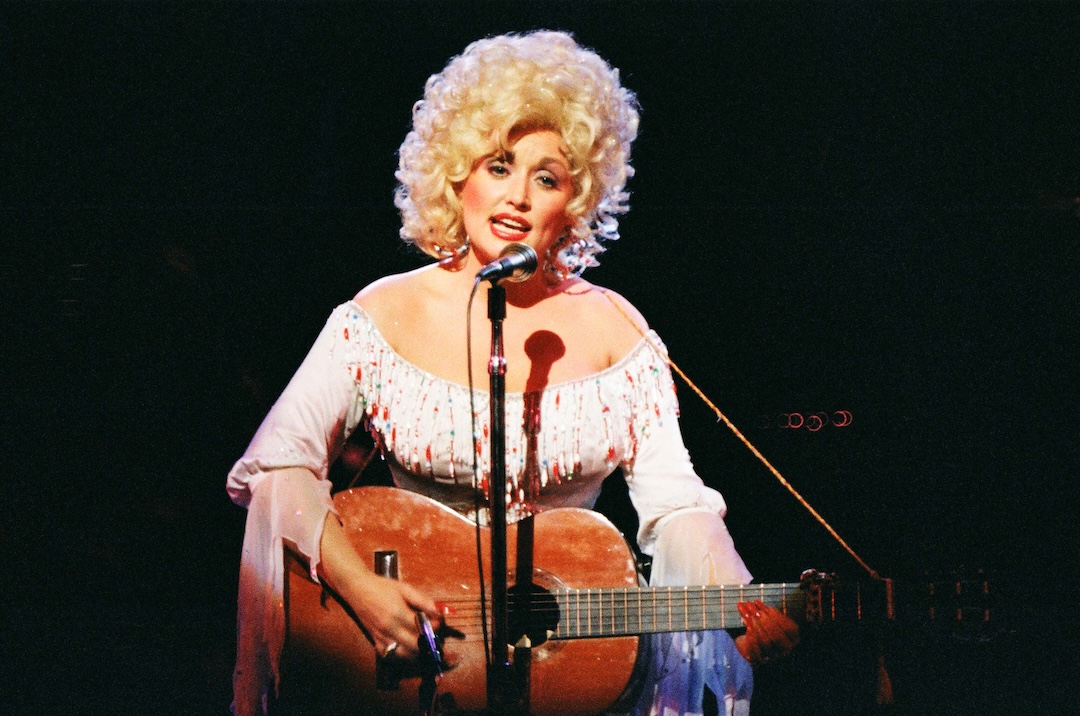
Dolly Parton performs on stage at the Dominion Theatre on March 29th, 1983, in London, United Kingdom.

Dolly Parton was a star without being a diva and loved working with other people, just as comfortable on harmony as melody. (Pete Still / Redferns via Getty Images)


I cannot easily remember a national treasure that has inspired a larger outpouring of eulogies, memories, and declarations than the passing of Dolly Parton. Personally, after hearing the news, I unplugged and had a day listening to the music, and — of course — watching the 1980 blockbuster 9 to 5 (which was only outsold by The Empire Strikes Back).

The madcap comedy starring Dolly, Jane Fonda, and Lily Tomlin gave voice to all the girls in the typing pool, the women of what Tomlin calls “the pink-collar ghetto,” where they are underpaid, overworked, sexually harassed, insulted, demeaned, overlooked, unrecognized, micromanaged, surveilled for any hint of dissent — or even complaint — and — of course — stolen from, by shitty bosses who get ahead by taking credit for somebody else’s work and ideas. And all while they are beset by dumb exes, family responsibilities, and comprador middle-management secretarial tyrant traitors to working women — right in their own office.

After elaborate fantasies of revenge, the three ladies — by a comedy of errors set off by sheer exhaustion and frustration — end up kidnapping their boss and imprisoning him in his own home. In his absence, they decide to run the company “on his behalf,” equal pay is instituted, and we see women of color and disabled people in the office (and even men!). The dress code is relaxed; the unfairly fired are rehired; a daycare is formed; flex and part-time hours are introduced. It’s a full-fledged office takeover (and there’s a happy ending too).

Fonda herself produced the movie, inspired by meetings with 9to5, National Association of Working Women (which eventually affiliated with the Service Employees International Union as District 925), founded by labor leaders Karen Nussbaum and Ellen Cassedy while they were working as secretaries at Harvard University. (Check out Julia Reichert and Steven Bognar’s 2021 documentary 9to5: The Story of a Movement to learn more.)

9to5 organizer Mary Jung said that most of the members “didn’t consider themselves feminists” and considered themselves “mainstream women,” recalling that “we couldn’t have a ‘demonstration,’ because a demonstration was considered too radical for our members, so we would have ‘actions.’“

Reichert emphasized how well Jung read the room: “She’s a really good organizer, and a good organizer . . . recognizes ‘what is the community we’re trying to reach? And let’s not have a litmus test.’“

That was the strategy of the 9to5 movement as well. Dolly was initially reticent to take part in an all-female cast with open feminists Fonda and Tomlin, but the fact that it was a comedy with a message, rather than a didactic propaganda film, got her to sign on. In a 2019 interview, Dolly reaffirmed her position, saying, “I still believe that women should get paid equal and should be treated with respect, I’m all about that. I don’t get out and have to preach it or march in the streets; I write about it.”

She also put her money where her mouth was when it came to labor.

Like most women, Dolly didn’t relate to Valerie Solanas, Germaine Greer, and the bra burners (though ever the self-deprecating charmer, Dolly once joked, “I was the first woman to burn my bra — it took the fire department four days to put it out.”). And finding common ground with “most women” isn’t just politically strategic; it represents a deep love and appreciation of humanity. It also helps to have a sense of humor and a killer song (when Dolly agreed to write the theme, she likely didn’t imagine getting a number one hit on the Billboard Country, Adult Contemporary, and Hot 100 charts).

And while she wasn’t reading Karl Marx, she was a card-carrying member of multiple artists’ unions for nearly sixty years. Dave Pomeroy, president of American Federation of Musicians (AFM) of the United States and Canada Local 257 in Nashville, saluted her commitment to her fellow musicians, saying, “Dolly and her team consistently filed AFM union contracts for gigs, sessions, and tours, ensuring that the bands, singers, and studio musicians working alongside her received the benefits of union membership.”

All writers should consider the room when writing anything, and eulogies even more so. So I know where this is being published, but while celebrating Dolly’s commitment to justice is great, for the love of God, let’s not Gritty-fy her.

Sigmund Freud said “the delusions of paranoiacs have an unpalatable external similarity and internal kinship to the systems of our philosophers” . . .  or something like that (give me a break, it was all originally in German). What he meant though, was that the endless, pathological need to interpret things, to find hidden messages and deep subtext, is . . . kind of crazy. It’s a liability for anyone — and particularly political people — who end up cracking a code that isn’t really there. A lot of people know that Freud said, “The paranoid is never entirely mistaken,” but they never catch the part right after: “He has a keen eye for something that escapes other people — only he completely misinterprets it and attaches an exaggerated importance to it.”

Sometimes leftists have a habit of latching on to people and art and artists by projecting their own motives, values, and worldviews onto them, scrutinizing, analyzing, and decoding secret meanings that aren’t really there, or at least aren’t really all that deep. And Dolly wasn’t a mascot; she was a brilliant artist and a wonderful person.

She was gracious, sunny, funny, and glamorous. She took no shit, but with class, laughing off criticism and condescension with grace and quick wit, and stayed above the fray when surrounded — and sometimes pursued — by petty celebrity drama. She didn’t care what people thought of her artistic or personal decisions, only the way she treated people.

Her philanthropy ran the gamut. She donated millions of books to children and millions of dollars to disaster relief. She was an animal lover, donating to rescues for both household pets and farm animals. She was a conservationist of her beloved Smoky Mountains, restoring native chestnut trees after a decimating blight and opening a bald eagle sanctuary right in Dollywood.

She was a star without being a diva and loved working with other people, just as comfortable on harmony as melody. She was experimental and tried new things throughout her career, often with other people, whether it be the trio with Linda Ronstadt and Emmylou Harris, or with gay pride parade grand marshal leather daddy Rob Halford. She was loyal and helped the people who helped her come up when they were on their way back down.

She never forgot her roots, as one of twelve children who grew up in the cabin you can see on the cover of My Tennessee Mountain Home. My Papaw (one of nine) and Mamaw (one of thirteen) both grew up in cabins just like it — no plumbing, electricity, or indoor running water — and they have no one to tell except our family. There aren’t a lot of Appalachians with the platform to talk about that history, or what it’s like now, for that matter. But she never stopped singing about it, and it lived in her lyrics as much as her music. Her autoharp on a live version of “Wildflowers“ or the Appalachian dulcimer on “My Mountains, My Home“ are transcendent, instruments that echo through the hollers of the heart.

And not to be all “name one album,” but as a genuine, longtime hardcore fan, I cannot stress enough what a brilliant songwriter, singer, arranger, and instrumentalist she was. She covered unexpected songs in unexpected ways until they were all hers. She was experimental but still had her signature sounds, like those acrylic nails clicking out percussion on a shuffling rhythm guitar (or standing in for a typewriter on “9 to 5"). She had that clear, pure soprano and that delicate, precise vibrato that could launch into a sweet but powerful belt. She used and sometimes improvised ingenious harmonies, with deft melismas and glissandos, and dynamic, playful variations in volume, sometimes in the same phrase. And those lyrics. Those melodies . . . 

Like any good country girl, she sang about love, God, and murder. But also about work and struggle and beauty, betrayal, pain, poverty, freedom, home, and family and joy. She sang about being a woman. She told us stories.

And so, dear Jacobin reader, I say that everyone should have a little lumpen in them, because while the divide between America A and America B may not be a brick wall, we live in a time of unprecedentedly little common culture. It’s important to see why so many people who seem to have nothing in common are feeling a sense of collective loss, why the atomized masses are a little heartbroken. Because you don’t need a political reason to love Dolly Parton. She’s Dolly. Our Dolly. Woman of the People.