After Blocking Fuel, the US Turns to Cuba’s Food Supply

The Trump administration has already cut off Cuba’s access to oil. Now it’s attempting to starve the Cuban people, targeting the country’s capacity to grow, process, and import food — unless it buys from US corporations.
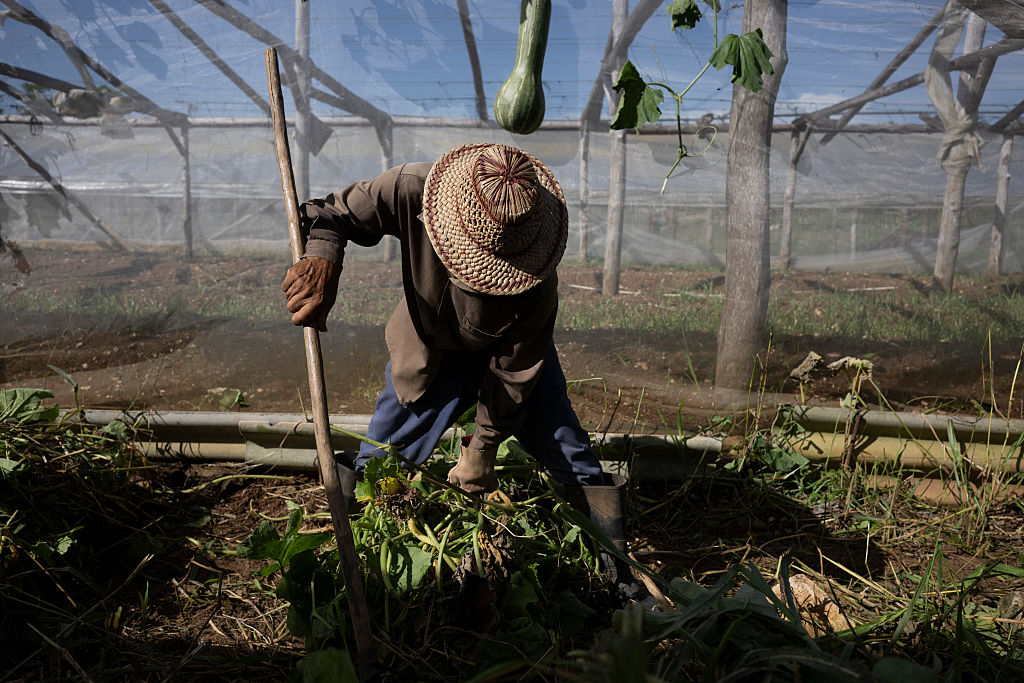
A farmer works at La Burgambilia agritourism farm in Caimito,  Cuba, on June 25, 2026.

As the Trump administration seeks to topple the Cuban government and open its economy to private US ownership, it is using access to food as the ultimate leverage. (Pablo Porciuncula / AFP via Getty Images)


Cuba’s right to grow, process, and eat its own food is under siege.

In July, the US State Department announced a round of broad economic sanctions against Cuba targeting industries that have historically been spared, limiting the Cuban government’s ability to purchase agricultural commodities and food processing equipment from third countries by singling out Cuba’s state importer (GECOMEX) and port operator (GEMAR).

This is happening in the context of America’s monthslong oil blockade against Cuba, which has already immiserated the general population by impeding basic sanitation and food safety and has killed scores of patients in Cuban hospitals. A US congressional delegation that visited in early July described the situation on the ground as a “silent Gaza.”

Given this context, it may surprise you to hear that the United States remains one of Cuba’s largest trading partners, exporting over $828 million in goods last year. Beneath the apparent contradiction of the US sanctioning a country it does business with is a strategy as old as imperialism itself. The United States is entirely willing to sell food and other select goods to Cuba, but it wants a monopoly over that trade.

A Compliance Nightmare

For decades, US sanctions against Cuba have targeted captive industries like mining and tourism, both of which are important sources of foreign exchange for the Cuban government. During this time, the United States held off on sanctioning entities that import some goods into Cuba, as those transactions result in foreign exchange leaving the country — very often to US firms, paid in full and in advance.

The mining operations and hotel chains that operate in Cuba are used to navigating complex regulatory environments (as are most major companies in those industries). These also tend to be smaller businesses that are not publicly traded. But the State Department’s singling out of GECOMEX and GEMAR, which facilitate the physical import and export of virtually everything entering and leaving the island, raises compliance risks for manufacturing and shipping companies. This in itself is a notable escalation.

For example, a firm like the Bühler Group, a Swiss industrial concern, now faces compliance risks if it sells grain milling equipment to Cuba. Ditto for a third-country company that might sell machinery for cleaning and sorting pulses. If GECOMEX can’t import equipment, its subsidiaries can’t efficiently process agricultural commodities like wheat and beans, which in turn reduces the basic foodstuffs making their way into Cuban households.

The sanctions against GEMAR, the port operator, are even more straightforward, creating compliance risks for any shipping company that pays them docking fees. More than seven thousand containers destined for Havana are now stranded across the Caribbean, after companies like Hapag-Lloyd and CMA CGM suspended their Cuban operations. So even though there are humanitarian carve-outs that permit the import of food into Cuba by third countries, this new round of sanctions could severely hinder such shipments.

“These sorts of measures demonstrate the genocidal intent behind the United States ‘maximum pressure’ strategy.” says Helen Yaffe, professor at the University of Glasgow and author of We Are Cuba! How a Revolutionary People Have Survived in a Post-Soviet World. “Food is a terrible vulnerability that was imposed on Cuba by colonial and imperial history. The whole country was turned into a sugarcane field.”

The Highs and Lows of Cuban Agriculture

Immediately following the revolution, the Cuban government nationalized the largest agricultural estates, plantations, and haciendas, while leaving many small campesino farms independent. During the Special Period (following the collapse of the Soviet Union), Fidel Castro passed Cuba’s Third Agrarian Reform law, which allocated more land to cooperatives and family farmers through usufruct rights. This decentralized the government’s agricultural production, turning import-dependent state farms into Basic Units of Cooperative Production.

“Farmer-to-farmer networks trained more than 200,000 farming families in agroecological methods,” says Margarita Fernandez of the Caribbean Agroecology Institute (CAI), which advocates for sustainable farming practices and food sovereignty. During the Special Period, urban gardens (organopónicos) proliferated across Havana, with the Cuban government estimating that over 50 percent of fruits and vegetables consumed in the capital were grown there.

In his book The Greening of the Revolution, food rights activist Peter Rosset argues that this was “the largest attempted conversion from conventional to alternative, semi-organic agriculture in the world’s history.”

“For a time, Cuba became a global symbol of what post-fossil-fuel agriculture might look like,” says Fernandez.

At the peak of this movement, in the mid-2000s, 35–40 percent of all calories consumed in Cuba came from domestic agriculture. However, the Special Period eventually ended once Cuba developed a closer trade partnership with Venezuela under Hugo Chávez. Once again, Cuba had access to the oil inputs that make industrial agriculture possible.

“As economic conditions improved intermittently, policymakers often shifted back toward conventional industrial agriculture,” says Fernandez. “Agroecology was never fully institutionalized as the foundation of the food system. Instead, it was treated as an emergency substitute.”

Crop and livestock yields were actually declining leading up to the Special Period. During the late ’80s, Cuba’s industrial farming model led to severe soil compaction and degradation, causing the yield of non-sugarcane agricultural production to drop.

Yields had also been declining over the past few years before the United States took over the Venezuelan government in January and triggered the present crisis. Between 2018 and 2023, the domestic harvest of staple crops like rice fell by more than 50 percent. The World Food Programme’s US affiliate estimates that Cuba now relies on agricultural imports to meet 70–80 percent of its needs.

That may not sound like a large reduction, but it’s important to remember that not all calories are created equal. Historically, Cuba has remained 90 percent self-sufficient when it comes to fruits and vegetables, which are filled with vitamins and fiber but contain very little protein. But Cuba now produces less than 1 percent of the poultry it consumes, and its pork industry recently collapsed.

Making matters worse, the present oil blockade has cut domestic agricultural output by 60 percent, estimates the UN human rights chief in a June report. “The ration book is threadbare now,” says Helen Yaffe. July’s sanctions are likely to exacerbate this.

Cooperatives and family farmers now manage approximately 69 percent of Cuba’s agricultural land, though not all of them engage in sustainable agricultural practices. Many remain reliant on irrigation methods that run on gasoline and diesel. And though use of biofertilizers and biopesticides, in lieu of fossil fuel derivatives, is widespread, those rely on stable transportation to distribute live cultures from labs to remote fields before they spoil — a virtual impossibility given the United States’ brutal energy blockade.

Estimates vary, but proponents argue that scaling agroecology practices could reduce dependence on agricultural imports by 35–40 percent. Others estimate that it could provide for 70 percent of all calories consumed in Cuba. This would also help reduce agricultural trade deficits, which organizations like the CAI view as an impediment to greater food sovereignty. Cuban spending on foreign agricultural imports was $2.7 billion in 2024, dominated by meat ($458 million) and cereals ($177 million).

Cuba also has to contend with an aggressive northerly neighbor that is not only limiting their ability to trade freely and receive fuel but remains fiercely defensive of its existing markets.

“Any attempts to grow food for local consumption are opposed by the American agricultural lobby,” says Yaffe.

A Distinctly Unfree Market

Of the food that Cuba imports, $403 million comes from the United States, $328 million comes from Argentina, and $282 million comes from Brazil. But again, not all calories are created equal. Cuba imports 85 percent of its wheat from Canada, and — perhaps most important — 80 percent of its poultry from the United States.

Frozen chicken quarters and legs are the most affordable and accessible animal protein in the Cuban diet. Cuba has been one of the top five largest export markets for American poultry for over ten years, ahead of countries with massive populations like the Philippines and China. Last year, the United States exported $298 million worth of poultry to Cuba, virtually all of it frozen chicken quarters and legs.

The latest sanctions are expected to tilt the balance of agricultural trade even further in the United States’ direction.

Canadian agribusiness is unlikely to see upside in continuing CAD$278 million of agricultural trade with Cuba in the face of compliance risks that have already led to one prominent mining firm being distressed into sale to a Donald Trump–allied US buyer. For comparison, Canada did over CAD$100 billion of agricultural trade in 2024, 62 percent of which was with the United States.

“If you’re a third country and you supply goods or services to a blocked party, you can be blocked,” explains Robert Muse, a prominent lawyer who specializes in US laws and regulations relating to Cuba. “Then anyone who supplies goods or services to you can be blocked. . . .  and so on.” Title III of the Helms-Burton Act, which opens private companies to lawsuits if they deal in assets expropriated during the Cuban Revolution, can theoretically be extended limitlessly.

Aside from their desire for market access to the United States, there is at least one other reason why companies don’t revolt against these unnecessary compliance risks: “The international banking system and the supremacy of the U.S. dollar prevents companies from fighting back,” says Helen Yaffe. Dollar transactions, which account for most world trade, need to clear the US banking system.

This leaves Cuba with only one frictionless trading partner: the country that is presently trying to dismantle its government. “American companies will be preferred investors in the ‘new Cuba’ that the US is trying to engineer through secondary sanctions,” says Muse.

Molding Cuba in the model of Latin American countries like Guatemala, locked in a relationship of dependency and unequal exchange with the United States, does seem to be the ultimate ambition of the Trump administration. As for the role of agriculture in this grand strategy, “America’s leverage over the Cuban government increases as the amount of food it imports to Cuba increases,” says Muse.

This may help explain this latest round of sanctions. By leaving the humanitarian carve-outs in place while targeting the port industry and importers, the United States can claim it is not forbidding the import of food to Cuba, even as it causes domestic food production and food imports to plummet.

“The effect is multiplied by existing food shortages. Cuba may be getting 16 percent of its imported food from America, but if you knock out the other 84 percent – now you’ve got a catastrophe,” says Muse.

As for now, most of the world isn’t willing to risk access to the US market and to payment and credit systems by continuing trading with Cuba. Yet pressure for an alternative continues to build as the United States’ mercurial trade policies and unilateral sanctions regime come under increasing stress in the context of trade disruptions related to the Iran war.

“If Cuba still had the rest of the world to trade with, it could prosper,” says Yaffe.

The US government has exploited the limitless reach of the Helms-Burton Act and the hegemony of the dollar to create a regulatory environment and sanctions regime so severe that no rational actor would defy it. Simultaneously, its oil blockade has made food sovereignty via an industrial agricultural model nearly impossible, leaving Cuba dependent on American agribusiness for cheap proteins.

Meanwhile, banking, mining, and tourism sanctions have starved Cuba of the foreign exchange it needs to fund a transition to more sustainable agricultural models. In other words, as the United States seeks to topple the Cuban government and open the country to private US ownership, it is using access to food as the ultimate leverage.