The Case for Carceral Minimalism
The American carceral state is a machine of human rights abuses. But abolition hasn't convinced the country that it can end them. To build mass support for dismantling it, we need carceral minimalism.
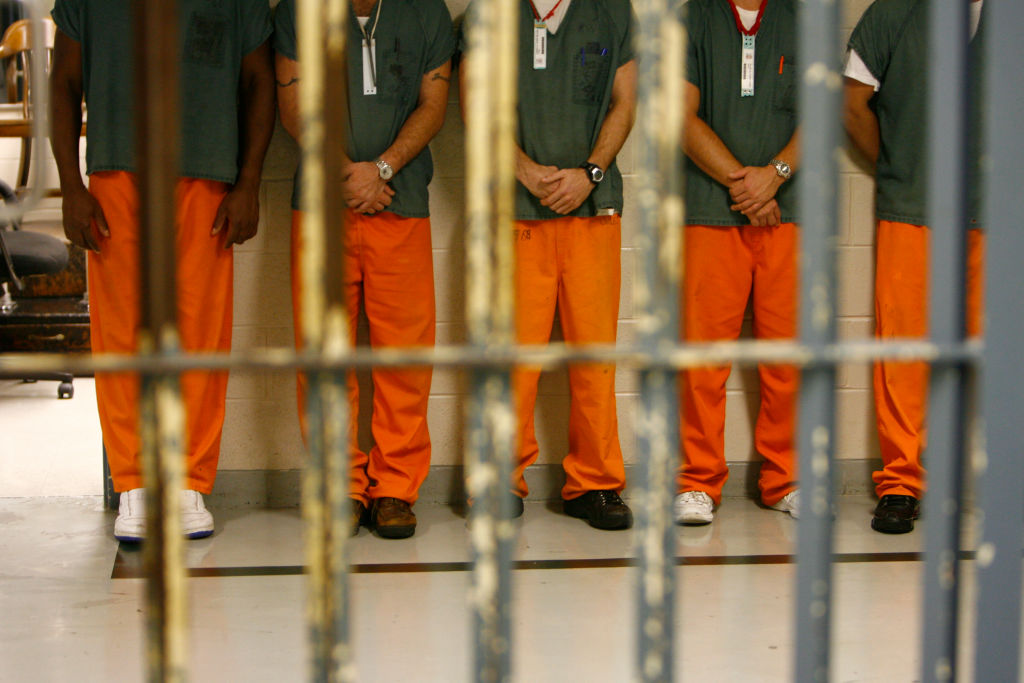
Carceral minimalism holds that the law should protect the weakest party at every stage, from crime victim to defendant to prisoner. (Nick de la Torre / Houston Chronicle via Getty Images)
When Karl Marx wrote that the past “weighs like a nightmare on the brains of the living,” he wasn’t talking about 2020, but he may as well have been. That year weighs particularly heavy, it seems, on democratic socialists running for office. Everyone from New York’s Zohran Mamdani to Wisconsin’s Francesca Hong has been confronted with statements they made in that year, generally on the subject of defunding or abolishing police and prisons. In almost every case, democratic socialists have walked back their endorsements of abolition, mindful of the deep unpopularity of the demand.
At the same time, a number of socialist writers have developed criticisms of abolition as a strategy. If abolition had a moment in 2020, that moment appears to be over. Yet socialist critics of abolition have not succeeded in articulating a positive framework as an alternative to abolition. This lacuna is made all the more glaring by the insistence of abolitionists that their project flows logically from, and is indeed required by, anti-capitalism.
Fortunately, such a framework does exist. It’s called carceral minimalism, and it ultimately provides a better path for realizing socialist ideals than abolition does.
The Law of the Weakest
Over the last few decades, a number of writers across the world have developed a framework that has been called minimalist criminal law or radical penal minimalism. I prefer “carceral minimalism” as a clearer and more succinct phrase and will use that instead. Legal scholars and social scientists like Máximo Langer, Luigi Ferrajoli, and Loïc Wacquant have argued that while in most societies the coercive footprint of the state should be significantly lessened, eliminating it altogether is not a viable road to social justice.
In thinking about the proper structure and scope of police powers for the state, Ferrajoli has argued for a framework he calls the “law of the weakest.” The law, he contends, should prioritize protecting the weakest party in each stage of criminal law. At the moment of offending, the law should prioritize the protection of the victim of crime, whose rights are being trampled by another. However, in both the trial stage and the penal stage, the accused and the convict are now the weakest party, standing more or less helpless before the awesome power of the state. As such, in those contexts, institutions and practices must be structured to protect their rights, since they are the ones most likely to have their rights violated.
It’s a very simple framework, and one that is deeply consonant with socialist ideals. Egalitarianism can, as the anthropologist Christopher Boehm has argued, be thought of as its own kind of hierarchy, one in which the weak dominate the strong in order to prevent them from dominating everyone. In egalitarian pre-state societies, this gives rise to a fiercely egalitarian ethos that actively suppresses the acquisition of excessive power by any individual in the group. Equality, in other words, is how the weak guard themselves against domination by the strong.
Socialism, in this account, is simply the proactive prevention of domination by those with the most resources. It is the protection of those with the fewest resources, or the economically weakest.
Rule by the Strongest
If this were all carceral minimalism consisted of, abolitionists might object that it’s not a different framework at all. After all, it’s a core contention of abolitionists that getting rid of police and prisons is the only way to protect the rights of the weakest, the main violator of which, they argue, is the coercive power of the state.
Carceral minimalism’s difference with abolition is thus not primarily in the realm of values, but rather in what Vladimir Lenin once called the “concrete analysis of the concrete situation.” Specifically, carceral minimalism asserts two theses concerning how the law of the weakest should be realized that directly conflict with abolitionist arguments.
First, carceral minimalism holds that the elimination of the coercive public safety apparatus will worsen the violation of the rights of the weakest, because crime will increase. And the kind of crime that is likely to increase is not simply the kind of victimless crime or crime of circumstances (stealing when one can’t afford food, for example) that abolitionists tend to focus on. Nearly half of the people held in American prisons and jails are there for offenses legally classified as violent. Poverty breeds crime, and it quite often breeds violent crime.
There is overwhelming evidence that police, and the threat of imprisonment they carry, do prevent crime. Much of this evidence is presented in social-scientific studies that can be intimidating for lay readers, but the basic line of reasoning is clear enough: people who commit crimes respond to incentives like anyone else, and when the costs of committing a crime rise (because, for example, it is likelier that the perpetrator will get caught), people commit fewer crimes. Police, through both their simple presence in areas where crimes are committed and their role in solving crimes after the fact, raise the likelihood of being caught, which leads to people committing fewer crimes.
Abolitionists often respond to this line of argument with their own, which is that it is policing itself that causes the violent crime that it is supposed to prevent. For example, it is often argued that the criminalization of recreational drugs creates a market in which participants must use violence to protect their market and enforce payment. Therefore, abolitionists contend, if drugs were decriminalized, violence would decline and the market for these drugs would be like markets for legal goods.
While the logic here is coherent, the implications of this argument are not at all favorable to abolitionists. After all, the reason that most markets are conducted without violence is that participants’ property rights and contracts are enforced by the coercive apparatus of the state. Abolitionists imagine that abolition will lead to the market for drugs becoming like the market for televisions, but the very logic of their argument implies the result will be the opposite — without any state monopoly on coercive power, the market for televisions would become like the market for drugs. In other words, it will be subject to rule by the strongest.
Rule by the strongest isn’t simply a problem for potential victims of crime. It’s also a threat to those who commit crimes. A state apparatus can be bureaucratically regulated, such that even if a victim’s family feels the sentence a court imposes is too lenient, there is little they can do about the situation without becoming offenders themselves. But in a situation where the state abdicates its role in coercion, victims and their families are bound by no such institutional framework, and the law of vengeance, itself a form of rule by the strongest, becomes the default. The law of the weakest protects the accused as well, but in order for it to obtain, the state must still retain the apparatus of law.
As such, carceral minimalism contends that the coercive apparatus of the state should be radically reduced rather than abolished, in order to protect the rights of the weakest.
The Price of Protection
The second major difference with abolitionism concerns how the rights of the weakest can be secured in steps two and three of criminal law — that is, trial and confinement. Abolitionists are committed to tearing down the apparatus of both courts and prisons. Many even argue that any increase in the institutional footprint of these structures, such as increasing the number of public defenders or increasing spending on prisons, only legitimizes them and makes them harder to eliminate.
Carceral minimalists, by contrast, argue that the law of the weakest will often require devoting more resources to penal institutions. Take prisons. American prisons are plagued by violence, including sexual violence. This violence is an outrageous violation of the rights of the incarcerated. But all the evidence suggests that what is needed to prevent this violence is more resources spent per prisoner — a demand entirely compatible with, and in fact easiest to meet alongside, a far smaller prison population.
From the shamefully incomplete data we have on the subject, it appears that Florida prisons are some of the worst in the country for sexual violence against inmates. Florida is also one of the states that spends the very least per prisoner (on an age-adjusted basis). Internationally, we observe a similar pattern. Northern European prisons are significantly less violent than American ones, in part because the ratio of prison staff to prisoners is about one-to-one. In the United States, it’s between one-to-two and one-to-five, depending on the state. In Brazil, where prisons are far more violent than even the United States, it’s about one-to-seven. The conclusion is inescapable: ensuring safety for prisoners requires considerable expenditure.
Abolitionists might object that this ignores that prison staff themselves are a frequent source of violence, and one unlikely to be solved by hiring more staff. It’s true that violence against prisoners by staff is rampant in American prisons. From the best data we have, it’s roughly as prevalent as violence by fellow inmates. But looking internationally, we can see that countries that spend considerably more resources per prisoner can do a much better job protecting prisoners’ rights.
In Norway, violence against inmates by staff is considerably less common. Part of this is training. Norwegian prison officers receive two years of paid training, and most have attended some college. In California, officers receive thirteen weeks of training. Another component is smaller prisons, which allow more relationship-building between staff and inmates. Both of these cost more money than the American way of incarceration.
None of this is to say that more spending per prisoner is sufficient to secure prisoners’ rights. It is perfectly possible to spend more without improving the lot of the incarcerated. And the issue of staff violence against inmates also illustrates the need for effective discipline of staff, a bureaucratic feature not directly tied to funding. But the differences in prisons both in the United States and internationally suggest insistently that it is impossible to secure the rights of the incarcerated without spending much more per prisoner than the United States currently does. Calls to defund the prisons will do little to protect the people inside them.
Preserve Only What’s Necessary
There is much that abolitionists and carceral minimalists agree on. The American justice system is a concatenation of human rights abuses, from the failure to protect the lives of the poorest people against violence to rampant, unjustifiable violence committed by agents of the state to the warehousing of huge numbers of people in institutions that violate their rights daily.
Minimalists would also argue that the policing and punishment apparatus of the state must be shrunk and softened. While, as Christopher Lewis and Adaner Usmani have argued, it is difficult to imagine the United States achieving Norway-like prison conditions without building a Norway-like welfare state, it is clear that there is room for reform even within the confines of this country’s benighted political economy. For example, during the COVID-19 pandemic, a number of states released large numbers of prisoners to maintain public health in prisons, and the best evidence suggests that this scale of release (generally between 5 and 10 percent of the incarcerated population) did not increase crime.
There are two consequences that follow for carceral minimalism. First, whatever the limits of reform under capitalism may be, we have not yet reached them. Further work to reduce the prison population by reducing sentence length or using alternatives to incarceration (from fines to community service) must be pursued. Second, in order for the American criminal justice system to live up to the demands of the law of the weakest, a broader challenge to the power of American capitalism is necessary.
It’s a vision of criminal justice that is both achievable in the short term and congruent with socialists’ deepest values.