As Mass Incarceration Rose, Corporate Crime Ran Amok
We spoke to political scientist Marie Gottschalk about how corporate criminals have been let off the hook as prisons have exploded and what the path to ending mass incarceration might look like.
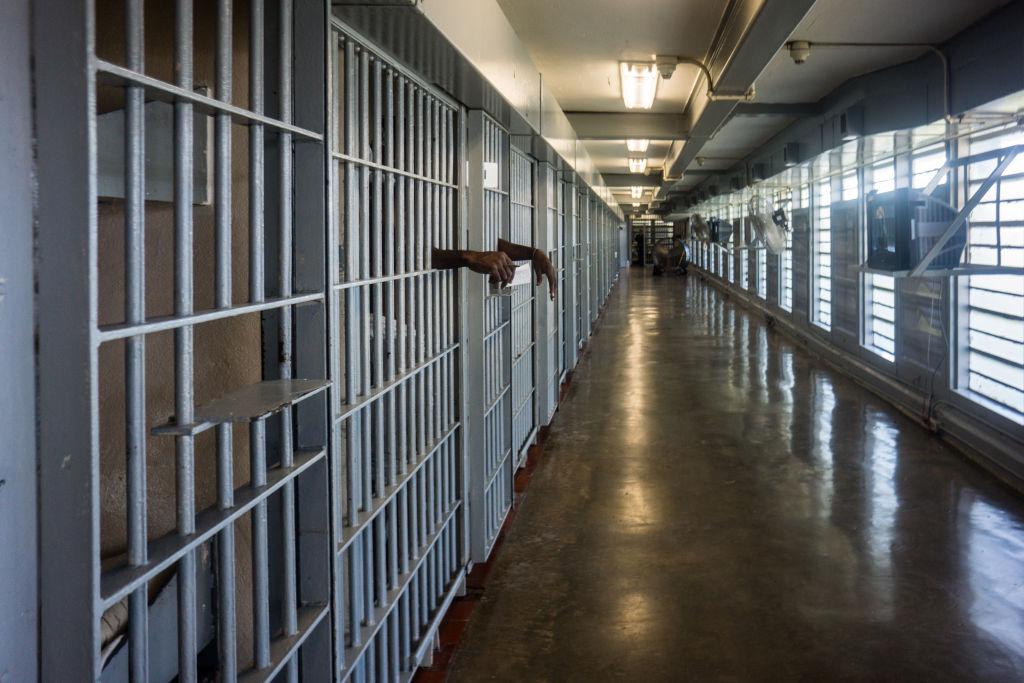
The US has built the largest incarceration system in the world. At the same time, it has carried out a radical decriminalization of corporate crime. (Giles Clarke / Getty Images)
- Interview by
- Meagan Day
Marie Gottschalk has spent more than two decades meticulously researching the origins and documenting the consequences of American mass incarceration. Her books The Prison and the Gallows and Caught are both foundational texts for anyone seeking to understand how the United States built the world’s largest penal system.
In her new book, Crime and No Punishment: Wealth, Power, and Violence in America, Gottschalk turns her attention to the crimes that never end up penalized, from the corporate malfeasance behind the 2008 financial crisis to the engineered opioid epidemic to the slow-motion violence of state neglect. For Gottschalk, mass incarceration and the mass decriminalization of corporate and white-collar crime are not separate stories but two facets of the same phenomenon of ultramagnified inequality.
Gottschalk is the Edmund J. Kahn distinguished professor of political science at the University of Pennsylvania. Jacobin’s Meagan Day spoke with her about “street crime” and “suite crime,” how rural America has quietly become subject to incarceration patterns previously associated with urban environments, whether there’s a role for police and prisons in an ideal society, and the concept of “radical penal minimalism” — a framework she thinks may offer the Left a way out of the trap of maximalist abolitionism versus reflexive law-and-order politics.
Meagan Day
Let’s start with the differential treatment of street crime versus white-collar crime. One will get you plunged into the world’s most vast and sophisticated carceral apparatus, possibly never to return. The other will either get you a slap on the wrist or be ignored. Certain flavors of white-collar crime, especially in the era of Donald Trump, will even be ostentatiously rewarded. How do you think about that selective approach to criminalization?
Marie Gottschalk
White-collar and corporate crime is largely invisible to us. We don’t count it; we don’t measure it. Official crime statistics are based on the FBI’s index crimes — murder, rape, arson, and so on — and those are what determine whether people believe crime is going up or down. Corporate crime doesn’t figure into that picture at all.
My book is partly a mea culpa. Those of us who study criminal justice have spent so much energy on mass incarceration — who goes to prison, at what rate, and why — that we missed the other half of the story: while the United States was building the largest incarceration system in the world, it was simultaneously carrying out a radical decriminalization of corporate crime. The book is about how those two trends are connected. What I try to do in Crime and No Punishment is get readers to step back from a narrow definition of “crime” — which in most people’s minds means interpersonal violence, or street crime — and think instead about violence writ large: who is causing harm, who is causing premature death.
The US has become one of the most violent countries in the developed world, whether you measure that by declining life expectancy, traffic deaths, incarceration rates, or the militarization of police and the resulting civilian deaths. At the same time, we have staggering income inequality contributing to that decline in life expectancy, and we have what the geographer Ruth Wilson Gilmore calls the “anti-state state” — a state that no longer feels it has a duty to protect the society it governs. That combination produces what I borrow from Friedrich Engels to call “social murder.” It’s not one person killing another by hand; it’s underlying structures producing death and harm at scale.
The 2008 financial crisis is a good example. I call it an act of violence. People lost homes, pensions, jobs — and unlike past recessions, the recovery was radically uneven. The coasts and the tech hubs bounced back; large parts of “flyover country” never really did. The opioid crisis is another. At its peak a few years ago, close to 110,000 Americans a year were dying of overdoses. To put that in perspective: over the entire decade the United States was in Vietnam, about 55,000 Americans were killed, an experience that seared itself into the national memory. Here we have twice that many deaths in a single year, and we’ve simply tolerated it.
Meagan Day
You’ve observed that incarceration and police violence are becoming less exclusively an urban, racialized phenomenon. Could that actually be a hopeful political development? There were understandable reasons to racialize the national conversation about incarceration, given the hugely disproportionate impact on black communities. But that framing may also have kept out people who don’t see themselves as positioned in a particular way in the broader culture wars.
Marie Gottschalk
What I’m trying to do in the book is push people toward a bigger political-economy view. And one important piece of that bigger picture is that the carceral state is not static — it’s changing geographically. It made sense in the 1970s, ’80s, and early ’90s to focus on urban areas, because that’s where incarceration was most intense. But over the last decade, we’ve seen something close to a flip: if you live in a rural or suburban area today, you have a better chance of being incarcerated than if you live in a city.
Some of that is the effect of progressive prosecutors and criminal-justice-reform coalitions anchored in urban centers, but we also see pronounced changes in rural areas. Look at New York state: the decline in incarceration is being driven by New York City, while rural areas are seeing increases. Pennsylvania shows the same pattern: a dramatic decline in Philadelphia, an increase out in the rural counties. That complicates how we think about race and incarceration, because some of the whitest, most rural counties in my state incarcerate people at very high rates, often in some of the most decrepit jails in the country, buildings well over a hundred years old.
This matters for coalition-building. If we want to challenge the carceral state, we need to understand what’s happening in rural America too. The same is likely true of police violence — we don’t have great data, but you probably have a higher chance of being shot and killed by police in a rural area than an urban one. Those deaths are undercounted because they happen in places without strong advocacy organizations or local media to publicize them.
Rural America has also disproportionately carried the physical burden of the forever wars. People in rural areas were far more likely to deploy to Iraq and Afghanistan. Actual combat deaths were relatively low, but the number of veterans who came home with serious physical or mental injuries was high — and this happened just as the country was cutting benefits for veterans and National Guard members. That’s another form of state violence that stays largely invisible. All of this is part of why I think it’s too simple to say that rural voters went for Trump purely out of misogyny and racism. There are many factors that have been brewing for a long time, and in some ways Trump is almost incidental to the underlying story.
If you actually want to reduce violence, you have to invest in the welfare-state side of things — jobs, health care, schools, neighborhoods — and you have to reinvest in corporate regulation. If we only focus on the police and the prisons as “the problem,” there simply isn’t enough money to squeeze out of that system to fund what’s actually needed. If activists are focused narrowly on defunding the police, there just isn’t enough there to fund the things that need to be funded. We have to look concretely at tax policy, redistribution, and winding down the military budget.
Meagan Day
Let’s talk about the order of operations. Someone might hear that and say: I agree, which is why we need to build the welfare state first, to address the root causes of crime, and only then will we have earned the ability to decarcerate. If we decarcerate before building that foundation, we’ll see a crime spike that sets the whole movement back. What do you say to that?
Marie Gottschalk
If your position is that we have to fix everything before we can make progress on decarceration, that’s ignoring some various obvious issues we can address right now. For example, if you just look at age demographics, leaving aside class or geography, the highest-crime population is young people in their late teens and early twenties, particularly young men. We can observe a kind of “criminal menopause,” where offending drops off sharply with age. So what’s the purpose of keeping people incarcerated for decades after that? It’s now costing roughly $120,000 a year to house someone in a California state prison, and the vast majority of incarcerated people are eventually going to come out anyway.
So yes, we can identify areas like these and start decarcerating now. A lot of the fear here rests on an overreliance on recidivism statistics, which are much shakier than people assume. You’ll often hear that two-thirds of people released “recidivate” within three years, without any explanation of what that means. In many cases, it’s a technical parole violation or a minor offense that, absent a prior record, wouldn’t have led to incarceration at all. In a lot of European countries, a prior record barely factors into sentencing. Our recidivism statistics are not actually a good predictor of public safety.
Meagan Day
Police and prisons are functioning in tandem right now to produce a metastasizing, highly punitive carceral state that extinguishes futures, proliferates inhumanity, and creates as many social problems as it solves. Consequently, the abolitionist line that a lot of people encounter when they first catch wind of those politics is: eliminate prisons, eliminate police — no distinction made between them, no exceptions.
But if you think about it seriously, you might conclude that a selectively recruited, democratically controlled, well-trained, community-rooted, and adequately restrained police force could be useful to the project of decarceration. It could respond in high-stakes situations without functioning as an automatic feeder system into prisons or brutalizing populations the state has otherwise abandoned. It could turn the temperature down in a way that obviates the justification for America’s vast mesh of jails and prisons.
Is there a role for police in decarceral politics or an afterlife for them in a decarcerated world? What about prisons themselves — is it possible to defend the existence of separate institutions to which violators of our social contract are removed?
Marie Gottschalk
Police are on the front lines of everything that’s failing: drugs, poverty, and the absence of adequate jobs, housing, and mental health care. We hand them that tray and say, “Fix it,” and all we actually give them are guns and more military hardware. As a society, we need to own those problems instead of just dumping them on police and saying policing can never work.
I do believe, after years of thinking about this, that a genuinely different law enforcement institution is possible — one that does what it’s supposed to do. It would probably look different enough from what we have now that we might reasonably call it something else. But police forces exist all over the world, under that name, functioning very differently from ours. I’ve visited prisons all over the world too, and a prison in Berlin operates nothing like the state’s largest facility just outside Philadelphia. Becoming a police officer in Norway is nearly as competitive as getting into Harvard, and it requires three years of training. In many US states, you need more training and licensing to become a hairstylist or a nail technician than to become a police officer. That’s a real, fixable failure, not a reason to conclude that the institution itself is beyond redemption.
There will probably always be some role for police in any functioning society. Sometimes you need the police to intervene. If someone’s breaking into your house with a gun, you’re not going to want a peace circle. But you also don’t necessarily want ten officers and a SWAT response that endangers everyone even more. There’s a middle ground. It’s also worth thinking right now about Charlottesville, where the police stood down while a white nationalist drove his car into a crowd and killed Heather Heyer. If you want to defund or eliminate the police at a moment when the Right is actively organizing and marching, you have to think hard about what that means.
My book does document how, in a number of places, police forces are increasingly infiltrated by the Right, and how police and military service function as recruiting grounds for white supremacist organizations. We have to acknowledge that reality. But I don’t think it’s accurate to lump “the police” together as a single undifferentiated entity. Albuquerque has an extraordinarily high rate of police killings of civilians compared to New York City. Those differences matter. Insisting that police everywhere are equally bad and should simply be abolished flattens real variation, and I think that’s its own kind of arrogance.
If we actually believe interpersonal violence has root causes — poverty, class inequity, racial inequity — then we have to recognize that in certain communities, violence tracks those indicators regardless of things like the “war on drugs.” Police need to be available to intervene and, where they can’t, to solve crimes. Roughly half of homicides in this country go unsolved. The families of murder victims generally aren’t demanding the death penalty or even necessarily a life sentence, but they do want some acknowledgment of the magnitude of their loss and some assurance that the person responsible won’t do it again. We need not only police for that but a whole functioning criminal justice system.
As for prisons, punishment serves a social function beyond direct incapacitation. It’s a statement that a given act is unacceptable. But it doesn’t have to involve torture or the conditions in most American prisons and jails today. When I teach my own book and we get to the final chapter on corporate violence and particularly the villains of the financial crisis, my students say: these people caused enormous harm; they should go to prison. And I tell them truthfully: that would satisfy a retributive impulse, but it wouldn’t solve the underlying structural problems.
Still, I don’t want to see them writing best-selling memoirs either. I’d like to see truth commissions. I’d like to see corporate executives personally charged, rather than corporations alone facing deferred-prosecution agreements that function as get-out-of-jail-free cards. There’s a wide range of sanctions available short of imprisonment. And some people probably do need to end up in prison or jail but not be subjected to current inhumane conditions.
Meagan Day
Many sympathetic people I know call themselves abolitionists. When someone asks, “So you really want to get rid of all police and prisons, forever?” they often start talking about horizons or hermeneutics. This is not how the term “abolition” was used in the context of slavery. It was an uncomplicated statement of moral principle: slavery had no defensible social function, and society would not miss it. It was not a horizon or a hermeneutic but a concrete demand for immediate eradication.
That’s not really the politics of most serious people using the term “abolition” today, because police and prisons are not actually structurally identical to slavery. Their actual position is closer to: we have a system running on its own barbaric internal logic rather than what it purports to do — minimize overall harm and enforce and uphold a democratically agreed-upon social contract — and we need to replace it with something that actually does those things. I agree with that, but I think calling it “abolition” confuses the issue.
Marie Gottschalk
I’m a real admirer of many people who identify as abolitionists, and I think “abolition” can be a capacious term. But I’ve become drawn to another phrase some people are using now: radical penal minimalism. Paradoxically, radical penal minimalism might actually mean investing more in certain parts of the system in order to shrink it overall.
For example, Pennsylvania is nearly the worst state in the country for funding public defenders. The state itself put essentially zero dollars toward it until very recently, and it still lags far behind other states; counties are left to cover it, and the American Civil Liberties Union just filed a lawsuit over conditions here. A purist abolitionist might balk at “expanding” any part of the criminal legal apparatus. But if expanding it means better public defenders, more diversion programs, more opportunities for community service, more careful attention to mitigation, or even potentially better-paid and better-trained prosecutors who stay in the work rather than burning out, then that’s a path to radical penal minimalism in practice.
Meagan Day
I much prefer that phrase. But do you think the American public will balk at the “minimalism” part of this formula too? People often report wanting more police, or at least more reliable and responsive law enforcement.
Marie Gottschalk
On this point, I’m heavily influenced by James Forman Jr, a Yale Law professor and former Washington, DC, public defender who wrote Locking Up Our Own — a deep dive into why DC, a majority-black city with a black city council and black mayor, became one of the most punitive jurisdictions in the country. His answer was that black communities have genuine, well-founded fears of street crime but also that it’s not as simple as “people want more police.”
Polling consistently shows that people in those communities simultaneously feel that they are being overpoliced and underprotected. In truth, public opinion in these communities tends to be “all of the above.” Philadelphia’s last mayoral race had local polling on this, and Los Angeles’s recent polling shows the same pattern. The press likes to quote it selectively as “people want more police,” but if you also ask whether they want more spending on schools, jobs, clean streets, libraries, and community centers, the answer is overwhelmingly yes to all of it.
Meagan Day
Offloading certain calls to mental-health responders, drug counselors, service providers, and other nonpolice entities — and giving police real training and the capacity to respond safely to the calls that genuinely require them — matters enormously. But I do think that in a country with this many privately owned guns, the state probably needs to retain a near-monopoly on legitimate force. It might be easier to shrink the role of police if we could actually disarm the population and then also make this population less aggrieved and disturbed.
Marie Gottschalk
That’s the hardest question in the book really — whether we’re in a cycle of violence, and I don’t just mean interpersonal violence. We have the highest rate of private gun ownership of any country in the world. How do you run a functioning society that is that heavily armed? Some of the explanation for higher rural police-shooting rates is that officers know nearly everyone is carrying, and there are fewer mental-health services available to divert people before a crisis. That’s an extremely combustible combination, especially with smaller departments, less training, and sheriffs who are largely unaccountable to the public.
The book can be bleak on this point. Are we becoming a dysfunctional state, one that’s failing at the basic obligation to protect its people from violence in all its forms, including drugs, including opioids? I often think about how shocked people were in the 1990s that life expectancy was declining in the collapsing Soviet Union. It was treated as proof of systemic failure. The United States has had its own unprecedented decline in life expectancy, in a country that spent the twentieth century as a leader in exactly that metric. And it’s declining unevenly, dropping fastest among poor and working-class white people, even as black and white life expectancy converge. Some of that convergence reflects real gains for black Americans, but a lot of it reflects a decline for white Americans. Is that really an achievement, equality reached by leveling down?
Meagan Day
Gulags are probably the best-known example of Soviet repression. Yet the US prison population is comparable to what the gulag system held at its height. We make a pretty remarkable exception for our own trajectory. Perhaps our society is not in spectacular health either.
Marie Gottschalk
I used to call the United States a “carceral democracy.” Now I’m not sure the “democracy” half still holds; even that’s been enfeebled. My book comes around to the idea that the fundamental legitimacy of the state is genuinely in question, and when that legitimacy is in question, it hollows out democratic institutions themselves. That adds a special urgency to our effort to understand the crimes committed and violence perpetrated not only on the streets but by people in power.