Uncovering America’s Forgotten Massacre in the Philippines
In 1906, US troops slaughtered up to 1,000 Moros at Bud Dajo in the southern Philippines, then called it a battle. Historian Kim Wagner explains how an empire can commit atrocities and how it teaches itself to forget them.
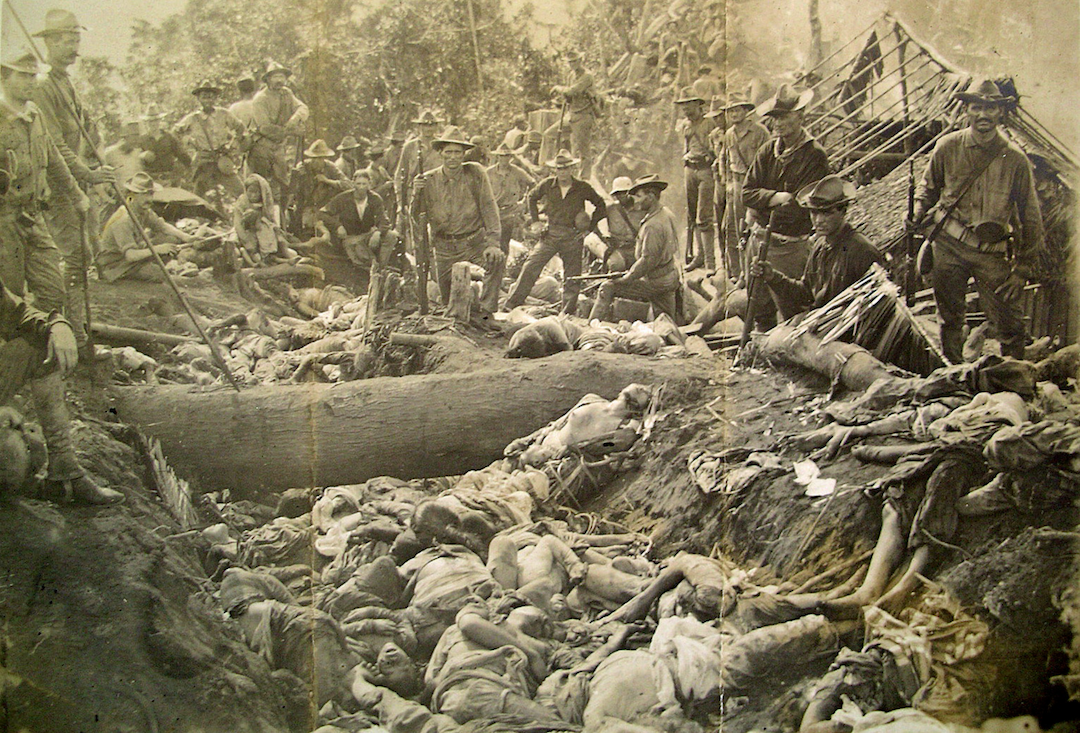
US troops massacred a thousand Moro men, women, and children in the Philippines in March 1906. US officials celebrated the massacre as a great military victory, and photographs of the dead circulated as souvenirs, postcards, and trophies. (National Archives and Records Administration)
- Interview by
- Michael G. Vann
In March 1906, US troops climbed the volcanic crater of Bud Dajo on the island of Jolo in the southern Philippines and killed a thousand Moro men, women, and children who had resisted American colonial authority. The event was celebrated by US officials as a military victory, and photographs of the dead circulated as souvenirs, postcards, and trophies. Today Bud Dajo is almost entirely absent from American historical memory.
In his new book, Massacre in the Clouds, Kim Wagner reconstructs the massacre and the machinery of denial that followed it. Wagner shows how US empire turned mass killing into a heroic “battle” and how that lie survived for more than a century. Historian Michael G. Vann spoke with Wagner about Bud Dajo, American colonial violence, atrocity photography, anti-Muslim racism, and why forgetting is never innocent.
Michael G. Vann
For readers unfamiliar with Bud Dajo, can you briefly walk us through what happened in March 1906? Who were the Moros in the crater, why were they there, and what did US forces believe they were confronting?
Kim Wagner
The Bud Dajo operation was one of a series of punitive expeditions that took place after the end of the Philippine-American War, as the United States tried to assert its authority in the southern Philippines. This went on for more than a decade. Every time American forces marched through the islands and burned villages, they claimed this would be the final campaign against the Moros. Then, the following year, they would do it all over again.
The Moros who retreated to Bud Dajo in 1906 refused to submit to American authority. They refused to pay the secular head tax, and they opposed the fact that the sultan of Sulu, their own leader, had become an ally of the Americans. In a very literal sense, they tried to remove themselves from American rule by retreating to a remote mountaintop.
But American authorities saw that as a direct challenge. That is why you then get a narrative of “outlaws” threatening the law-abiding population and the claim that one final battle was necessary to finish them off.
Michael G. Vann
The event is often called the “Battle of Bud Dajo,” but your book frames it as a massacre. What is at stake in that language?
Kim Wagner
It was reported as a battle in the United States at the time — and that’s how it is described on Wikipedia today. You see the same thing with Wounded Knee. Calling it a battle is a conventional way of turning an atrocity into something that allows for a heroic narrative. Three Medals of Honor were awarded after Bud Dajo, and the operation is celebrated with a campaign streamer on the US Army flag. So language was central to the cover-up — it transformed mass violence into military valor.
That is why the choice of words matters so much. We see similar disputes today when people argue over whether something should be called a genocide. The terminology shapes the public meaning of the event, and the prevalent use of euphemisms and the passive tense is responsible for far more violence than we usually acknowledge.
Michael G. Vann
Your book reconstructs the massacre in close detail. What surprised you most as you worked through the military reports, photographs, letters, and colonial records?
Kim Wagner
The well-known photograph from Bud Dajo was only one image among many, and I found something like thirty or forty other images. There were actually three photographers present, and the iconic image of the trench is not even the most graphic one. There are worse photographs, if you can believe it.
At first, I was not sure I would be able to tell the story, because the American authorities did such a thorough job of burying it. They controlled the trans-Pacific cable and could effectively suppress the story while the official military reports were carefully doctored to downplay civilian casualties.
But the US soldiers wrote letters home, and those letters were not censored. By trawling through contemporary American newspapers, I found accounts in which soldiers would write home with ordinary details and an opening like “Dear Mom, I’m in the Philippines, I’m enjoying myself,” but then proceed to describe extreme violence, using racial slurs and language that framed the Moros as savage enemies to be exterminated. That was when I realized there was a story to tell beyond the official record.
There is also an oral tradition in Jolo today among descendants of the Moros. I managed to visit Bud Dajo and talk to some of the descendants, and that was really important as I did not want American soldiers to have the final word.
Michael G. Vann
What did the local perspective add?
Kim Wagner
The local traditions are in the form of songs, almost like epic poems. They do not always clearly distinguish between the Spanish and American periods and are stories about heroic sacrifice by Moros, within an Islamic framework, who refused to submit to Christian invaders. So the narrative is stylized and formalized.
But what you get from those traditions is a sense that this was not simply a refusal to submit to American authority. These were people taking a stand for a way of life they saw as threatened. For all their rhetoric of nonintervention, the Americans had completely transformed Moro society and upended many of the traditions that formed its backbone. To the Americans, however, such resistance to colonial rule could never be accepted as legitimate.
Michael G. Vann
One of the most disturbing aspects of Bud Dajo is that it was photographed. How did the images function at the time — as evidence, trophy, warning, scandal?
Kim Wagner
The key photograph was taken by a local American photographer who made a living by producing tourist images of Moro life — Orientalist photographs for visitors. He happened to be present during the expedition. There were also two other photographers there with cameras. At this point in time, the line between amateur photography, tourist photography, and official photography was very fluid.
The photographer, who had the improbable trade name of Aeronaut Gibbs, captured this scene on the final day of the massacre, after almost every Moro had been killed. We see the soldiers are posing and facing the camera. This is not a snapshot in the modern sense of war photography. It is part of the violence, and that is what makes it a trophy image: soldiers posing with the dead bodies of people they had killed. Not too different from how hunters pose with their prey — or how some soldiers today take selfies in the middle of a battlezone.
The photograph from Bud Dajo later became one of Gibbs’s most popular postcards. He reproduced and sold it, and it circulated widely. I found copies in the private papers and photo albums of American officers, including some of the highest-ranking officials in the Philippines.
Leonard Wood, the commanding officer, had some of the most graphic images in his family album. On one page, you see his children with a nanny from the Philippines or riding horses on the beach; then you turn the page and see Bud Dajo. That tells us something about the normality of this kind of violence. These images were not understood by many Americans as evidence of atrocity.
Michael G. Vann
You and I have both worked with images of racialized colonial violence. In fact, that’s how we met many years ago. We recently spent several days with the staff of the My Lai Massacre museum and memorial in Vietnam, discussing their displays of photographs both in the secular Communist Party–run museum and in the Buddhist prayer hall.
I’ve always been impressed with how thoughtful you are when engaging such documents as historical artifacts. What responsibilities do historians have when writing about atrocity photographs?
Kim Wagner
In a general sense, I don’t think we know what to do with such images, and we are still not very good at “reading” them. It is important to consider the ethical implications of reproducing images of racialized violence, for sure. But I also think that refusing to look can become a kind of evasion.
The American authorities later tried to destroy the most incriminating image. So we have to ask whose interests are served if we hide it now, even if our intentions today are admirable. Susan Sontag made an important point about Abu Ghraib: the posing of tortured prisoners recalled lynching photographs. That historical perspective is precisely why we need to look closely at these images and dwell on them.
Some people have accused me of indulging in war pornography. I think that comes from a superficial way of thinking about atrocity photographs. If all you see are dead bodies and a source of trauma, you cut yourself off from a crucial historical source.
This image shows the soldiers who carried out the massacre, posing, and they then sent it home to their families. It is incriminating not just of the act itself but of their mindset. If we want to understand why atrocities happen — how supposedly liberal nations can kill civilians and think nothing of it — we cannot afford to look away.
Michael G. Vann
How did US officials justify the killing of women and children at Bud Dajo?
Kim Wagner
It is interesting because they actually did have to justify the killing of women (nobody seemed to care much for the children). They could not simply get away with it. After all, this was only sixteen years after Wounded Knee. In American political culture, the definition of “savage” warfare had long included indiscriminate violence against women and children, yet the very notion of innocence was highly gendered.
At first, the US Army denied that women had been killed. Then officials said women were collateral damage, hit by artillery from a distance. Finally, they admitted women had been killed but claimed the soldiers could not tell they were women because they were wearing trousers.
The cover-up ended by asserting that these women had been fired up by religious fanaticism. By not conforming to expected feminine behavior, they supposedly lost their protected status as women and became legitimate targets. The Army could then say: yes, women were killed, but we had no choice because they acted like men and were just as dangerous. That argument tied directly into ideas of Muslims as irrational, fanatical, and uniquely dangerous enemies.
Michael G. Vann
The subtitle of your book is An American Atrocity and the Erasure of History. How does an atrocity that was photographed and reported become forgotten?
Kim Wagner
We can look around the world today and see how easily people can watch mass violence unfolding before their eyes and deny that it is happening. Atrocities are not difficult to deny — in the past or in the present.
There was a cover-up that went all the way to President Theodore Roosevelt, and parts of the press helped bury the story. The San Francisco earthquake also cleared the headlines, which mattered because San Francisco was the forward base of American empire in the Pacific.
But it was a strange cover-up because it happened in plain sight. There were newspaper headlines; there were debates in Senate. Both Mark Twain and W. E. B. Du Bois commented on the affair — though not publicly. Ultimately, the fate of a thousand men, women and children on a faraway island was not enough to capture the attention of the American public. And that’s still pretty much the way it is today.
The forgetting is not passive. It is a matter of choice. Raoul Peck says in his film Exterminate All the Brutes that knowledge is not what we lack. The problem is the willingness to confront uncomfortable facts.
Michael G. Vann
Many Americans know about Wounded Knee and My Lai, which you are currently writing about, but not Bud Dajo. What does that absence tell us about how Americans remember empire?
Kim Wagner
Bud Dajo was arguably the worst massacre of its kind. More people were killed there than at Wounded Knee and My Lai combined, and yet, as you say, it is almost completely forgotten.
One thing to note is that even Wounded Knee and My Lai are remembered in a very particular way. They are recognized only as isolated episodes and framed as exceptions that prove the rule of America as a benign or progressive force. The emphasis becomes rogue officers, poorly trained soldiers, or “bad apples.”
In one documentary, for instance, Ken Burns describes the Sand Creek Massacre of 1864 as a “dark chapter” or a “shameful moment,” and that is what I would call historical containment. You acknowledge atrocities that cannot be explained away, but only as discrete episodes. There is never an acknowledgment that they are part of a broader pattern, and a larger history, of indiscriminate or exterminatory violence.
Bud Dajo was buried because powerful interests wanted it buried. But the amnesia has lasted because for too many Americans, it is preferable not to remember these kinds of events.
Michael G. Vann
How should Bud Dajo change the way we understand the Philippine-American War and the broader US presence in the Philippines? Should this be taught as foreign policy, military history, colonial history, or American history?
Kim Wagner
One of my arguments is that there is a direct line from settler violence and westward expansion to Bud Dajo. Some of the senior officers at Bud Dajo were actually veterans of the last stages of the so-called Indian Wars. A couple had been present at Wounded Knee, and it was commonplace to compare to the Moros to the Apache.
At the same time, Americans were deliberately studying how European empires administered Muslim populations. Bud Dajo sits at the intersection of an American tradition of settler violence and European imperialism. It is a particularly brutal convergence.
So this is US history, imperial history, military history, and colonial history all at once. Interestingly, the Moros did not necessarily see themselves as Filipinos, so Bud Dajo also sits at the margins of the conventional Philippine-American story. It belongs to several intersecting histories that are too often kept separate.
Michael G. Vann
What role did Islam and anti-Muslim attitudes play in the way American soldiers, politicians, and journalists understood the Moros?
Kim Wagner
I began this book before the US withdrawal from Afghanistan, so I was very much thinking about the “war on terror.” What struck me were the historical continuities — some headlines about Bud Dajo could have been taken from American newspapers a century later.
The anecdote that Donald Trump told about General John J. Pershing and the use of bullets dipped in pig’s blood is actually an oblique reference to the campaigns against the Moros — and American officers did use pig’s blood as a type of spiritual warfare against the Moros. So the discourse about what Trump referred to as “radical Islamic terrorism” is straight out of the colonial playbook.
The Americans inherited much of it, not from the Spanish so much as from the British and the Dutch. This playbook held that Muslims constituted a particular type of enemy against whom ordinary weapons were ineffective and normal rules of war did not apply.
Leonard Wood, when pressed to explain why US forces had wiped out hundreds of men, women, and children, said they fought as fanatics and did not wish to live. That is almost identical to later narratives about suicide attackers and in the American context, this way of thinking comes from the campaigns against the Moros.
The logic is that Muslims are irrational, superstitious, intractable, and implacable; violence is supposedly the only language they understand. That is a self-fulfilling political strategy with an inevitable outcome.
Michael G. Vann
What do you hope readers take away from Massacre in the Clouds about history and accountability?
Kim Wagner
There is real value in recovering a forgotten atrocity. I was surprised that no American historian had really done this before. Bud Dajo is probably one of the best visually documented colonial massacres in history, yet it became almost a nonevent in the historical record. So establishing the facts matters in a very basic sense.
But I also wrote the book so that it wouldn’t be so easy for Americans to say, “I never knew.” This is, I should add, not about guilt-tripping. I do not think guilt or shame are especially useful ways of engaging with the past.
We are not responsible for the past, but we are responsible for what we choose to remember and what we choose to forget. When we choose to forget atrocities like the Bud Dajo Massacre, exceptionalist myths persist — and we can see how that is playing out right now.
Michael G. Vann
Your previous work has examined British colonial violence in India — the Thuggee campaigns, 1857, Amritsar. Why turn to American colonial violence?
Kim Wagner
From a historical perspective, the parallels made sense. After working on the British Empire for a long time, I looked at what Americans were doing in the Philippines and saw many similarities. US history needs to be contextualized globally — as a growing number of scholars have shown in recent years. These broader connections and comparisons are crucial if we want to move beyond the conventional national framing of the past.
But there is also the issue of American exceptionalism. Americans, and I’m obviously generalizing here, often find it difficult to face violent moments in their past without falling back on justifications: “This is not who we are,” or “I no longer recognize my country.” There is a kind of denial of reality that I thought was important to engage with. Since I am a historian, that is how I do it. History is not just a nerdy hobby. It helps us see the present — however uncomfortable that might be.