Workers Are Demanding a Share of Samsung’s AI Windfall
A last-minute deal headed off a planned strike at Samsung, the Korean electronics giant. The unions have shown that a sustained campaign backed up by the willingness to strike can extract concessions, even from one of the world’s most powerful firms.
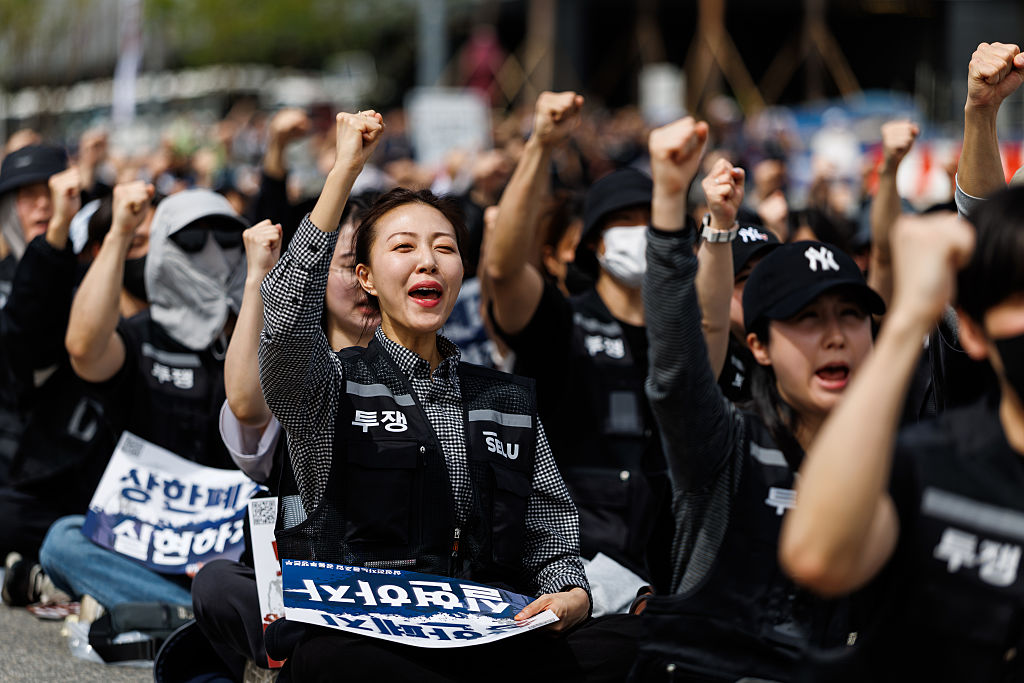
Samsung Electronics Co. workers chant slogans during a rally outside the company's semiconductor plant in Pyeongtaek, South Korea. (SeongJoon Cho / Bloomberg via Getty Images)
A planned strike at Samsung this month would have been the biggest industrial action in a South Korean workplace since the heyday of labor militancy in the 1980s, involving more than 47,000 workers.
It would almost certainly have been the biggest work stoppage in the history of the global semiconductor industry, where high pay and generous benefits often foster a sense of privilege and prestige among the majority of workers, despite their experience of chemically drenched working conditions, cutthroat competition, and long, risky working hours.
On May 21, Samsung Electronics Co., Ltd. and two unions at the world’s leading memory-chip maker reached a tentative wage agreement, ending six months of contentious negotiations and heading off the prospect of strike action the following day.
A Mixed Bag
For the unions and rank-and-file members, the deal is, at best, a mixed bag, marked by a vast incentive gap between memory chip and non–memory chip workers, each of whom will likely take home 620 million won ($408,000) and 190 million won ($125,000) respectively.
These payouts come in the form of treasury shares. Under South Korean regulations, these shares function more like non–publicly traded preferred stock — often dividend-bearing but without conferring voting rights on their holders — rather than being permanently withdrawn from circulation, as is common in Western capitalist economies.
Superficially, the deal appears to reflect mutual concessions between the unions and management, with employees giving up immediate cash remuneration in exchange for what seems to be generous corporate payouts. In reality, it represents a hodgepodge compromise.
Its negative repercussions are likely to extend beyond Samsung itself to the broader South Korean political economy, driven by anxieties over a volatile global artificial intelligence boom and the limited economic mandate of Lee Jae-myung’s liberal government.
The collective bargaining agreement, which has been reviewed by Jacobin, bifurcates compensation around Samsung’s two principal divisions: device solutions (DS), which covers semiconductors, and device experience (DX), which encompasses smartphones and other consumer products.
Under the agreement, base salary will increase by 4.1 percent. Treasury-share incentives will play out over three years, with one-third becoming cash-convertible each year. Payouts for DS workers are about six times as large as those for DX employees. This is a disparity that is likely to further deepen tensions between workers across the two divisions that were already apparent during the negotiations.
Value Added
When Samsung workers walked off the job for the first time in the company’s history two years ago, they demanded an end to the use of EVA (economic value added) as a metric and a ceiling on incentive payouts. Both demands have only partially been met.
EVA, a metric coined by a New York business consultant firm in the early 1980s, is designed to factor financial returns on capital costs into the determination of executive compensation. It has little to do with individual or collective shop-floor performance. When applied to nonexecutive compensation, it will be used to pass the burden of borrowing costs for investment on to ordinary employees.
Above all, this opaque metric is vulnerable to misuse, as management can bundle and unbundle arbitrary capital costs when it suits them in order to deliberately undermeasure worker performance and drive down pay. “Transparency” was one of the slogans adopted by the unions and frequently inscribed on their picket signs.
The agreement does not explicitly state that EVA is repealed. Instead it specifies that incentives will be paid according to a performance metric jointly determined by management and the unions for each pay cycle.
As for the ceiling, Samsung agreed to establish an incentive pool equivalent to 10.5 percent of after‑tax operating income, with no pay ceiling, exclusively for the DS division. The unions at Samsung were merely calling on the firm to follow the precedent taken by SK Hynix.
Samsung’s rival has grown significantly in recent years, riding high on the global AI boom thanks to its dominance in HBM (high bandwidth memory) chips, a core component in AI large language models (LLMs). In September of last year, SK Hynix decided to repeal the ceiling and create an incentive pool equivalent to 10 percent of operational income. This was a concession to joint demands pressed by its two labor unions, representing white-collar and blue-collar workers, respectively.
It was not that SK Hynix management was inherently more benevolent or responsive. Just a month before, Chey Tae-won, chairman of the conglomerate that controls the chipmaker, publicly opposed the proposal, claiming that “adherence to compensation” was a myopic approach that would not ensure “happiness.”
What sets Samsung and SK Hynix apart is the latter’s strong level of union representation, which includes more than 90 percent of chip fabrication workers and their demonstrated willingness to walk off the job in response to an unmet demand. This leverage has been further strengthened by the aversion of management to production disruptions in the midst of the global AI boom.
The Triple Alliance
At Samsung Electronics, three labor unions are currently cooperating with each other while simultaneously competing for dominance. Two years ago, the National Samsung Electronics Union (NSEU) led the conglomerate’s first strike, which ultimately petered out. Once broadly anchored in the DS division, the NSEU imploded in influence and membership following revelations of collusion with management.
The campaign leading to the latest wage agreement was instead orchestrated by Samsung Group United Union (SGUU). With a strong presence in the DS division, SGUU claims that it now represents more than 50 percent of the firm’s entire workforce. Meanwhile, workers in the DX division are represented, on a smaller scale, by the Donghaeng (“Companion”) labor union. Altogether, about 70 percent of the workforce, or about 47,000 workers, are now unionized.
At first, the three unions jointly formed a taskforce to bargain with management. By March, 91 percent across the three organizations voted to authorize an eighteen-day strike in June if the outcome of negotiations was not satisfactory.
However, the unity then began to fracture as Donghaeng resigned from the tri-union alliance, accusing the other unions of prioritizing the demands of chip fabrication workers at the expense of their colleagues. For the first quarter of fiscal 2026, semiconductors made up 94 percent of the conglomerate’s operating profit. Only a year ago, however, underperformance in the DS division slashed Samsung’s overall income in half.
Contradictory Mandate
The weakening of internal solidarity further encouraged government pressure on the unions at Samsung. On May 20, liberal President Lee threatened to invoke compulsory arbitration power in the event of a strike.
His threat came amid mounting concerns by tech giants both at home and abroad about production disruptions that might bring global chip supply chains to a halt, from data center construction to the production of smartphones. The president also criticized the demand of the unions for 15 percent of operating income to be allocated to an incentive pool: this was inappropriate, he claimed, because such profit sharing should be for shareholders rather than workers.
In fact, it was Lee Kun-hee, father of the current Samsung Chairman Lee Jae-yong, who first introduced the profit-sharing scheme in the early 1990s. It was intended to incentivize productivity in chip development and fabrication by financially compensating long, dangerous working hours. The son has now supplanted what is often touted as one of his late father’s most effective innovations with the EVA three-card trick and put a ceiling on the incentive pool.
Since he assumed office in June last year, President Lee has been pursuing what he termed a “money move” to channel funds from an overheated real estate market into an undervalued stock market. Lee campaigned on a pledge to lift South Korea’s stock index, the KOSPI, to a level of 5,000, which would mean nearly doubling its value.
Within five months of assuming office, he appeared to have made good on that promise as the KOSPI surged to its highest ever level, surpassing his pledge. By the last week of May, the index had risen above 8,000 — almost three times the level when Lee took office.
Lee attributed the gains to his amended commerce law, which mandated the retirement of treasury stock from any circulation. However, under the latest wage agreement, Samsung will exploit a loophole in the amended law by distributing treasury shares as incentives. Lee has remained silent on the matter, even though his labor secretary, a former president of the Korean Confederation of Trade Unions, brokered the deal.
The past six months of campaigning by Samsung labor unions challenged the idea that Lee’s legislative reforms or verbal interventions were responsible for the stock-market surge. In reality, South Korea was well positioned to benefit from the global AI windfall. Samsung Electronics and SK Hynix now account for nearly half of the KOSPI’s value.
The red-hot index is undoubtedly enriching many asset holders, to the point of giving rise to a new upper-middle-class constituency that self-identifies as “New Lee Jae-myung.” However, its overall economic impact is limited, with only 1.3 percent of index gains translating into overall increases in consumer spending, according to a May 2026 brief by the Bank of Korea.
Both flagship chipmakers achieved this momentum without major entrepreneurial breakthroughs of their own. HBM chips had limited applications beyond gaming graphic cards before Nvidia, the US chip designer behind the global AI boom, incorporated them into AI chip architectures for large language models.
For its part, Samsung has yet to develop a chip that meets Nvidia’s strict standards for top-tier AI chipsets. However, the conglomerate has received an enormous boost from the global expansion of AI data centers that is driving up demand for memory chips.
The Human Factor
Despite their shortcomings, ranging from weak solidarity to alleged collusion with management and the limited scope of their gains, the unions at Samsung showed that a sustained union campaign can still extract concessions, even from one of the world’s most powerful employers.
This is all the more notable in an emerging era of AI, with many pundits claiming that workers will be no longer able to fight back as AI is rendering much human labor increasingly irrelevant. So long as they need even a sliver of human labor to produce the components that power AI, the corporations will not be invincible.