Korea’s Samsung Workers Are Striking for the Very First Time
Samsung, the flagship of South Korean capitalism and one of the world’s biggest electronics firms, is facing its first-ever strike.
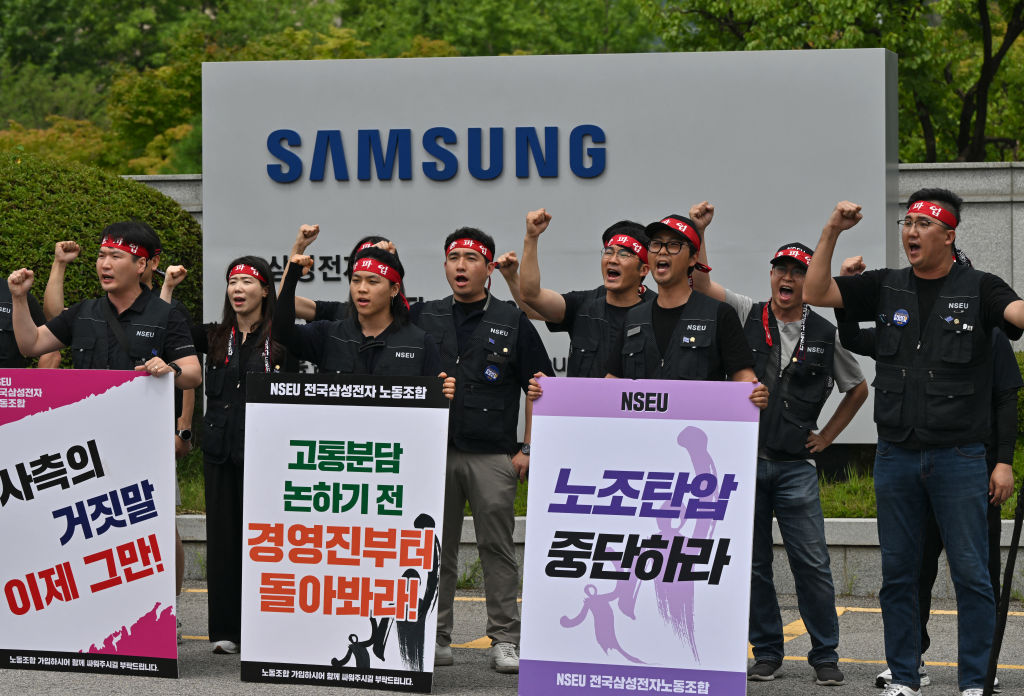
Members of the National Samsung Electronics Union outside the company’s Giheung Campus in Yongin on July 10, 2024. (Jung Yeon-je / AFP via Getty Images)
The Korean electronics firm Samsung is the world’s biggest manufacturer of memory chips. It also usually outpaces Apple, its main rival, for the production of smartphones. Until last month, Samsung’s workers had never gone on strike throughout its fifty-five-year history as a company, during a period that saw the rise of a strong labor movement in South Korea.
Yet after a one-day stoppage in June, a labor union representing Samsung workers, the National Samsung Electronics Union (NSEU), decided to extend their strike until further notice on July 10 as the company continues to dodge negotiations over pay and holidays. The NSEU represents about 25 percent of Samsung’s 125,000-strong workforce. The open-ended strike is the union’s latest attempt to step up pressure on the global tech giant, which has refused so far to engage in dialogue, citing the union’s lack of majority representation.
The union’s action appears to have strategic leverage over the company, since about 90 percent of the NSEU’s members are employed with device solutions, which is the integral part of chip production. The union leadership has said the strike will gradually cripple chip production: so far, only about sixty-five hundred workers have put down their tools.