Indonesia’s Army Is on the March Against Democratic Rights
An acid attack on the Indonesian human rights activist Andrie Yunus fits into a wider pattern of creeping authoritarianism under President Prabowo Subianto. Democratic gains since the fall of the Suharto dictatorship are being systematically eroded.
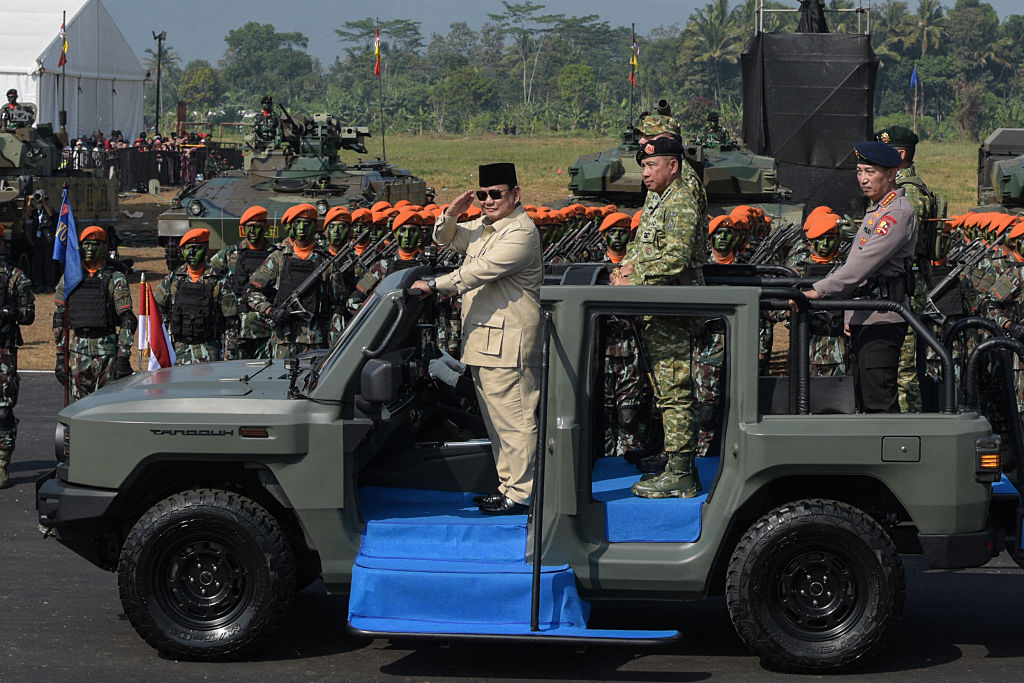
Indonesia’s president, Prabowo, has increasingly framed critics as threats to national unity. His rhetoric echoes the ideological framework of Suharto’s New Order, in which human rights activism was treated as a form of political sabotage. (Timur Matahari / AFP via Getty Images)
The acid attack on Indonesian human rights activist Andrie Yunus in March 2026 was a message written in chemical burns and delivered in the language of fear: dissent will be punished. For those familiar with Indonesia’s political history, the attack feels less like a shocking rupture than another grim echo of President Suharto’s New Order dictatorship.
Andrie’s assault also recalls the 2004 assassination of Munir Said Thalib, Indonesia’s most prominent human rights defender. The parallels reveal a continuity of violence, impunity, and state-linked intimidation that suggests Indonesia’s twenty-eight years of democratic gains are being systematically eroded.
Terror in Plain Sight
On March 12, 2026, two men on a motorcycle attacked Yunus, the deputy coordinator of the Commission for the Disappeared and Victims of Violence (KontraS). As he was riding his motorcycle home in Jakarta, they threw acid at him and fled the scene.
CCTV captured the attack, complete with audio of Andrie screaming in agony. The assault left him with burns across roughly a quarter of his body, including his face. He is now blind in one eye.
This was not a random act of violence. Andrie had just recorded a podcast criticizing the growing role of Indonesia’s military in civilian life, a subject that has become increasingly contentious under President Prabowo Subianto (himself a general dismissed for human rights violations after the fall of Suharto).
During the previous weeks, Andrie had been subject to various forms of intimidation, such as a series of anonymous calls. Clearly there was a systematic effort to spread fear among the country’s human rights activists.
Andrie was also a target for his work as a member of the Fact-Finding Commission (KPF). He spent months with KPF, an independent organization, investigating the nationwide protests against police brutality and corruption that began in August 2025. For a week, protesters shut down roadways and burned police stations in cities throughout the world’s fourth-largest nation.
In the course of the chaotic protests and the heavy-handed crackdowns with which they were met, there were at least a dozen deaths. Rumors spread that President Prabowo came close to instituting martial law in September. The state response was the largest wave of repression against civil society since the fall of the dictatorship in 1998. Andrie helped produce a KPF report accusing the security forces of using disproportionate force, mass arrests, and torture.
Dual Functions
Before those demonstrations, Andrie protested against the lack of transparency in revisions to the Indonesian Military Law. On March 15, 2025, together with other members of the civil society coalition, he forced his way into a parliamentary meeting at the Fairmont Hotel in Jakarta and interrupted the closed-door discussion of revisions to the military law between the government and Indonesia’s House of Representatives. This action protested the lack of transparency over the deliberations, which excluded public participation and risked reviving Dwifungsi, the military’s “dual function” Suharto-era doctrine.
Dwifungsi was a New Order policy that gave the military authority to act in domestic affairs as well as to defend the republic. Under Suharto, himself a general, the officer corps had seats reserved in parliament, engaged in extremely lucrative business ventures, and enjoyed a culture and practice of impunity. The 2004 Indonesian National Armed Forces Law was supposed to remove the military from civilian affairs and foster a return to the barracks. Twenty-two years later, this seems to have been a road not taken.
Human rights organizations were quick to identify the attack for what it was: an attempt to silence dissent. Amnesty International Indonesia’s executive director, Usman Hamid, described it as “a violent attack aimed at silencing human rights defenders,” while broader civil society groups warned that it fit into a pattern of intimidation targeting activists who challenge state power.
Within days, disturbing but unsurprising reports circulated that members of the Indonesian military were involved. Military authorities detained several soldiers. While official discourse claims that they were rogue actors, many critics of the army point toward a deeper crisis: the reemergence of security forces as political enforcers.
In a military court, four intelligence officers from the Strategic Intelligence Agency (BAIS) were charged with premeditated assault. A captain, two lieutenants, and a sergeant received between three years to eighteen months. Citing continuing concerns for his safety, Andrie did not attend the trial, and his lawyer called it a “sham.” Human rights observers have criticized the trial, believing the four soldiers are scapegoats protecting a larger conspiracy.
Munir’s Shadow
For Indonesians of a certain generation, this pattern is hauntingly familiar. In 2004, Munir Said Thalib, founder of KontraS and one of the country’s most courageous critics of military abuses, suddenly died aboard a long-haul flight with Garuda Indonesia, the national airline.
Munir had spent years documenting enforced disappearances, extrajudicial killings, and corruption within Indonesia’s armed forces. His murder bore all the hallmarks of a state-linked operation: careful planning, institutional complicity, and, ultimately, incomplete justice. His murder is one of the many examples of elite impunity in Southeast Asia.
Though a Garuda pilot called Pollycarpus Prinyanto was convicted, credible evidence pointed to the involvement of BIN, Indonesia’s intelligence agency. However, the full chain of command was never exposed. The masterminds were never held accountable, and even Pollycarpus only served a fraction of his twenty-year sentence.
Shortly before he died of COVID-19, Pollycarpus announced his membership in the political party of Tommy Suharto, son of the late dictator. In 2002, Tommy was convicted of hiring hit men to kill Supreme Court Justice Syafiuddin Kartasasmita and received a fifteen-year sentence but was freed in 2006.
Many hoped that Munir’s assassination would be the last gasp of a dying authoritarian order, a brutal reminder of the past that Indonesia was moving beyond. Instead, it now appears as a point of continuity.
A Pattern of Intimidation
The attack on Andrie did not occur in isolation. Since 2025, Indonesian activists, particularly those opposing the expansion of military authority, have faced increasing harassment, surveillance, and threats, as well as disinformation campaigns on social media. KontraS itself has reported repeated intimidation, including military vehicles monitoring its offices.
This escalation coincides with a series of political developments that have alarmed democratic observers. Chief among them is the revision of the Indonesian military law, which allows active-duty officers to occupy civilian positions, a direct challenge to the post-Suharto principle of civilian supremacy.
When mass protests erupted across Indonesia in August 2025, many expressed fears about the revival of the Dwifungsi. The state’s response to these protests (arrests, violence, and allegations of torture) only reinforced those fears. Andrie himself was involved in investigating these abuses, placing him squarely in the crosshairs of those who benefit from impunity.
What distinguishes the current moment is not only the violence itself but also the political climate that enables it. President Prabowo, who was also a son-in-law of Suharto, has increasingly framed critics as threats to national unity. He has dismissed dissenters as “unpatriotic,” invoking intelligence reports to question their motives. His rhetoric echoes the ideological framework of the New Order, in which opposition was equated with subversion and human rights activism was treated as a form of political sabotage.
Under Suharto, repression operated through a combination of overt violence and covert intimidation. Following all too familiar necropolitical practices, activists were kidnapped, disappeared, or killed, often by shadowy networks linked to the military.
In the Petrus “Mysterious Killings” of 1983–85, hundreds of young men were summarily executed as alleged petty criminals. Simply having tattoos was sufficient evidence for the death squads. As part of the reign of state terror, the bodies of the victims were left in public, often strung up like a lynching, to create a climate of pervasive fear.
The attack on Yunus fits this model with chilling precision. It punished one individual but is spectacular enough to attract attention to warn everyone.
Democratic Backsliding
Indonesia’s post-1998 democratic transition was built on a fragile consensus: the military would retreat from politics, civil liberties would be protected, and past abuses would not be repeated. That consensus is now unraveling. The reexpansion of military authority, the stigmatization of activists, and the apparent tolerance of, if not complicity in, attacks against dissenters all point toward a systematic rollback of democratic norms.
To argue that Indonesia is “returning” to the New Order is not to suggest a simple restoration of the Suharto-era dictatorship. History rarely repeats itself so neatly, but the structural similarities are undeniable.
Under both regimes, the military occupies a central role in political life. Under both, dissent is framed as a threat to national stability. Under both, violence against activists occurs within a context of impunity.
What is different today is the veneer of democracy in which elections, media pluralism, and formal legal protections coexist with illiberal practices. This hybrid system may, in some ways, be more insidious than outright dictatorship. It allows repression to operate in the shadows, obscured by the language of law and order.
Indonesia’s human rights movement has endured decades of repression. It survived the New Order, helped bring about democratic reform, and has continued to demand accountability in the face of persistent impunity.
But survival is not enough. Without meaningful accountability for attacks like the one on Yunus, without a clear break from the politics of intimidation, the space for dissent will continue to shrink.
Munir’s murder remains unresolved more than two decades later. If Andrie’s attackers are allowed to fade into the same fog of impunity, it will confirm what many activists already fear: Orde Baru Baru, “a new New Order.”