The Dark Indonesia Protests Are Challenging Prabowo’s Rule
Indonesia’s right-wing president Prabowo was elected with a commanding share of the youth vote in 2024. This year, a new youth protest movement is challenging Prabowo’s spending cuts and the role of the military in Indonesian politics.
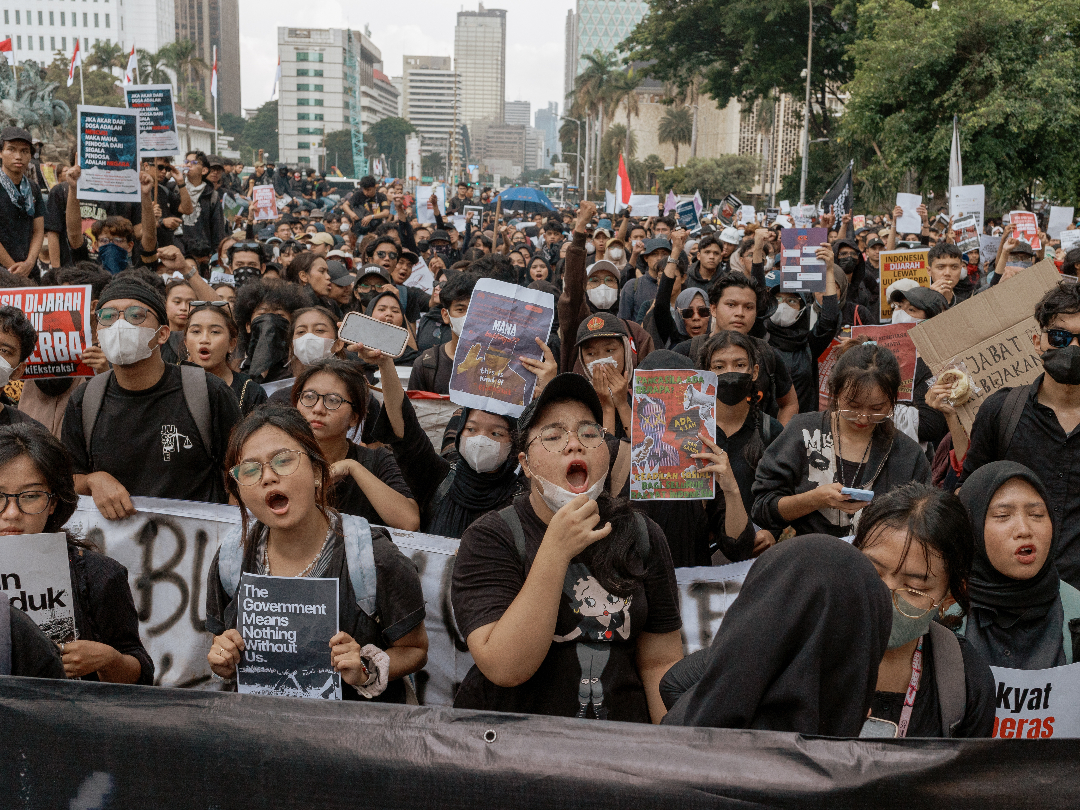
Demonstrators protest against Indonesian president Prabowo Subianto near the Presidential Palace in Jakarta, Indonesia, on Friday, February 21, 2025. (Muhammad Fadli / Bloomberg via Getty Images)
On Monday, February 17, in a series of demonstrations across Indonesia, students challenged President Prabowo Subianto. The protests continued all week, culminating in major events on Friday. Organized under the hashtag #IndonesiaGelap or #DarkIndonesia, the protesters oppose a range of the new administration’s policies, including budget cuts of Rp306.7 trillion (US$19 billion), the role of the military in domestic governance, nepotism, corruption, and the surprisingly controversial free school lunch program.
President Prabowo’s austerity measures triggered the angry outbursts. University students fear deep cuts to funding for schools will hurt their education. Others point to poorly funded government offices that are increasingly unable to serve the people. However, the various articulations of the movement’s goals as competing five-point, seven-point, and thirteen-point lists of demands single out police corruption, a new mining law that will benefit the wealthy, and the increasing power of the Tentara Nasional Indonesia (TNI), the Indonesian military.
Dual Function
During Suharto’s New Order dictatorship (1966–1998), the army adopted a wide range of domestic authority and power under the policy of dwifungsi, or “dual function.” With the restoration of democracy, the military was supposed to return to the barracks, but the process was incomplete at best. Currently Prabowo has mused about returning to and expanding dwifungsi.