Pushed Face to the Ground, Abderrahim Fakir Couldn’t Breathe
Abderrahim Fakir died of suspected lung compression after several minutes pressed to the ground by Italian police. The killing has shone a light over police impunity, just months after a new law helped shield officers from prosecution.
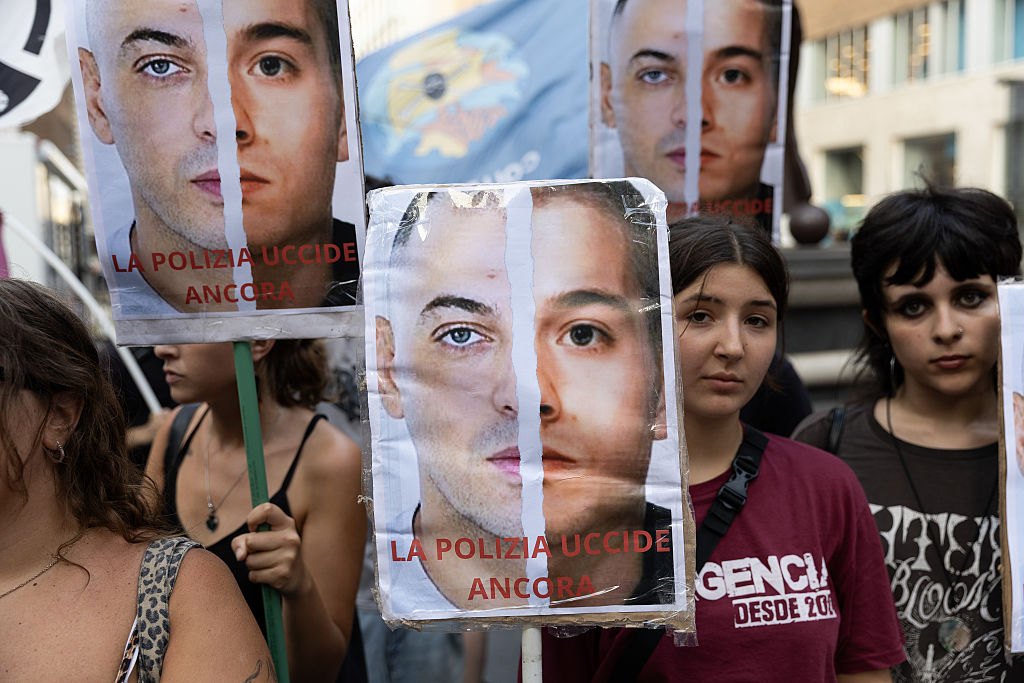
Earlier this year, the Italian government passed a law helping shield police from prosecution. After police killed 42-year-old Abderrahim Fakir in Bologna last Sunday, protesters say the law is feeding a climate of police impunity. (Iso Ekle / Anadolu via Getty Images)
Anger stirred in Italy this past week after forty-two-year-old Abderrahim Fakir was killed while under police restraint during a routine check in Bologna. On Sunday, Fakir’s neighbors had called emergency number 118 after hearing screams, and police arrived first on the scene. Video footage shows two officers grabbing the man and holding him face down on the street for several minutes, applying pressure on his back after pepper-spraying him while he was already face to the ground, his ankles bound. When paramedics arrived, they stood watching as Fakir cried “help, stop.” He then stopped talking and moving, before being pronounced dead at the scene. A later preliminary exam showed lung compression was a possible cause of death.
Fakir was a Moroccan national, and the country’s embassy said it was “following the case closely and with deep concern.” The Bologna city attorney has already opened a case against two officers and four paramedics, ordering an autopsy. But this case is also significant because for the first time a so-called criminal shield was invoked. This legal device, introduced in the right-wing government’s security decree this April, can prevent attorneys from writing someone on the suspect list if there is reason to believe they acted in self-defense or — crucially for violence by police — in the line of duty. This restarted debates about the propriety of this measure that many Italians already feared would give police too much power, and even impunity.
“They murdered him in cold blood. We are asking for justice and the truth about my brother’s death,” said the victim’s sister Khadija Fakir as she and hundreds of other people gathered spontaneously in Bologna on Sunday night to protest the killing. This event sparked sadness but also anger among social movements, who called for a reform of Italy’s institutions and police system. The next day, Bologna’s mayor Matteo Lepore pleaded for a “united city,” as he called for and then attended a further demonstration on Monday, at which thousands of people gathered in the city’s central Piazza del Nettuno. “Those who wear a uniform bear a huge responsibility: to protect people, especially the most vulnerable,” Yossra, Fakir’s niece, insisted from the stage.
When some activists confronted the police forces deployed in the square, as people were trying to reach the police prefecture in Bologna’s Piazza Roosevelt, tensions rose. Within minutes, the confrontation spiraled from shoving to the police using tear gas and water cannons. It’s an all-too-common feature of the Italian state’s way of imposing public order. The protest ended in violent clashes, with many activists hurt and cars set on fire.
If Fakir’s death again brought out a deep polarization in Italian politics, it was the conflict at this protest march that really made the masks fall. The ruling right-wing coalition had soon expressed solidarity with the police agents involved in the fatal incident. The Senate president Ignazio La Russa — a longtime member of the neofascist Movimento Sociale Italiano — said he “always stands with police” and expressed his distance from those “who can always be assumed to be against them,” adding that he has full “trust in the judicial system” to find out what happened. The opposition reaction was, however, timid. The Partito Democratico’s leader Elly Schlein said “the state has failed and has the responsibility to shed light on this tragedy.” Nicola Fratoianni, another prominent center-left opposition leader, asked for questions in Parliament for the justice and interior ministers.
Political leaders of all colors distanced themselves from activists. Prime Minister Giorgia Meloni spoke of “unacceptable violence against the police,” in a claim echoed by both the ruling and opposition coalitions. Many representatives — both members of far-right parties like Matteo Salvini’s Lega and centrists like Azione’s leader Carlo Calenda — went further, calling for Bologna’s center-left Mayor Lepore to resign over having attended the demonstration and called for the protest to happen. On Wednesday, the police union Sindacato Autonomo di Polizia (SAP) instructed a lawyer to file charges against Mayor Lepore to make him “answer for the damage from a demonstration he organized.” Even though this is a right-wing union, the tensions between these different organs of the Italian state should not be underestimated.
These reactions vastly oversimplified what happened. They prevented any assessment of whether the police had indulged in a disproportionate use of force from the start and whether it had fueled tensions, which were already high given the anger over Fakir’s death. In the last year, there have been repeated clashes between left-wing activists and police, and condemnation by opposition leaders has widened the distance between social movements and the political class.
Lack of Transparency
The deep concern over police violence and officers’ responsibility for Fakir’s death extended beyond Bologna itself. Demonstrations were organized in cities across Italy in the last week, including in the capital, Rome.
If this was all somehow reminiscent of what happened to George Floyd in the United States in 2020, it is not the first time it has happened in Italy either. Many similar cases in the past have shown an unjustified use of force by police officers, causing the death of men in custody.
Federico Aldrovandi, Igor Squeo, Stefano Cucchi, and Riccardo Magherini were just some of the best-known cases. Aldrovandi was killed in 2005, when he was eighteen years old. His mother, Patrizia Moretti, this week told Italian daily Corriere della Sera that Fakir’s “cry for help sounded like my son’s. I struggled a lot watching that video,” as the pain from her son’s death resurfaced. She expressed concern over the use of the “criminal shield” to protect police officers from investigation, “where there should be complete transparency, and the determination to prevent these events from happening.”
According to Moretti, it isn’t yet obvious whether that will happen: “I fear there is a tendency to distract from what happened and to blame the victim, by looking into his past and speculating about him. But no one should ever pay with their life.” Here, Moretti was referring to the propaganda used by the far-right parties and some national media outlets in recent days, who dug into Fakir’s past in order to uncover some minor criminal charges he faced years ago — trying to shift the public blame from the police officers to their victim. It’s an example of what sociologist and politician Luigi Manconi often called a “double death” — one that kills the person, and a second that kills their image.
This same approach had been used on Stefano Cucchi, depicting him as a criminal who went looking for trouble. He died from severe beating by police officers in 2009. His sister Ilaria Cucchi, now a senator, made it her life’s cause to change the Italian police and penitentiary system.
Riccardo Magherini was killed just like Abderrahim Fakir, pushed face down on the street for more than twenty minutes, during a police stop in Florence in 2014. Twelve years on, this January 15, 2026, Italy was finally condemned by the European Court for Human Rights (CEDU) regarding that case. The Court concluded that the “prolonged position and physical pressure” under which he was kept was “unnecessary.”
Yet this did not prevent Fakir’s death or the propaganda that followed it. And we are still waiting for a frank debate that will lead to real reform of how police are trained.