In Defense of the Fourth of July

The Declaration of Independence has been quoted by abolitionists, suffragists, socialists, civil rights activists, and the Black Panthers. Why should conservatives get to own it now?
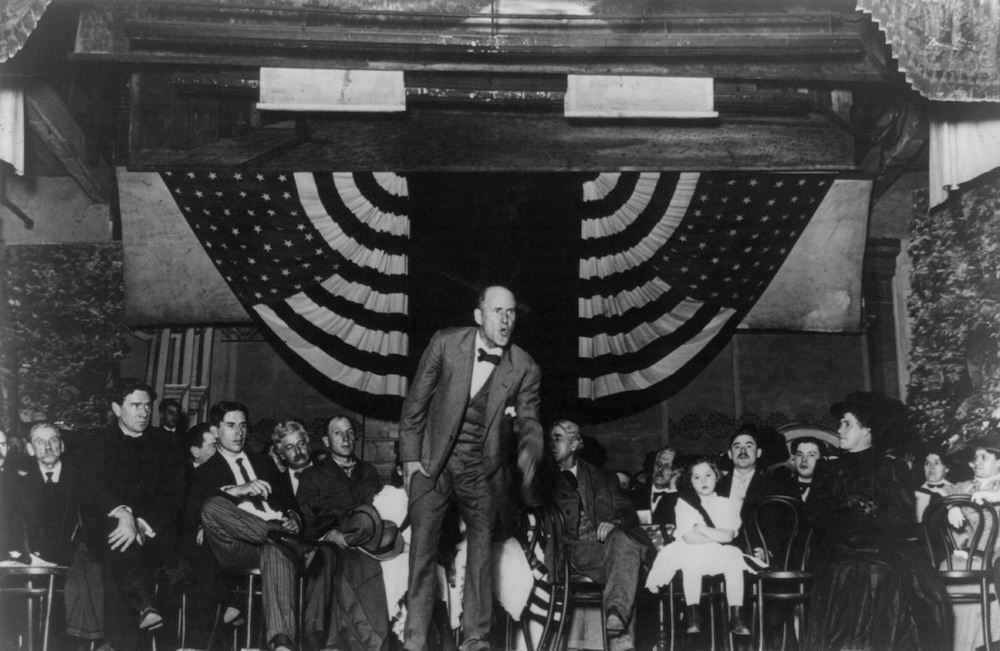
Eugene V. Debs addresses a crowd in front of an American flag.

"The 4th day of July, as a national holiday, commemorates an event which ought to be very dear to American workingmen," claimed Socialist leader Eugene V. Debs.


“I like the Fourth of July, it breathes a spirit of revolution,” said Eugene V. Debs in a 1901 Independence Day speech. The socialist firebrand was far from blindly patriotic (“I am not of those who worship the flag,” he added in the same speech), but throughout his life, Debs refused to let the American flag, the Fourth, or the revolutionary inheritance of 1776 fully fall into the hands of reactionaries.

Debs consistently cast himself as an heir to a native tradition of dissent, invoking not only John Brown, Thaddeus Stevens, Susan B. Anthony, but also Thomas Jefferson, Thomas Paine, and Abraham Lincoln. For Debs, these figures were not just ancestors cast in marble, but unfinished business. The American Revolution had announced a principle that capitalism, racial hierarchy, and class rule had betrayed. Socialism, in Debs’s telling, was not some foreign poison poured into the American bloodstream but the next democratic demand made by the same revolutionary spirit that had once waged a war on monarchy itself. Why abandon the American democratic promise when you ask it to live up to its own ideals?

Yet, “I like the Fourth of July” is not a popular take on the Left in the twenty-first century. This is a mistake. It’s one thing to say the American Revolution was compromised. It is another to say it is useless. The Left has increasingly confused the two. As Debs proves, it’s entirely possible to separate the art from the artist.

Growing Paines

The socialist case for 1776 is not that the Revolution was some pure emancipatory rebellion, but that it was historically progressive — far more than just a tax revolt by annoyed Boston merchants. It was a sustained, often genuinely radical argument — argued in pamphlets, sermons, town meetings, and taverns before it reached the battlefield — against the idea that some people are born to rule others. The British Empire represented monarchy, aristocracy, and imperial rule. Certainly, the Founders were not secular saints: many were slaveholders, speculators, creditors, pursuers of Native displacement, and men of property whose idea of liberty often stopped at the edge of their own class interests. But the colonies, for all their contradictions, were also fighting for self-government, national independence, and a wider democratic horizon.

Anti-imperial revolt against a distant, extractive metropole; a refusal of aristocratic privilege; a claim to popular sovereignty against rule by birthright — these are not incidentally compatible with left politics.

Just ask Thomas Paine, America’s original left-wing populist, who criticized monarchy in language so blunt it still practically draws blood. In Common Sense, he called England’s king “the Royal Brute of Britain,” who “hath wickedly broken through every moral and human obligation, trampled nature and conscience beneath his feet, and by a steady and constitutional spirit of insolence and cruelty procured for himself a universal hatred.” He understood that the point of republican politics was not simply to replace one bad king with wiser administrators. It was to destroy the idea that anyone had a natural right to rule. That’s why Paine wasn’t just offended by the British ruler, but monarchs in general, calling them absurd, useless — even evil. Monarchy “was the most prosperous invention the Devil ever set on foot for the promotion of idolatry,” he wrote.

It’s hard to overstate how much Paine’s words helped shape the political ideology of the Revolution, even if it also served the Founders’ self-interest. Common Sense, published in January 1776, perhaps sold somewhere north of 100,000 copies in its first few months in a colonial population of perhaps two and a half million free adults — proportionally the best-selling book in American history. In 1776, Paine’s searing words were crucial to inspiring the American Revolution. “Without the pen of the author of Common Sense,” John Adams is alleged to have said, “the sword of Washington would have been raised in vain.”

Then there are the words of the Declaration of Independence itself, which have done more damage to hierarchy than almost any political sentence in the English language. “All men are created equal” was written by a slaveholder, which is both the central American hypocrisy and the reason the line has never stopped burning. Its power lies partly in the gap between who wrote it and what it said. Jefferson did not live up to it, nor did the republic he helped found. But the words transcended him almost immediately. Abolitionists invoked it relentlessly, and Frederick Douglass didn’t reject the Declaration of Independence in his famous 1852 speech (“What, to the American slave, is your Fourth of July?”) — he beat the country over the head with it, demanding it mean what it said. Elizabeth Cady Stanton, at Seneca Falls in 1848, also didn’t write a new manifesto. Instead, she sat down and rewrote the Declaration, replacing “King George” with “man” and insisting that the self-evident truths be self-evident.

Even the Black Panthers, who were not exactly in danger of being mistaken for Daughters of the American Revolution docents, understood this. Their Ten-Point Program concluded with a lengthy quotation from the Declaration of Independence. They used the language of rights, grievances, and the right to alter or abolish oppressive government because they knew American power could be indicted in the language it claimed for itself.

The Unfinished Revolution

For the past half-century, since the bicentennial, the Left has treated the American project not as unfinished but as inherently fraudulent. In doing so, it’s fully ceded 1776 to conservatives who have reduced the Revolution to conservative kitsch: tricorn hats, powdered-wig memes, patriotic lesson plans, decorative muskets, and the general conviction that America was born perfect until the universities came along and spilled Foucault all over the parchment.

The notion that 1776 is a solidly conservative property was formalized by Donald Trump, who, in his first term, convened a “1776 Commission” to draft a so-called “patriotic education” to counter what he called the “left-wing indoctrination” of American schoolchildren. The commission’s report was a thin, ahistorical pamphlet, more interested in flattering the Founders than understanding them. It also goes to great lengths to make villains out of progressivism, communism, and identity politics as “false theories” that betray the ideals of the founding of America.

Yet, the 1776 Commission had a perfect foil. Two years earlier, the New York Times had published the 1619 Project, which relocated the country’s true founding to the arrival of the first slave ship at Point Comfort, Virginia, and recast the Revolution itself as, in part, a counterrevolution waged to protect slavery from a supposedly abolitionist Britain. Historians picked that claim apart fairly thoroughly. But the project’s deeper argument — that 1776 is best understood as original sin rather than founding myth persists.

The 1619 Project wasn’t wrong to insist that slavery sits at the center of American history rather than its footnotes. But it was wrong to treat that as the whole story — as though Paine’s antimonarchical argument was simply a cover for slaveholders’ property interests, rather than a genuinely separate current that abolitionists spent the next eighty years dragging toward its logical conclusion. The point isn’t to adjudicate which tradition was more “authentically” American. It’s that two things can be true at once: the Revolution was deeply compromised, and the language of the Revolution has always been the most effective instrument the American left has ever wielded.

It’s why, when Karl Marx wrote Abraham Lincoln on behalf of the First International during the Civil War, he told the president that “as the American War of Independence initiated a new era of ascendancy for the middle class, so the American Antislavery War will do for the working classes.” The Revolution represented by 1776 didn’t truly end when King George surrendered; the claim that “all men are created equal” was a promise to be fulfilled by future generations.

The Left’s posture has changed from “America hasn’t lived up to its ideals” to “America’s ideals are themselves the problem,” which might appear as radicalization. It’s actually a retreat — unilateral disarmament from a weapon that has worked in American politics for a moral purity that has nowhere to go.

Reclaiming the Day

Today, the invocation of the Revolution has shifted once again, this time toward older mainstream liberals defying Trump in the streets under the slogan “No Kings.” It’s common to go to a No Kings protest and hear liberals clad in American Revolution costumes chanting for limits on executive authority (“No Kings, No Tyrants!”) and waving the kind of Don’t Tread on Me flags that, a decade ago, were flown by libertarians.

That the old Tea Party costume box has been passed to the resistance libs is, in one sense, comic. But it is also revealing. “No Kings” works because it touches something deeper than anti-Trump proceduralism. It does what all the best American radical language does: it converts a specific political crisis into a simple republican principle. No kings. No rulers by birthright. No presidents as sovereigns. No executive who treats law as a nuisance, office as property, and loyalty as the highest civic virtue. The slogan is almost childish, which is why it is so effective. It reaches beneath the bloodless vocabulary of norms and institutions and hits the nerve center of American politics.

The Left’s job isn’t to compete with the liberals for ownership of the wig-and-bayonet aesthetic. It’s to insist on the more radical reading — one that asks not just “is this constitutional?” but “who has power over whom, and why?” A genuine left 1776 Project would say that the Revolution’s core claim — that no one is born with the right to rule anyone else — doesn’t stop at the White House. It applies to the boss, the landlord, the monopoly, and the creditor just as much as the king. That was Debs’s argument. The Revolution as a permanent demand, not a founding moment encased in glass.

America’s 250th anniversary is here, and Trump is busy acting like the Second Coming of King George. What would Thomas Paine do?