Holocaust and Genocide Scholars Are Navigating a Minefield
Since October 7, academic institutions have applied overt and covert pressure to discourage Holocaust and genocide scholars from criticizing Israel’s actions in Gaza. Still, many academics are organizing new networks to defend free inquiry.
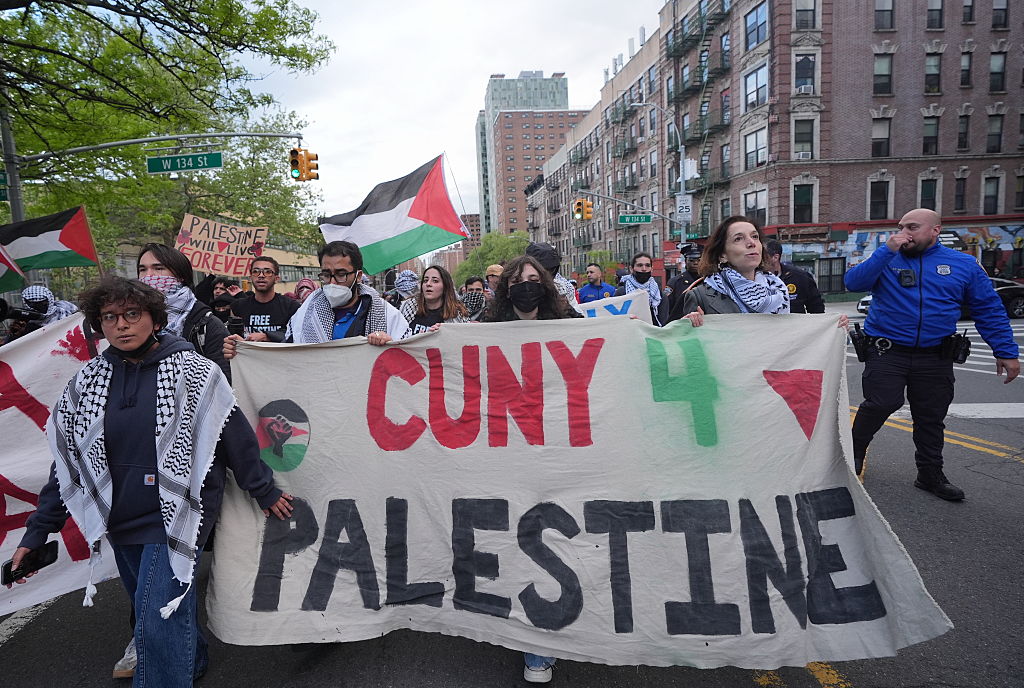
Since October 7, the atmosphere in Holocaust and genocide studies departments has grown thick with suspicion and warning, causing scholars to shy away from analogizing Israel’s actions in Gaza. But a new architecture of dissent is emerging. (Selcuk Acar / Anadolu via Getty Images)
Since Hamas’s attack on Israel on October 7, 2023, and Israel’s ensuing war on Gaza, few academic fields have experienced more internal upheaval than Holocaust and genocide studies. Scholars who once shared broad institutional consensus now find themselves divided over whether Gaza constitutes genocide, whether antisemitism and Holocaust memory are being politically weaponized, and whether universities can still be said to permit open debate on critical and contentious questions.
Broad and often subtle effects have begun to structurally transform how research, engagement, and intellectual debate within these fields are processed and legitimized. Jobs are increasingly insecure, research funding is harder to come by, and academics are facing micromanagement and harassment from forces both internal and external. These broader trends are dovetailing with the political climate to create a uniquely thick atmosphere of trepidation in Holocaust and genocide studies.
In an effort to understand how these fields are navigating this juncture, Jacobin spoke with a diverse array of scholars and experts. Despite the mounting pressures, I found many of them to be optimistic. New organizations devoted to debate and academic freedom have emerged, as have new conversations and paradigms that years ago would’ve been deemed unrealistic or problematic. The current moment is indeed dire, but it also offers glimmers of potential for those willing to look past sensational headlines.
The Big Chill
Within our current environment of controversy around Gaza and Israel, many have observed a chilling effect, where any deviation from strict pro-Israel boosterism is met with opprobrium and official censure. Since 2023, professors and students have been routinely doxed by pro-Israeli groups. Professors have been fired, suspended, or demoted for statements or works. Speakers have been canceled or harshly criticized for their actions during commencement speeches or course-related events. The Foundation for Individual Rights and Expression (FIRE) even found that in the year after October 7, “students, faculty, and invited speakers faced retaliation nearly every single day” for political speech related to the controversy. While a handful of examples involved pro-Israel speech, the overwhelming majority were targeted at pro-Palestine speech.
This phenomenon has been widely covered. What has not been adequately addressed is how this chilling effect has evolved in the years since the October 7 attacks. Since the earlier days of high-profile cancellations and firings, repression has grown more subtle, enacted through the various internal institutional hoops and hurdles that characterize contemporary academia.
Research funding and the ability to publish essays, chapters, and full-length books are extremely important for professional security. Tenure-track positions come with strings attached and often require professors to conduct original research that will expand knowledge in their field. Meeting these requirements is not something an academic can do in a vacuum; there are always many cooks in the kitchen, from administrators to publishers to boards and committees.
These burdensome procedural areas create an environment rife for quiet repression on a granular level. Sandra Babcock, a clinical professor who teaches international human rights at Cornell University, recalled being forced to jump through various hurdles for a live interview relating to a report on apartheid in Israel. Before the interview, she was instructed to make clear that her views were not affiliated with Cornell. The university then banned her from using the traditional digital backdrop showing an aerial view of the campus, Babcock said, which appears in virtually all videos shot at the studio. The studio director, she said, “had to take pictures of his own apartment because he didn’t have any other backdrops because this had never happened before. . . . We had to use pictures of the venetian blinds in his apartment.”
Work pertaining to Palestine, Israel, or related areas carries with it a unique possibility for reprisal or pressure, which causes academics to shy away entirely when it’s not central to their area of expertise. In conversation with Jacobin, many scholars described having to fill in for certain courses because the professor on duty was hesitant to address contentious subjects.
Political disputes have also made the research funding landscape noticeably harder to navigate. “Imagine you’re a younger scholar who studies comparative genocide,” said Eric Kurlander, a professor of history and Jewish studies at Stetson University. “You say, I’m going to look at the Holocaust, the Armenian genocide, and the genocide in Cambodia. And suddenly doing that work at a particular school or funding institute means you’re antisemitic because you’re comparing the Holocaust to other genocides.”
Kurlander added that these allegations have now even been applied to simple statements of fact or, at the very least, empirically defensible points of view within academic debate. “Let’s say you study the Middle East and you’re giving lectures on what Israel may have done that’s oppressive or colonialist [toward the Palestinians], and now that’s seen as antisemitic,” he said. “So, in those cases, there have been problems, often from university administrations, sometimes from Jewish studies programs, trying to maintain a certain kind of narrative.”
Research questions, even those which are far removed from public areas of contention, have faced expanded pressure. At the same time, academics have been forced to adapt to political trends — and to situations where departmental narratives directly contradict their own research. Want tenure? Make sure to play ball with your department. Want an easier time finding funding? Use language that circumvents certain phrases or ideas.
Applying for funding for entire swaths of research now requires much more caution, and attention to contentious terminology and debate has especially emerged as something which must be tracked constantly. In 2025 alone, the Trump administration withheld billions in funds for various schools that were alleged to have antisemitism problems on campus.
Several of those I spoke with found conducting their research increasingly difficult, and even more interviewees expressed concern about the decline of real and honest discussions within their field. Concerning recent divisions, Professor Debórah Dwork, a historian of the Holocaust and the founding director of the City University of New York’s Center for the Study of the Holocaust, Genocide, and Crimes Against Humanity, told me:
The Holocaust history field is split, with some of my colleagues denying that a genocide did occur and is occurring in Gaza. They base their arguments on the allegation that a successor state of the Holocaust could not possibly be perpetrators. And what I find remarkable is that it is as if Auschwitz and the history of Auschwitz operate like a lens that distorts their view. It’s not a lens that offers them a nuanced view. On the contrary: applying the Auschwitz lens, perfectly rational people become irrational on this subject.
Several of the Holocaust experts I spoke with described increased friction with colleagues, departmental narratives, and, especially, with vital institutions that have been cornerstones of research and debate for decades. Among those mentioned were the US Holocaust Memorial Museum in Washington, DC, the Center for Jewish History in New York City, and other smaller archives and museums.
These have long provided pivotal support to young researchers and established academics, aiding them in critically examining questions and concerns within their fields. But some within the field have begun to take more critical stances against what they described as increasingly hypocritical behavior from these institutions. They charge these organizations and others with failing to adequately address the genocide in Gaza and even earlier forms of ethnic cleansing and violence that have occurred since the Nakba.
Genocide scholar Marianne Hirsch, a Columbia University professor emerita who has suspended her classroom teaching in protest of the university’s adoption of a broad definition of antisemitism that includes anti-Israel speech, put this issue quite succinctly. “I think all these institutions have basically failed us because they’re spouting a lot of hypocritical lies,” she told Jacobin. “There’s a lot of denial. There’s a lot of unwillingness to look at the reality of what’s happening on the ground.”
These disagreements with institutions, departments, and campus administrators have eroded trust and brought about a crisis of legitimacy. Scholars emphasized that antisemitism was now being routinely weaponized against those who were critical of Israel, especially against professors who align themselves with the Left. Many expressed shock at the readiness to condemn even Jewish professors as antisemites.
People I spoke to described the repression as directly impacting departments and their output. Increased pressure from both the government and private groups led universities to restrict and regulate curricula. Terms and contentious topics, such as the Nakba or the war in Gaza, suddenly, as a matter of campus policy, became unfit for teaching because of their ability to generate protest and reprisal. Most vitally, federal funding and grants were paused and threatened as a form of soft — or sometimes not-so-soft — censorship.
As this new reality took hold, many vital clinics and courses have suffered as their scope of work has been limited and their activities surveilled. Core institutional guardrails have taken serious hits, including tenure-track jobs, free speech protections, harassment protections, and access to funding. If current trends continue, political pressure and institutional incentives threaten to gradually reshape research agendas as new generations compete for funding, job security, and personal safety in a post–October 7 world.
The Genocide and Holocaust Studies Crisis Network
What was most surprising to me in surveying the terrain of these disciplines was how optimistic everyone I spoke to remained, despite many causes for demoralization. Rather than acquiesce, a solid majority have even created and engaged with organizations devoted to bolstering free speech, protecting academics, and preserving institutional legitimacy. The most substantial of these that I came across was the Genocide and Holocaust Studies Crisis Network (GHSCN), made up of hundreds of academics trying to save their fields from repression and structural degradation.
The network has drafted and signed letters challenging university practices that they believe harm academic expression and research. A key concern has been the growing adoption of the International Holocaust Remembrance Alliance’s (IHRA) definition of antisemitism, which equates antisemitism with criticism of Israel — the same definition Hirsch protested at Columbia.
“We wrote a letter that was signed by something like 1,200 scholars of Holocaust and genocide studies,” Brett Ashley Kaplan of the University of Illinois told Jacobin, “which said that this definition has a chilling effect on free speech and that people should be allowed to express themselves.”
The network is also engaged in the difficult academic and moral questions currently facing these fields. Especially within Holocaust studies, two professors I spoke with highlighted a growing need to reconcile the horrors of the Holocaust with the reality that the oppressed can become the oppressor, and that this warrants a greater degree of discussion around the memory of the Holocaust and what “Never Again” means in the context of Gaza.
Others highlighted the weaponization of not only antisemitism broadly but also of the specific memory of Holocaust. They emphasized a need to remember the horrors and lessons of the Holocaust without also justifying or trivializing modern-day ethnonationalist violence, ethnic cleansing, and genocide. Most important within these criticisms was a growing call to view the Holocaust’s place in history differently, as a story not just about one particular episode but instead about the ultimate trajectory of political currents that maintain influence today. Dwork described these ongoing critiques quite succinctly, telling Jacobin:
There are others, all too many others, who view the Holocaust as if it were only about the murder of the Jews of Europe. And if it were a unique event, what would be the point of studying it? It would be relevant to nothing, so I think that’s a dead-end argument.
Some scholars have begun to construct and argue new paradigms for their departments. Professor Barry Trachtenberg of Wake Forest University, for example, brought to my attention the Liberatory Jewish Studies Network, comprised of students and professors who have begun to imagine what the field of Jewish studies can be outside of Zionism and other long-held paradigms.
Importantly, during my many conversations, no one described the long-dominant assumptions and orientations within Holocaust and genocide studies as evil, nor did they describe them in exaggerated terms. Instead, these scholars encouraged the emergence and debate and the permission of other areas of thought. The terms non-Zionist, post-Zionist, and anti-Zionist emerged frequently, as did ways of thinking that call for attention to previous genocides and systems of oppression that are often misunderstood or never discussed at all. New lines of inquiry, debate, and focus are in development as dissenting networks try to create a steadfast institutional bulwark against democratic decline and the erosion of academic legitimacy.
Everyone I spoke to remarked on the profound chilling effect, its negative impact on colleagues, and the enormous systemic hurdles that are emerging for younger scholars willing to challenge orthodoxy. But they also sounded a hopeful note about the field’s future and the prospects for open debate. They spoke of protecting the right of all scholars, regardless of political persuasion, to pursue their areas of concern without pressure or censorship, and of the growing need to study fraught questions without fear of reprisal. Their message was one of democratic resistance by means of academic rigor and free inquiry, offering an optimistic suggestion for how the field can survive and thrive.