Socialism Was Central to W. E. B. Du Bois’s Thought
The leading black intellectual and freedom fighter W. E. B. Du Bois was a longtime committed socialist and, eventually, a Marxist — commitments that were central to his life and work. Liberals are dead set on suppressing this aspect of his legacy.
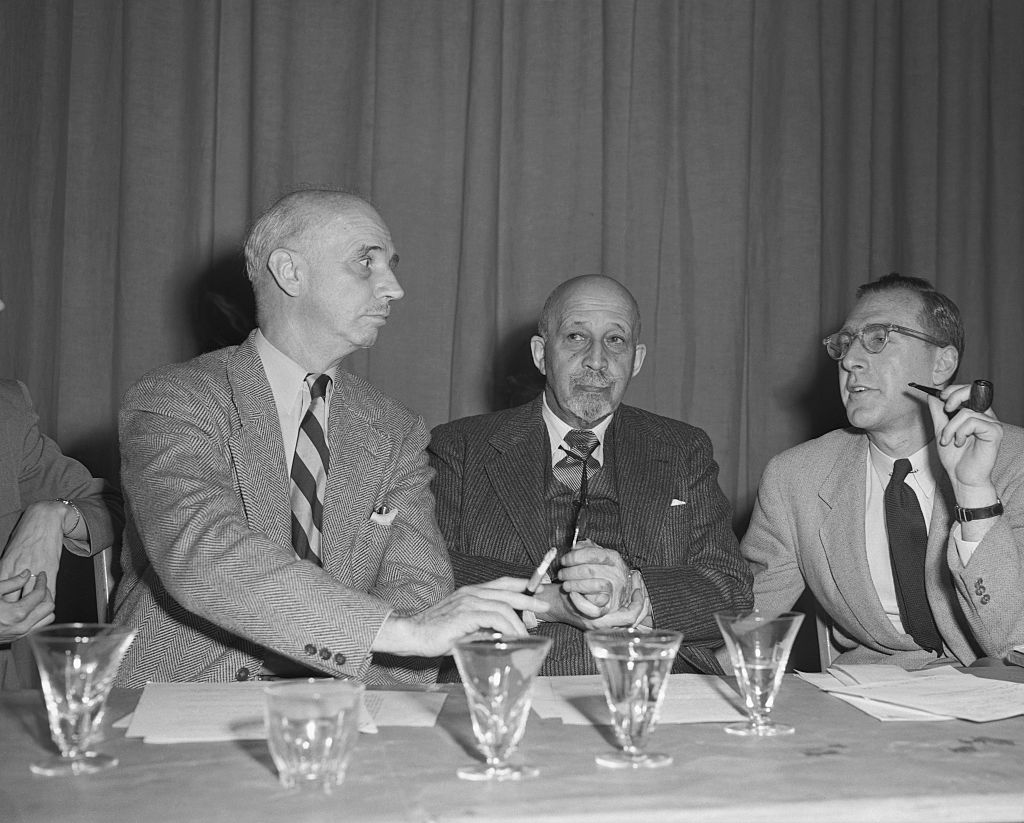
W. E. B. Du Bois participates in a press conference at the April 1949 World Congress for Peace in Paris, a largely Soviet-directed initiative. (Bettmann Archive via Getty Images)
In 1935, W. E. B. Du Bois told his friend George Streator, “I believe in Karl Marx. I am an out and out opponent of modern capitalistic labor exploitation. I believe in the ultimate triumph of socialism in a reasonable time, and I mean by socialism, the ownership of capital and machines by the state, and equality of income.” A clearer short summary of Du Bois’s political perspective would be difficult to find.
Du Bois was sixty-seven years old when he wrote these words and at the height of his intellectual powers and influence. He had recently completed a quarter century editing The Crisis, the influential magazine of the National Association for the Advancement of Colored People (NAACP), the civil rights organization he had helped to found in 1909. The previous week, Du Bois had submitted to his publisher the final proofs of his magnum opus, Black Reconstruction in America, his magisterial contribution to what has been called the Black Marxist tradition — a book that produced, in the words of his biographer, David Levering Lewis, “one of those genuine paradigm shifts periodically experienced in a field of knowledge, one that sunders regnant interpretations into the before-and-after of its sudden, disorienting emergence.”
Rebel With What Cause?
Rita Coburn’s sprawling new PBS documentary, W. E. B. Du Bois: Rebel With a Cause, released last month, is brimming with words: the words of Du Bois, read dramatically by several actors; the words of Du Bois’s contemporaries; the words of an omniscient narrator, the actress and producer Viola Davis; and the words of commentators — lots and lots of academic commentators. But Du Bois’s letter to Streator is not mentioned. In fact, the viewer will never hear, not once, one word about Du Bois’s intellectual turn to Marxism in the early 1930s, the motives behind it, or how it shaped his ideas about race, Black Reconstruction, or any of his subsequent writings and activities.
The Coburn documentary does acknowledge Du Bois’s embrace of the communist movement following World War II and the fact that he eventually joined the Communist Party in 1961 at the age of ninety-three, two years before his death. But there is no discussion of his long-standing socialist beliefs — which date back to at least 1907 — or of the reasons why Du Bois was attracted to socialism and, later, communism. Nor is there any discussion of how Du Bois’s Marxist and socialist views shaped his perspective on race, racial oppression, and black liberation. On the contrary, the documentary systematically obscures Du Bois’s radicalism in order to present him as a liberal “civil rights pioneer” who naively espoused communism as an old man.
Rebel With a Cause is in fact a brilliant work of liberal propaganda. The documentary is fast-paced and stretches nearly two hours. It is chock-full of facts and observations about Du Bois’s long life. It feels as if every one of Du Bois’s ninety-five years receives some mention. Photographs, newsreels, audio recordings, dramatic readings, and commentary abound. Those who are not familiar with Du Bois’s life and writings are likely to feel that this is an exhaustively researched portrait of the man.
And yet, by means of a hundred and one omissions, Coburn presents a fundamentally distorted and misleading picture of Du Bois. His socialist and Marxist commitments have been systematically erased. Unsurprisingly, the small army of academic commentators in the documentary does not include any contemporary left-wing intellectuals who have written about Du Bois, such as Adolph Reed Jr, Gerald Horne, Charisse Burden-Stelly, Bill Mullen, Zine Magubane, or Zophia Edwards.
Erasing Du Bois’s Marxist Turn
What exactly has Coburn omitted?
The first time Du Bois discussed his socialist sympathies at any length was in 1907, shortly before he became editor of The Crisis, in an essay titled “The Negro and Socialism,” published in the journal Horizon, which was later reprinted as “Socialism and the Negro Problem.” The Coburn documentary does not mention it. Coburn does discuss a collection of Du Bois’s writings called Darkwater: Voices From Within the Veil, published in 1920. Darkwater includes an essay titled “Of Work and Wealth,” in which Du Bois wrote that “we are rapidly approaching the day when we shall repudiate all private property in raw materials and tools and demand that distribution hinge, not on the power of those who monopolize the materials, but on the needs of the mass of men.” Du Bois suggested that with “this coming socialization of industry,” the working day could be reduced to three to six hours, leaving “abundant time for leisure, exercise, study, and avocations.”
In another essay in Darkwater, “Of the Ruling of Men,” Du Bois espoused “the careful, steady increase of public democratic ownership of industry.” To this end, Du Bois underscored the need for social equality and solidarity across races, colors, and creeds, writing that “perhaps the finest contribution of current Socialism to the world is neither its light nor its dogma, but the idea back of its one mighty word — Comrade!”
The brief discussion of Darkwater in Rebel With a Cause is mainly devoted to a short work of fiction in the volume. There is no mention of Du Bois’s vision of socialism — more Fabian than Marxist at that time — nor of his exaltation of comradeship. Du Bois’s conviction that socialism was irrepressible was one he maintained for more than forty years, until his death in 1963. Coburn never mentions this.
In 1926, Du Bois spent some time traveling around the Soviet Union. It turned out to be a momentous trip for him. According to Levering Lewis, “Never before in life had he been as stirred as he would be by two months in Russia.” “Here is a people,” Du Bois wrote in a Crisis editorial, “seeking a new way of life through learning and truth.” Du Bois added that he might be “partially deceived and half-informed” about Russia, but if what he had seen there was Bolshevism, “I am a Bolshevik.” Coburn makes no mention of Du Bois’s trip to the Soviet Union or this bold political declaration.
Levering Lewis also notes that, in 1933, as the Great Depression dragged on, Du Bois “set himself the formidable task of [a] comprehensive assimilation of Marx’s writings.” Du Bois sought guidance in this task from some of the so-called Young Turks in the NAACP, a group of socialists, based mainly at Howard University, who had challenged the association to develop an economic program — and closer ties to the labor movement — in addition to its long-standing focus on segregation and discrimination. Du Bois’s goal was to read the “best books which the perfect Marxian must know.” Du Bois took pride in assembling a personal library at Atlanta University that he believed contained the most extensive collection of socialist and communist literature in the South. Rebel With a Cause does not mention the Young Turks, Du Bois’s book collection, or his crash course in Marxism.
The Strange Obfuscation of Black Reconstruction
The immediate product of Du Bois’s Marxist turn was Black Reconstruction in America (1935), his greatest book and a landmark of twentieth-century history and literature. Du Bois argued that the Civil War unleashed a great revolution — on par with the French and Russian — that was propelled by a “general strike” of enslaved workers who fled from the plantations to the Union armies. The Union’s victory, which no less than Abraham Lincoln attributed to the role of the freedmen, was profoundly revolutionary, resulting in the overthrow of slavery and the democratization of the Southern states.
Du Bois described the postwar Reconstruction era as a “great experiment in Marxism,” which saw the rise of labor-backed governments in the South. But this experiment was itself eventually overthrown by a “counterrevolution of property” led by Southern planters and supported by Northern capitalists, a counterrevolution that disenfranchised black workers and drove a wedge through the South’s working class. The rhetorical crescendo of Black Reconstruction comes at the end of the chapter on this counterrevolution, with Du Bois issuing a full-throated cry for a future democratic “dictatorship of the proletariat” “for slaves black, brown, yellow and white” — in other words, a multiracial democratic socialism.
To say that Rebel With a Cause does not do justice to Black Reconstruction would be an understatement. Oddly, the documentary devotes only a few minutes to the book, less time than it devotes to Du Bois’s The Philadelphia Negro (1899) and Darkwater (1920) and far less time than it allocates to The Souls of Black Folk (1903), a collection of essays written by a much younger Du Bois who saw civil rights and the education of talented blacks (“the talented tenth”) as the way forward. More oddly still, the discussion of Black Reconstruction in the documentary mainly emphasizes how Reconstruction governments in the South promoted public education — a hugely important achievement, to be sure, but hardly the book’s central theme or the foundation of its enduring significance.
Coburn does not mention the book’s Marxist pedigree, the dialectic of revolution and counterrevolution, the slaves’ general strike, “the great experiment of Marxism,” the counterrevolution of property, or the hoped-for socialist democracy. This is all very strange. Imagine, if you will, an analysis of Moby Dick that focused on the book’s treatment of the whaling industry — which Melville does discuss at length — but never once mentions Ahab’s obsession with the great white whale.
Whitewashing the Late Du Bois
After Black Reconstruction, Du Bois went on to write many more books (including several historical novels), articles, and speeches over the next quarter century that were deeply influenced by Marxism. Like other liberal interpreters of Du Bois, Coburn all but ignores these writings. There is no mention, for example, of Dusk of Dawn (1940) or its Marxist theory of racism, which Du Bois views as a potent ideological justification for labor exploitation as well as a tool to divide the working class. Moreover, Du Bois’s most extensive discussion of colonialism, Color and Democracy: Colonies and Peace (1945), which argued that capitalism was the foundation of the global color line, is also ignored.
Coburn says nothing of Du Bois’s 1946 speech before the left-wing Southern Negro Youth Congress (SNYC), “Behold the Land,” which Levering Lewis describes as “an instant classic of the left” and which was widely distributed as a pamphlet by the SNYC. The documentary also ignores Du Bois’s 1948 “Talented Tenth Memorial Address” at Wilberforce University, where Du Bois told the audience that he now rejected the very idea of a “talented tenth” of black Americans. The address began, “Karl Marx stressed the fact that not merely the upper class but the mass of men were the real people of the world.”
Rebel With a Cause says nothing about Du Bois’s 1950 book manuscript, Russia and America: An Interpretation, which Harcourt Brace refused to publish because it was too sympathetic to the Soviet Union and too critical of the United States. (It remains unpublished.) Nor does it mention that Du Bois taught for several years at the Jefferson School of Social Science in Manhattan, an adult education school established by the Communist Party, where the playwright Lorraine Hansberry was one of his students.
Coburn does utilize some excerpts from an audio recording of a speech Du Bois gave at the University of Wisconsin in 1960 — “Socialism and the American Negro” — but the theme and principal arguments of the speech are never mentioned. It was the last major speech Du Bois delivered in the United States before his departure for Ghana the following year. Du Bois’s host in Ghana, President Kwame Nkrumah, is described in the documentary as a Pan-Africanist, but not also as a Marxist and a socialist who developed ties to the Soviet Union and China. (Nkrumah was ousted in a military coup in 1966, three years after Du Bois’s death, a coup encouraged and supported by the United States.)
Du Bois’s Communism
Rebel With a Cause does acknowledge Du Bois’s strong embrace of communism after World War II. But Coburn shows little interest in trying to understand what attracted Du Bois to the communist movement. Because the documentary does not discuss Du Bois’s long-standing socialist beliefs, his trip to the Soviet Union, or his Marxist turn, his attraction to communism seems quite puzzling. What led to this? There is a subtle implication that Du Bois was pulled into the communist movement by his much younger second wife, Shirley Graham. But it makes no sense that Du Bois could be manipulated in this way. He was clearly a man of strong convictions who took ideas, especially his own, very seriously. In intellectual matters, he was decidedly a leader, not a follower.
The only clue the documentary puts forward to explain Du Bois’s attraction to communism is propounded by one of the academic commentators, the sociologist Aldon Morris. “The main thing . . . to understand,” claims Morris, “[is] that Du Bois wanted to embrace any system that he thought would liberate humankind.” Morris adds that “there was some naivete” in Du Bois’s enthusiasm for communism. But why did Du Bois think that communism would liberate humankind in the first place, and African Americans in particular? And what did he mean by human liberation? The documentary doesn’t say.
As for Du Bois’s “naivete” about communism, there is in fact no question that he was well aware of the authoritarian and repressive aspects of the Soviet Union. But he also viewed the leaders of the Soviet Union as sincere opponents of racial and national oppression both within its own borders and internationally. Du Bois believed, accordingly, that the Soviet Union acted as an important counterweight to the racism and imperialism of the United States. Consequently, on the whole Du Bois was not inclined to lend his voice to the legions of anti-communist intellectuals in the United States, who certainly required no assistance from him. One may doubt the wisdom of this stance, but it provides some context for understanding what we might call Du Bois’s strategic silence when it came to Soviet repression.
Du Bois, Roy Wilkins, and the NAACP
Rebel With a Cause ends exactly as it begins, by noting that Du Bois died on the eve of the great 1963 March on Washington and that his death was announced to the assembled crowd by Roy Wilkins, head of the NAACP. The implication of this framing seems clear: Du Bois’s historical significance is that he helped pave the way, both intellectually and organizationally, for the civil rights movement of the 1950s and ’60s.
But there are some ironies here that go unmentioned by Coburn. To begin with, Du Bois thought that Wilkins was a well-meaning but half-educated man of narrow vision, and that Wilkins’s NAACP offered no real program or leadership to working-class African Americans. Du Bois thought its single-minded focus on racial discrimination was “desperately inadequate.” He wanted an organization that would also fight the class exploitation and material deprivation of African Americans, which he saw as the main function of and incentive for discrimination. This was, in fact, the principal reason he supported the communist movement.
Coburn’s documentary, furthermore, makes no mention of how Wilkins conspired not once but twice — in 1934 and again in 1948 — to remove Du Bois from the NAACP. Coburn suggests Du Bois was forced out of the NAACP in 1948 because he campaigned against Harry Truman, the preferred presidential candidate of Wilkins and Walter White, who led the NAACP at the time. But there was much more to Du Bois’s banishment than this — Wilkins and White sought to remove all communists and “Reds” from the NAACP. McCarthyism was not solely a project of the US government, we should remember, but extended deeply into so-called civil society, including the many trade unions, the American Civil Liberties Union, and the civil rights movement.
Initially, in fact, Wilkins refused to announce Du Bois’s death at the march. “I’m not going to announce that Communist’s death,” he told march organizer Bayard Rustin, though he eventually relented.
The Same Old Song
Of course, we’ve seen this movie before, as the saying goes. The corporate media and cultural elites despise Marxists and socialists. To paraphrase Upton Sinclair, it is difficult to get someone to like something when their salary depends on their not liking it. When liberal elites deal with genuinely radical intellectuals or political figures — a Helen Keller or Albert Einstein, for example, or a Martin Luther King Jr or Stephen Hawking — they will dilute and whitewash their ideas, rinsing and repeating, until nothing more than an ordinary liberal remains. The recent biopic about Bayard Rustin, produced by the Obamas, is a case in point.
In this respect, Coburn understands her task and has done her duty. Sadly, viewers who might have learned something of Du Bois’s radical ideas about capitalism, imperialism, racism, and black liberation will never even realize what they have missed. Nor will they be able to grasp Du Bois’s place within a larger tradition of Black Marxism and radicalism, a tradition that includes such figures as Hubert Harrison, C. L. R. James, Claudia Jones, Frantz Fanon, and Walter Rodney, among many others. This imperceptible erasure of radical ideas and traditions is the hallmark of liberal propaganda in its most effective form.