As Centrist Dems Go After the Left, Beware the P-Words
Democrats are trying to defeat socialism by deploying concepts that, while sounding reasonable, ultimately play to the Right. Words like “practical” and “pragmatic” may sound objective, but they’re used to undermine a left that’s winning elections.
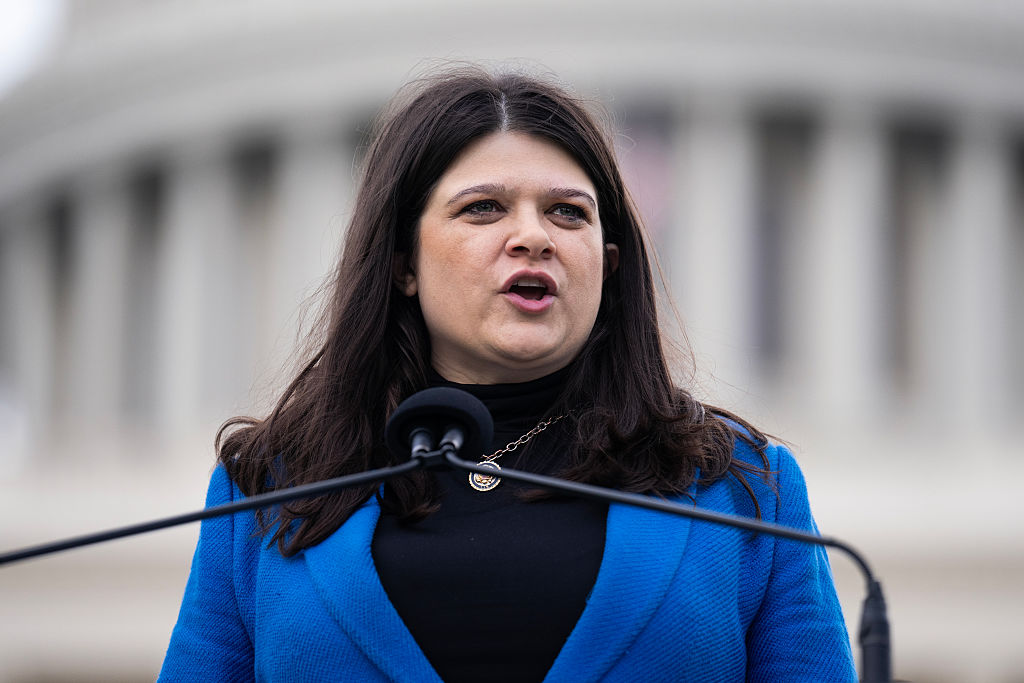
A telling recent headline contrasts the “pragmatism” of Haley Stevens (pictured) to Abdul El-Sayed’s “progressivism.” (Tom Williams / CQ Roll Call via Getty Images)
As centrist Democrats sharpen their knives to counter surging democratic socialists, we should beware of what I’ve come to call the P-words, a series of concepts that, while sounding objective and reasonable, play rightward. Seemingly liberal, they normalize pushback while implying a rational, “practical” center to which we all presumably want to revert.
I first noticed these P-words while lobbying Congress for many years about human rights and US policy in Honduras. Now they’re all over the place, deployed to delegitimize and undermine progressive forces from Black Lives Matter to Abolish ICE to New York Mayor Zohran Mamdani, Michigan Senatorial candidate Abdul El-Sayed, and many others who identify as democratic socialists.
It took a while for me to catch on to the first word. After the 2009 military coup that deposed democratically elected President of Honduras Manuel Zelaya, I put on trim little suits and traveled to Washington, DC, every few months to try to convince Congress to stop police and military aid for the post-coup government. For a week at a time, I’d meet with five, six, or even seven aides a day, usually twentysomethings who stared at me with blank faces. At the end, some of them would politely wrap up with, “I admire your passion.” I’d feel encouraged, vaguely flattered.
It took me a couple of years to realize the pattern: the aides that said that were never going to do anything to help, ever. They were patronizing me.
“Passion,” for these staffers, was equated with caring too much; it contrasted with rational, nonemotional, objective, and therefore correct. Yes, I was passionate, I should say, in a precise, controlled way involving dozens of op-eds and meticulous documentation of evidence about the Honduran state atrocities, because friends of mine were getting killed.
The next word I picked up on was “pragmatic.” Aides employed it to describe centrists who they contrasted to those of us, of widely varying political views, who wanted to cut off US support for the post-coup government and for then-President Juan Orlando Hernández — eventually extradited to the United States, convicted of drug trafficking, sentenced to forty-five years in prison, then pardoned by Donald Trump.
I first noticed its usage when an aide referred to the Washington Office on Latin America (WOLA) as more “pragmatic” than my colleagues and me. At that point, WOLA was working closely with the State Department to advise the Honduran state, helping it spend $200 million in US and European funds so the Honduran police could supposedly clean themselves up — just as those police answered to their director, Juan Carlos “El Tigre” Bonilla, a vicious death squad leader who is now himself serving a nineteen-year sentence in the United States for drug trafficking.
“Pragmatic” spun rightward. Those of who weren’t being pragmatic were by implication ineffectual. At best, we were naive dreamers; at worst, in the view of one staffer I heard about, we were “communists.” Rather than challenge the roots of US policy in Honduras, we should accept the status quo, however loathsome, and tinker with it in order to do good. Otherwise we were not being “practical” — another P-word, a cousin to pragmatic.
Today “pragmatic” is all over the place in reference to Mayor Mamdani. In November 2025, for example, the New York Times headlined an opinion piece by Mara Gay “Mamdani’s Surreal and Shrewd Pragmatism.” Gay was complimenting him: the mayor-elect was being practical, getting things done by making compromises. Other liberals who praise Mamdani for being pragmatic similarly support him but just want him to tone it down in order to achieve reforms. More commonly, though, failure to be pragmatic is used as a subtle weapon against the Left. For example, a recent headline from Michigan Public Radio about Haley Stevens, the mainstream Democratic candidate for Senate in Michigan, versus Abdul El-Sayed, the surging left candidate, announced: “Stevens’ Pragmatism Takes on El-Sayed’s Progressivism in Michigan Senate Debate.”
There’s nothing wrong with wanting to achieve concrete goals by mapping and deploying power wisely. But neither should we tone down our expectations too far. My own political background is with the labor movement, in which unions, at their best, help working people make huge demands from employers, then negotiate down to the most they can get, always with an eye for asking for more in the next round. The Democratic Socialists of America are doing this too: making seemingly outrageous demands, in so doing constantly raising expectations, then firing people up with often surprising victories, which in turn fuel new, higher aspirations.
In my work in Congress, too, I found that quite often a gutsy higher “ask” could produce a surprising yes. Starting off by being “pragmatic” gives away half the battle.
During my years of Honduras advocacy work, I also picked up on “polarized” and especially “polarizing,” used widely in both the mainstream media and sometimes in otherwise supportive missives from senators and congresspeople. I wrote politely to reporters and aides I knew, suggesting they avoid its usage, noting that one side in Honduras controlled the police and military and was using them to kill people in order to shore up an illegitimate government, while the other side was peaceful, unarmed, and trying to uphold constitutional order. “Polarized” implied a natural, virtuous center to which everyone wanted to return, a previous golden age that protesters had inappropriately disrupted — as in “Teachers Strike Fuels Unrest in Polarized Honduras,” when riot police in 2011 violently attacked peaceful protesters, killing a teacher. In 2014, when Juan Orlando Hernández was inaugurated for an illegal second term after stealing the election, a headline announced: “Hernandez Takes Reins of Chaotic, Polarized Honduras,” as if all sides were to blame.
In the Trump era, “polarized” is everywhere. But its usage all too often equates, on the one hand, grassroots activists seeking equality, social justice, an end to racism, and respect for women and LGBT people with, on the other hand, Trump, MAGA, the Proud Boys, and their ilk. Are we equally to blame, then, with white supremacists for disrupting the centrist status quo? “Polarization” implies two equal sides and a natural center to which we should return and all will be well. “Polarization has led to deep and passionate disagreement between the major parties,” concluded an essayist for the centrist Brookings Institute in February, for example, as if going too far to make demands for social justice has torn apart an earlier consensus in which we could all get along. But as others have pointed out, political views in the United States were plenty divergent long before Trump.
The charge of “polarization” is out there about Mamdani, too. “Zohran Mamdani’s Meteoric Candidacy is Deeply Polarizing New York,” as Politico warned in October 2025. Politico’s assumption is that before Mamdani stirred things up, the city’s residents more or less agreed that their situation was acceptable, although finance capital and billionaires were increasing their power, rents were impossible, and jobs were disappearing. A favorite target for those condemning polarization has been Black Lives Matter. “Our findings suggest that the Black Lives Matter movement is a politically polarizing issue,” concluded a 2018 study at the University of Texas, Dalllas. Should we shut up, then, in order to not produce polarizaton?
Finally, to carry us happily back to the virtuous center, there’s the ubiquitous “pendulum,” which is presumed to naturally swing back and forth all by itself. We don’t need the power of social movements, mass protests by the disenfranchised, or dedicated get-out-the-vote operations; we can just await the pleasant, gentle gliding of the pendulum to rescue us. The terrifying and growing forces of the Right, whether billionaires, high tech, or white supremacists, will fade away, allowing us to return to the natural center. But “What if the Political Pendulum Doesn’t Swing Back?” Michael Brenes asked in a recent critique of historian Arthur Schlesinger’s famous concept of “the cycles of American history,” and the notion of a natural center.
It’s a coincidence that all these words start with a p. But they nonetheless form a pattern in which seemingly objective, mild concepts can front for the deeper forces of capitalism and its defenders, and the forces entrenched in both mainstream parties. The P-words seek to scold, delegitimize, and disincline those of us who are, at this moment, successfully promoting progressive policies with growing popularity and scaring the powers that be.