Young Washington: a Simpleminded Take on Our First President
The Christian conservative Angel Studios’ Young Washington feels more like a MAGA political project than a movie. Sadly, it’s the exact kind of paint-by-numbers George Washington biopic you would’ve expected.
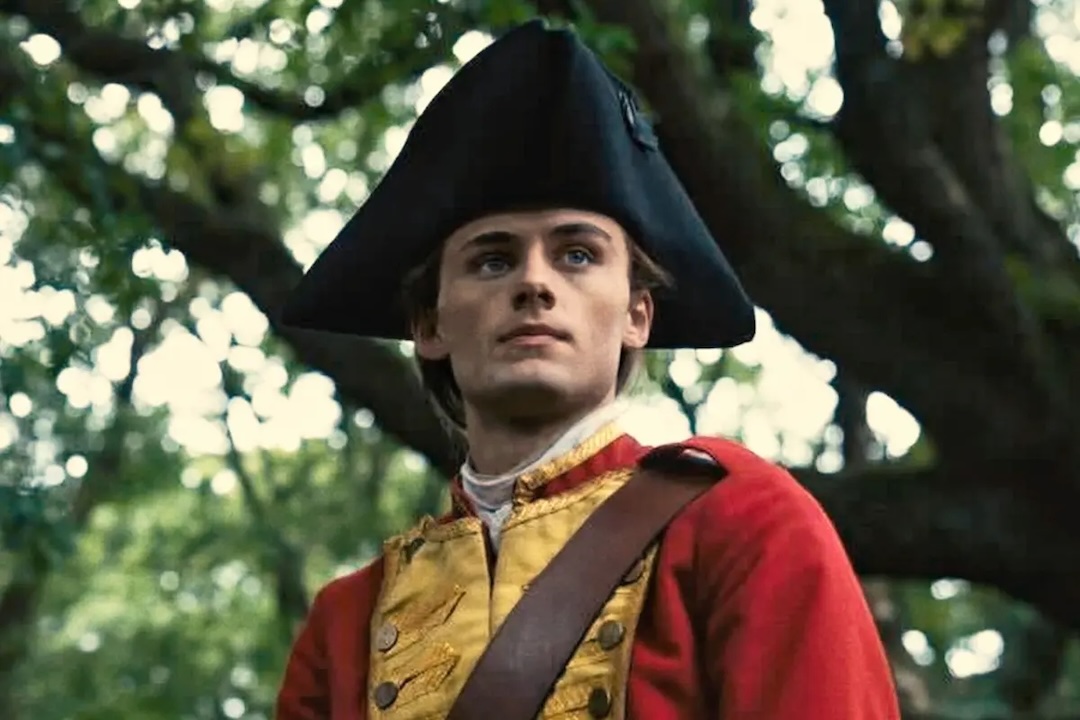
William Franklyn-Miller stars in Young Washington. (Angel Studios)
You may have heard of Angel Studios, the producer and distributor of Young Washington, a pretty dunderheaded biopic about George Washington as a self-centered but hunky young idiot who redeems himself in battle, which is currently playing in theaters. The film ends with a “special message” from actor Kelsey Grammer, who also appears in Young Washington as a smug British peer who’s making a fortune as an American planter. Grammer makes an incoherent speech about how George Washington represents the true values that are still worth fighting for in the United States, and therefore you should go to the Angel Studios website and click on the QR code (which appears on-screen) and donate money to Angel Studios in order to “pay it forward,” buying tickets for others to see this inspirational movie and make it a big hit.
The whole thing is very odd. But it’s all part of the bold new business plan of Angel Studios, which has allowed it to pump feature films into our entertainment system at a rapid pace. Angel Studios is one strand of the corporate model, which also incorporates the video-on-demand service Angel. The filmmaking plan involves equity crowdfunding, allowing independent investors to buy shares in the company as well as individual film projects. Angel produces “values-based entertainment,” and you can guess what that means after decades of hearing about “family values” from the religious right: G-rated content with evangelical Christian and ultranationalistic themes rah-rah-ing about American exceptionalism and revering the traditional family unit.
Angel Studios is based in Lehi, Utah, and was founded and is run by Mormons — that is, members of the Church of Jesus Christ of Latter-Day Saints (LDS), to use their preferred nomenclature. The LDS Harmon family — four brothers, Neal, Jeffrey, Daniel, Jordan, plus their cousin Benton Crane — began their entertainment ventures with VidAngel in 2013. It provided a service allowing viewers to filter out content they considered objectionable, skipping past or muting scenes of sex, nudity, violence, profanity, and, I have no doubt, religious impiety and political views that contrast with those approved by the LDS church. Sued by various Hollywood corporations — Warner Bros., Disney, Twentieth Century Fox, Lucasfilm — for copyright violations, the Harmons settled out of court, sold VidAngel, and started the Angel Studios and Angel streaming services.
One early success was The Chosen, a television drama about the life and ministry of Jesus of Nazareth that streamed on Amazon Prime Video and is currently in its fifth season. Also successfully crowdfunded was Dry Bar Comedy, filmed in Utah, featuring fifty-two sets by little-known comedians who do “clean comedy.”
But Sound of Freedom (2023) was Angel’s big, undeniable breakout hit. You may recall at least the ballyhoo around this dopey jingoistic movie full of debunked claims about a US government agent played by Jim Caviezel rescuing children from sex traffickers in Columbia, which made a staggering $251 million on a $14.5 million budget. It was voted into existence by members of the Angel Guild, potential viewers who choose projects they’d like to see completed.
The background info on Sound of Freedom is every bit as sus as you’d expect. Caviezel, the ultra-Christian actor, portrays Tim Ballard in the film, and Tim Ballard was the CEO of Operation Underground Railroad (OUR), an anti-sex-trafficking organization accused of amplifying QAnon conspiracy theories. He was ousted as CEO in 2023 because — you’ll never guess what — allegations of sexual misconduct were brought forward by six of his former employees. The lawsuit was dismissed because of insufficient evidence. But there were consequences — Ballard was excommunicated by LDS.
Ballard denies all the charges and claims the LDS church is participating in a giant defamation conspiracy against him and his noble work rescuing children from sex traffickers. But Angel Studios marches on. A huge slate of about twenty films, in a wide variety of genres including historical dramas, sports dramas, biopics, documentaries, sci-fi thrillers, fantasy comedies, and animated kids’ films, have come out in just the past few years. Animal Farm (2025), directed by actor Andy Serkis, who plays General Edward Braddock in Young Washington, was notable last year for being both critically lambasted and a rare box-office bomb for Angel Studios.
And another batch of films are soon to be released. At the Young Washington screening, the previews included upcoming Angel Studios productions such as The Brink of War. It’s a historical drama about the Reykjavik Summit of 1986 and the fraught negotiations between Ronald Reagan and Mikhail Gorbachev, which eventually led to the Intermediate-Range Nuclear Forces Treaty of 1987 between the United States and the USSR. Jeff Daniels stars as Reagan, looking ludicrous in fat-face prosthetics that do nothing to make him look more like the former president, making windy speeches about peace in our time. Jared Harris looks remarkably like Mikhail Gorbachev, however. J. K. Simmons and Hope Davis round out the cast as George Shultz and Nancy Reagan.
And is it just me, or is it slightly shocking that so much great talent is apparently scrambling to work with Angel Studios? Some are presumably there out of ideological allegiance — ultra-Christian Jim Caviezel, outspoken Trumper Kelsey Grammer — but Andy Serkis seems to be practically an Angel stock company member and yet also a former member of the Socialist Workers Party in England.
Of course, it could simply be the generous paydays that are reason enough for any actor anxious to keep working. Unlike the acting talent, the Angel Studios film directors are more clear-cut in their right-wing religious bona fides. Alejandro Gómez Monteverde, a Mexican filmmaker and devout Catholic, is the director of several Angel Studios features including Sound of Freedom as well as Cabrini (2024), a biopic about the life of the Catholic missionary and first American saint, Francesca Cabrini aka “Mother Cabrini,” and the forthcoming Zero A. D. (2026), a biblical epic about the massacre of the innocents by King Herod, the flight of Joseph and Mary, and the birth of Jesus. Young Washington director Jon Erwin — when working with brother Andrew, they’re known as the Erwin brothers — openly identifies as a “Christian filmmaker,” having made steady “values” money-makers such as Moms’ Night Out (2014), I Can Only Imagine (2018), Jesus Revolution (2023), and The Best Christmas Pageant Ever (2023).
A Portrait of the Washington as a Young George
But back to Young Washington, which is doing brisk business at the box office while its only competition in major release, the aggressively hyped Monsters & Minions, suffers from “franchises fatigue” and fading profits. It was canny to release Young Washington on the Fourth of July weekend during the notoriously uncelebrated 250th anniversary of the founding of the United States. In fact, it’s downright amazing that the major Hollywood conglomerates could come up with nothing better than Monsters & Minions for a holiday weekend that used to be one of the most reliably profitable in the entire calendar.
As many of the extremely mixed reviews will tell you, Young Washington is an earnest but dull and often ludicrous account of Washington’s ambitious early manhood that has the quality of many a stodgy “after-school special.” William Franklyn-Miller as Washington plays him as a stupendously handsome young supermodel making an arrogant idiot of himself on the battlefield but learning important lessons at the expense of his own slaughtered men. Once he figures out that he must fight for God and country (which is Virginia, in his view) as well as his suffering soldiers, rather than just to advance himself in the eyes of haughty British officers whose ranks he’s desperate to join, he becomes the legendary Washington, God’s chosen hunk, fearless and unkillable in battle, an inspiration to all.
To be fair, it’s rather commendable to make so much of the film about Washington’s frustrated ambitions and self-centered determination to climb the social ranks from obscure colonist to British officer at a time when the Brits regarded the colonists as lowly rustics. And to focus on Washington’s nadir, leading the Virginia militia to abject defeat in their attempt to force the French out of then-frontier territory in Ohio claimed by the British as well as the Shawnee and other Native American tribes. Washington’s rickety “Fort Necessity” was abandoned before it was fully built.
The reckless Washington was sent off on a suicidal mission by the Scottish Governor Robert Dinwiddie (Ben Kingsley), an administrator in charge of British forces in the colonies. Washington had only a ragtag, badly equipped colonial force. In the movie, it’s a little obscure why Dinwiddie does this, because the resulting debacle was bound to reflect badly on him. What’s left out of the narrative — and it’s a shame — was Dinwiddie’s hawkish warmongering reflecting an attitude among prominent Virginians that the Ohio Territory was rightfully theirs: “He had wanted a war over the Ohio valley,” according to historian David Stewart. “After Fort Necessity, he had one.”
Washington is forced to surrender to the sneering French and to rely on a British officer and translator to tell him what the treaty says. The loss of a proper aristocratic education in Great Britain when he was young, which would’ve included learning French, costs Washington dearly — because the translator doesn’t tell him when he signs the treaty that he’s also taking the blame for the killing of a French officer. A case can be made that George Washington started the French and Indian War by firing the first reckless shot that led to the disastrous battle. In the movie, he’s innocent of that blunder and demands to know who fired first, but according to some historical accounts, it may very well have been him.
In broad strokes anyway, much of the Young Washington narrative is true. Washington’s father died young, which meant a loss of fortune and status that prevented George from being sent to England to be educated in proper upper-class fashion as his older brothers had been. In the movie, he’s shown as a boy being denied an education at the local schoolhouse, because now he’s got to help his harassed mother (Mary-Louise Parker) run their mere tenant farm on the Mount Vernon property inherited by George’s half-brother Lawrence (John Foss). The suggestion in the film seems to be that they’re leading a hardscrabble life, but they’re really just socially demoted to a lower rank of gentry. And no amount of local schoolhouse education would’ve helped him much in Virginia high society.
George Washington didn’t recover his lost wealth and status until much later when Lawrence’s widow remarried and relocated, allowing him to take back control of the Mount Vernon plantation. That plus his rapid military advancement did much, but what really carried him to the top was marrying the vastly wealthy and aristocratic Martha Dandridge Custis, bringing him a 17,000-acre estate worked by hundreds of slaves. This will presumably be part of the Young Washington sequel already in the works. Though what part Washington’s slave ownership will play remains to be seen. It’s only vaguely touched on in Young Washington, with a few black actors playing slaves in the background and George Washington referring briefly to Mount Vernon’s slaves: “We have many of them.”
George Washington’s love life in this first film involves his heavy flirtation with Sally Fairfax (Mia Rodgers), which plays out like some absurd Bridgerton episode. She’s an unmarried Virginia belle who’s far above his station in life and bound to wed someone of equal rank. In real life, Washington’s fling with Sally, well-documented in letters, occurred after she was already married.
And Washington was by no means so friendly with Native Americans as he’s shown being with Tanacharison (Ryan Begay), Seneca chief and leader of one of the few tribes in the disputed territory that aligned with the British even briefly. The French were known to treat Native Americans better than the British, though you’d never guess it from the scowling cartoonish villain playing the French Canadian commanding officer Joseph Jumonville (Clement Toyon). He makes John Cleese’s inventively insulting French soldier guarding the fort in Monty Python and the Holy Grail seem well-mannered by comparison. (“I fart in your general direction! Your mother was a hamster and your father smelt of elderberries!”)
The Angel Studios Treatment
The last section of the film involves Washington’s redemptive return to the fight against the French, which is all heroics on his part. The second time around, it’s the British General Braddock (Andy Serkis) in charge, with the demoted Washington as his mere aide-de-camp trying to make his commander see reason. It’s the general’s turn to screw everything up in the most mortifying way. All the famous British blunders we learned about in fourth grade — knowing nothing of the rough densely forested terrain, insisting on gentlemanly frontal charges, and those idiotic red coats like showy targets on every soldier’s back — are on display here. Braddock gets killed saying “Who would’ve believed it?” Washington takes command, and suddenly the rustic colonial fighting style is born.
This was indeed the battle that began to create Washington’s outsize military reputation for fearlessness, daring, and weird good fortune under fire, earning the admiration of his soldiers. He was unusually tall for his time, making him an excellent target on horseback, yet he reportedly came out of the battle with bullet holes in both his hat and his uniform, while he somehow emerged unscathed. His horses were not so lucky — two were shot out from under him, though these grim incidents aren’t depicted in the film. Instead, we get images of Washington standing godlike in misty light, and Native Americans affirming that he’s been chosen by “the Great Spirit” for some stupendous fate.
This finale accords with right-wing conservatives’ reverent view of the Founding Fathers as demigods that walked the earth in order to Make America Great the first time around, conforming to Angel Studios ideology. If you actually read a book by any sane historian, of course, it’s the overwhelming fallibility and often venality of almost everyone involved in the founding of the not-very-united United States, leading to corrupt dealmaking and every kind of compromise of the ideals of liberty and equality from the start, that makes it amazing any nation at all ever got pulled together out of such a hellish mess.