The Founders’ Own Second Thoughts
Even the Founding Fathers had second thoughts about the system they had created.
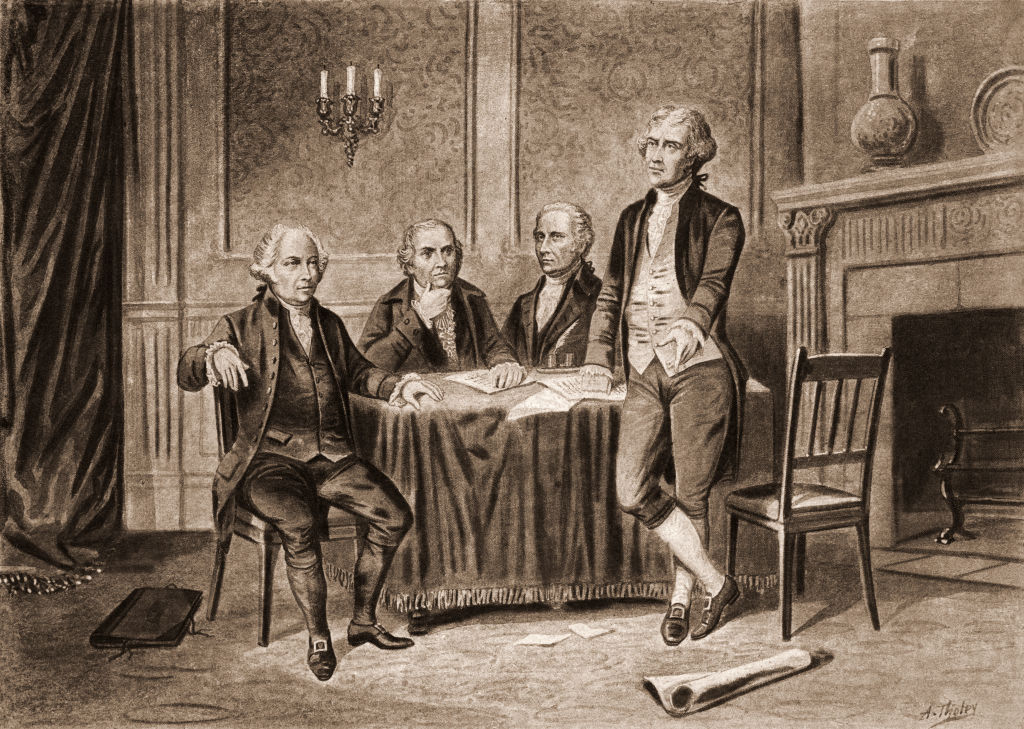
In their private correspondence, the Founding Fathers expressed grave doubts about the Constitution they wrote and the fate of the young American republic. (Stock Montage / Getty Images)
“In vain was the collected wisdom of America convened at Philadelphia. In vain were the anxious labours of a Washington bestowed. Their works are regarded as nothing better than empty bubbles destined to be blown away.”
“Perhaps no man in the United States has sacrificed or done more for the present Constitution than myself — and contrary to all my anticipations of its fate, as you know from the very beginning I am still labouring to prop the frail and worthless fabric. Yet I have the murmurs of its friends no less than the curses of its foes for my rewards. What can I do better than withdraw from the Scene? Every day proves to me more and more that this American world was not made for me.”
“There is so much Rascallity, so much Venality and Corruption, so much Avarice and Ambition, such a Rage for Profit and Commerce among all Ranks and Degrees of Men even in America, that I sometimes doubt whether there is public Virtue enough to Support a Republic.”
“Oh my Country, how I mourn over thy follies and Vices, thine ignorance and imbecillity, Thy contempt of Wisdom and Virtue and overweening Admiration of fools and Knaves! . . . The never failing effects of democracy. I once thought our Constitution was quasi a mixed Government, but they have now made it, to all intents and purposes, in Virtue, Spirit and effect a democracy. We are left without resources but in our prayers and tears.”
“The Selfishness of our Countrymen is not only Serious but melancholly, foreboding ravages of Ambition and Avarice which never were exceeded on this Selfish Globe. . . . The distemper in our Nation is so general, and so certainly incurable.”
“I have duly recieved your favor of Dec. 31 and fear with you all the evils which the present lowering aspect of our political horison so ominously portends. That, at some future day, which I hoped to be very distant, the free principles of our government might change, with the change of circumstances, was to be expected. But I certainly did not expect that they would not over-live the generation which established them.”
“The difficulty of finding an unexceptionable process for appointing the Executive Organ of a Government such as that of the US [Electoral College] was deeply felt by the Convention; and as the final arrangement of it took place in the latter stage of the Session, it was not exempt from a degree of the hurrying influence produced by fatigue and impatience in all such Bodies. . . . The part of the arrangement which casts the eventual appointment on the House of Reps. voting by States, was, as you presume, an accommodation to the anxiety of the smaller States for their sovereign equality, and to the jealousy of the larger towards the cumulative functions of the Senate.”
“A party exists in the United States, formed by a combination of causes, who oppose the government in all its measures, and are determined (as all their conduct evinces) by clogging its wheels, indirectly to change the nature of it, and to subvert the Constitution.”
“I feel pain when I am reminded of my exertions in the cause of what we called liberty; and sometimes wish I could erase my name from the declaration of Independence. In Case of a rupture with Britain or France — what shall we fight for? — for our Constitution? I cannot meet with a man who loves it. It is considered as too weak, by an half of our Citizens, and too strong by the Other half.”
“I consider the cause of good government as having been put to an issue and the verdict against it.”
“Avarice, Ambition, Revenge or Galantry, would break the strongest Cords of our Constitution as a Whale goes through a Net. Our Constitution was made only for a moral and religious People. It is wholly inadequate to the government of any other.”
“Our dear Americans perhaps have as much [public spirit] as any Nation now existing, and New England perhaps has more than the rest of America. But I have seen all along my Life, Such Selfishness, and Littleness even in New England, that I sometimes tremble to think that, altho We are engaged in the best Cause that ever employed the Human Heart, yet the Prospect of success is doubtfull not for Want of Power or of Wisdom, but of Virtue.”
“I yield slowly and reluctantly to the conviction that our Constitution cannot last. . . . The union has been prolonged thus far by miracles. I fear they cannot continue.”
“The new Governments we are assuming, in every Part, will require a Purification from our Vices, and an Augmentation of our Virtues or they will be no Blessings. The People will have unbounded Power. And the People are extreamly addicted to Corruption and Venality, as well as the Great.”
“If ambition and avarice are not as strong in this Country, as in others, my observations have been inaccurate. If intrigues and manuevres in Elections have not been practised, and are not now practising, I have been misinformed; and if the people are not every day deceived by artifice and falsehood, I have no understanding.”
“Instead of the most enlightened people, I fear we Americans shall soon have the character of the silliest people under Heaven.”
“The great object of my fear is the federal judiciary. That body, like Gravity, ever acting, with noiseless foot, and unalarming advance, gaining ground step by step, and holding what it gains, is ingulphing insidiously the special governments into the jaws of that which feeds them.”
“Civilisation, commerce and science have done their utmost to produce national happiness without success. The last experiment to make man happy without his God is now trying by means of liberty. It will certainly fail. It has already disappointed the expectations of its most sanguine and ardent friends.”
“I feel pain when I am reminded of my exertions in the cause of what we called liberty; and sometimes wish I could erase my name from the declaration of Independence. In Case of a rupture with Britain or France — what shall we fight for? — for our Constitution? I cannot meet with a man who loves it. It is considered as too weak, by an half of our Citizens, and too strong by the Other half.”