Edi Rama Must Go
A luxury resort backed by Jared Kushner has prompted massive protests in Albania, now ongoing for over a month. The project has become a lightning rod for opposition to Prime Minister Edi Rama’s cronyish development model.
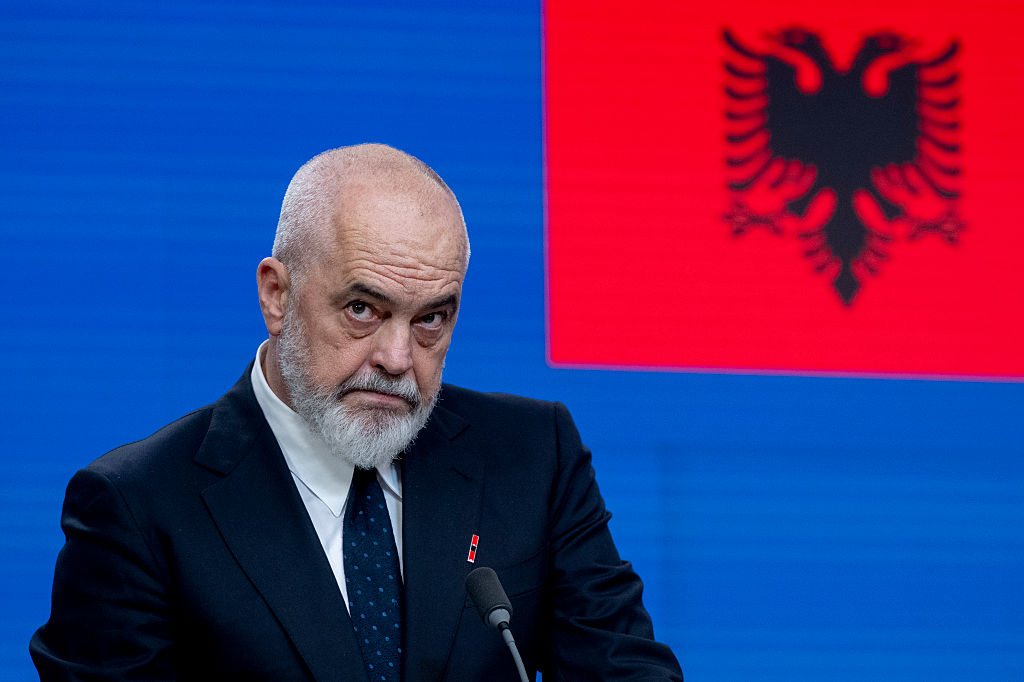
Albanian Prime Minister Edi Rama has handed over his country’s territory to host the European Union’s migrant prisons. But while Rama has won friends among foreign leaders, a popular uprising against a luxury resort project is demanding his resignation. (Daniel Gnap / NurPhoto via Getty Images)
In July 2021, Ivanka Trump was on a yacht off Albania’s western coast when she, like a modern-day Columbus, discovered Sazan Island, an Enver Hoxha–era army base. She and her husband Jared Kushner were so captivated by the pristine, unpopulated island that they decided to launch a $4 billion mega-resort with ten thousand rooms, planned for wealthy tourists.
The Kushner proposal envisions a vast coastal project centered on Sazan and the nearby Zvërnec peninsula consisting of luxury hotels, residential apartments, and private villas within the ecologically protected Vjosë–Nartë delta ecosystem. Flamingos (among more than two hundred types of birds) and dozens of endangered species inhabit the area.
The project received a major boost in 2024 when the Albanian government designated Atlantic Incubation Partners, an entity connected to Kushner’s Affinity Partners, a “strategic investor,” granting it access to a fast-tracked investment framework.
Excavators moved into the protected area in May, carving out access roads, digging through coastal dunes, and erecting fencing around sections of the site. Yet this stirred up a response. Public anger grew and pushed hundreds of people to protest after videos surfaced showing bulldozers clearing land among the pine forests in the project area. Tensions escalated further when demonstrators clashed with private security personnel following one citizen being dragged along the ground by these private forces in the presence of the Albanian policemen.
Ever since, hundreds of thousands of Albanians have been taking to the main square of capital Tirana over the past weeks, in what can be called the largest uprising since the fall of the Communist government. Dubbed the “Flamingo Revolution” after the bird emblematic of the protected area, this ocean of demonstrators has united together beyond environmental activists to include students, workers, artists, members of the diaspora, and grassroots collectives calling for broader systemic change.
While the immediate trigger was the Kushner-linked luxury resort project planned on Sazan Island and Zvërnec, the mobilization quickly grew into something that goes far beyond a single tourism project. In recent weeks, Albanians have rallied against corruption, state capture, economic inequality, and a development model that many protesters believe has sacrificed public interests in favor of political elites, oligarchs, and foreign investors.
Controversies surrounding the project grew after recent findings from a major anti-corruption investigation in Albania. According to Albanian investigative journalist Lindita Cela, the nation’s anti-corruption prosecutors have frozen the accounts of a landholding company involved in the luxury resort plans. On June 12, Albania’s Special Anti-Corruption Prosecutor’s Office (SPAK) requested twenty arrest warrants and frozen assets worth more than €128 million as part of an investigation into an alleged international cocaine trafficking and money laundering network.
The protests have also attracted international attention. Following nationwide protests, the EU parliament called for an immediate moratorium on developments in Vjosë–Nartë, more specifically urging the Albanian government to repeal the 2024 amendments to the Law on Protected Areas, which allows large-scale tourism projects inside protected zones and strips away key environmental oversight mechanisms.
Several prominent organizers report receiving threats to their employment, online harassment, and intimidating messages from anonymous social media accounts. Over the first nineteen days of demonstrations, authorities initiated criminal proceedings against eighty-five protesters on charges including disturbing public order, obstructing traffic, and participating in unlawful gatherings. Protest organizers have denounced the measures as an attempt to discourage participation and have called on authorities to respect constitutional rights to peaceful assembly and free expression.
Yet despite the mounting police repression, demonstrators show little sign of backing down. The growing protests show the Albanian youth filling the streets against a political regime that for years has decided who gets to control, develop, and profit from Albanian territory while sidelining local communities. But how is Prime Minister Edi Rama dealing with these calls for his resignation?
Serving the Western Core to Maintain Power
“There is no chance for this investment to stop as long as I am here,” declared Rama on June 2, showing his uncompromising support for the Vjosë–Nartë project despite the Albanian youth damning his rule.
Nominally headed by a Socialist party, the governments under Rama’s leadership have all too often subordinated national priorities to the interests of powerful external actors, paving the way for foreign influence over strategic sectors and public assets. For many demonstrators, the protests represent a challenge not only to controversial developments on the Albanian coastline, but also to a broader political and economic order that has shaped the country since its protracted post-socialist transition.
“The protesters have unanimously demanded from the beginning the resignation of the prime minister and are calling for a new development model different from the one we have had so far” Edison Lika, one of the coordinators of the protests, told Jacobin.
Since the end of the Cold War, the Albanian leadership has been a bought-off tool in service of Euro-Atlantic allies, who have sought for years to increase their spheres of influence and expand their military expansion in the Balkan state.
Sazan Island, where Kushner wants to build the luxury resort, is a former Soviet military base positioned in a strategic waterway. Nuclear bunkers lie behind it. Following the Soviet-Albanian split in 1961, Hoxha retained control over the submarines, and the base continued to serve as a key military outpost, patrolling against perceived external threats while also preventing Albanians from fleeing the country. When the country’s Communist leadership collapsed in the early 1990s, the base became defunct. In 2010, the Albanian government established the Karaburun-Sazan National Marine Park, which encompasses Sazan and, five years later, the island was formally demilitarized and opened to visitors. While Donald Trump’s son-in-law seeks to turn the island into a summer hot spot for wealthy tourists, it seems that the area around the coast has become a bulwark for various projections of military power in the region.
Just a forty-minute drive from Zvërnec lagoon, where barbed wire has fenced off the area for the construction of the Kushner-linked resort, Israeli companies are set to train Albanian military and civilian pilots in the reopened Aviation School, inside Vlora International Airport.
The agreement to reopen the Aviation academy was signed earlier in 2025, a partnership between KAYO, the Albanian state-owned arms manufacturing company, and Elbit Systems, Israel’s largest weapon manufacturer, supplying arms reportedly used during the genocide in Gaza.
Rama has been scrambling to slam the protests as part of a broader “hybrid war” by warning about “foreign agents” fueling disinformation campaigns. He denounced the protests as backed by enemies of Israel, calling out Iranian and other foreign agents for destabilizing Albania. This rhetoric used by Rama, of an anti-Israel hybrid war, comes as no surprise given his growing diplomatic ties with the Israeli government in recent years.
Around the Bay of Vlorë, where Sazan Island lies, Albania is also preparing to expand military shipbuilding at the Pashaliman Naval Base. Following the strategic partnership signed with Giorgia Meloni’s Italian government, the agreement foresees the creation of a new base to produce ships in Albania, which will serve the Albanian army but also the militaries of allied countries. The company involved in the agreement is Fincantieri, the same one producing Libra military ships that have been transferring migrants to Italian-run detention centers in Albania.
Taken together, the resort developments, migrant detention centers, and defense partnership with a genocidal state emerging along the Albanian coastline reveal a country undergoing rapid transformation as it struggles to advance its way to membership in the European Union. However, for many protesters these projects have become emblematic of a development model that prioritizes foreign investment and strategic partnerships while long-standing concerns over corruption, transparency, and democratic accountability force Albanians to leave their country.
Who Gets to Decide
Indeed, this question stretches beyond the Kushner-backed resort. In late 2023, in another controversial project carried out with little public consultation and in full violation of Albania’s sovereignty, Prime Minister Rama announced a bilateral agreement with Italy. It effectively granted Meloni’s Italian government use of portions of Albanian territory for the establishment of two extraterritorial asylum-processing centers. The first, located within the Shëngjin Harbor, serves as a disembarkation and screening hub where migrants are identified, medically examined, and subjected to vulnerability assessments. From there they are transferred to a larger center in Gjadër, a remote former military zone, where asylum claims and detention procedures are administered under Italian jurisdiction.
I traveled to the centers in Gjadër last week. At the entrance, two Albanian police cabins stand guard with local officers patrolling the outer perimeter of the centers. Since transfers from Italy began, the centers have remained largely sealed off to public scrutiny. Access to entry has been tightly restricted, with only a small number of parliamentarians, independent monitoring bodies, and authorized personnel permitted to enter.
For journalists, obtaining access to enter the centers remains impossible. Nestled between the slopes of Kakarriqi Mountain and the banks of the river Drin, the centers are enclosed by five-meter-high walls that shield their operations from public view. In the absence of official access, reporters have resorted — as in my own case — to climbing the mountain to catch a glimpse of what happens inside the centers.
As we attempted to reach a vantage point overlooking the centers, we were stopped by Albanian policemen. Initially, they tried to warn us off — telling us about the presence of snakes on the mountain — before ordering us to turn back, claiming that we had to respect the external security perimeter surrounding the centers. We were forced to go down even though we were standing on Albanian territory, outside the area formally under Italian jurisdiction.
The determination to shield the controversial centers from public scrutiny becomes easier to understand when examining what has unfolded inside them. Since the centers were repurposed as repatriation hubs in April 2025, protests, acts of self-harm, attempted suicides, hunger strikes, and violent incidents have repeatedly been reported. According to investigations by the Italian outlet Altreconomia, operators recorded fifty-four “critical events” during the first forty-eight days of operations alone.
These incidents are documented in the centers’ internal “register of critical events,” maintained by Medihospes, the managing company under a contract worth more than €133 million. The register offers a glimpse into the painful realities of migrants transferred to Gjadër. Despite the human costs documented so far, EU states are seeking to replicate the Albania-Italy model in what has been branded as the new innovative solution for migration management.
By turning Albania into a testing ground for the EU’s new deportation regime, Rama emboldens his rule at home by strengthening his standing in Brussels. At a time when most European governments are searching for new ways to curb migration, the Italian-run centers in Albania have become the most visible blueprint, helping cement Albania’s image as a willing ally in the bloc’s efforts to externalize border controls.
Such has been his willingness to seek EU support that Rama promised European Commission President Ursula Von der Leyen that for his Brussels friends “he will even go beyond what seems possible, and can even kill.” Yet as Rama nets political victories abroad while accepting to do the EU’s dirty work, he faces growing scrutiny at home. The question now is whether Rama can maintain his status as a darling of the EU and one of the Balkans’ most influential leaders, while confronting a historical uprising against him at home.