Europe’s New Asylum Pact With the Devil
After the EU Parliament passed legislation last week to detain and expel more migrants, some lawmakers chanted “Send them back.” The anti-migration measures were pushed by the far right — but passed thanks to centrist pro-EU parties.
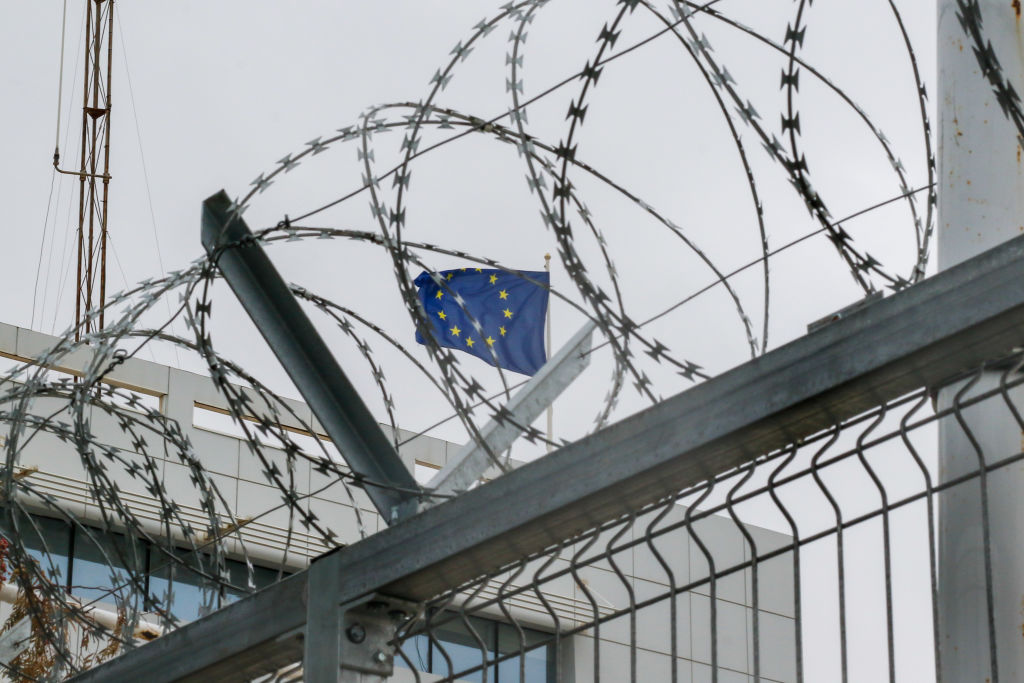
New EU legislation making it harder to apply for asylum won’t stop people heading for Europe in search of a better life. But it will undermine basic legal protections and produce an easily blackmailed mass of undocumented workers. (Hasan Mrad / DeFodi Images News via Getty Images)
As the European Union’s Brussels parliament voted through the latest piece in a jigsaw puzzle of anti-migrant legislation, dozens of far-right politicians took to their feet chanting “Send them back! Send them back!” There could not have been a clearer sign that Europe’s fascist past has successfully taken hold of its current political heart.
EU migration policies — designed by the far right and ushered in by centrists — attempt to unite Europeans behind a vision of mass violence against black and brown people. It will almost certainly fail in its ostensible objectives: it will not bind together the member states of the EU more intimately and correct the inequalities between them; it will not stop people dying at sea; it will not safeguard “real” refugees. And it will also fail in the implicit objectives of its strongest proponents: it will not deport hundreds of thousands of people; it will not make Europe more white, or more Christian, or more prosperous, or more secure. It will fail in every single way, on everyone’s terms.
A Decade in the Making
Ten years ago, in response to the arrival of hundreds of thousands of people fleeing the repression of the Arab Spring, the EU instigated the “hotspot” policy. As I wrote back then, the term “hotspot” can be traced back to New York’s 1980s zero-tolerance policy and the first introduction of computing into police operations. The idea was that instead of responding to crimes after they happen, police units sit and wait at predicted “hotspots” to intervene before a crime happens. In 2016, the name was applied to a new method of detaining people on arrival in Europe, enforcing mass fingerprinting, screenings, and smuggling investigations. The “crime” was illegal entrance, the “heat” was simply people, and the “spots” were Mediterranean islands, from Lesbos to Lampedusa. For a decade, the hotspots have staggered onward without any proper definition under EU or national laws, a legal limbo in a political mess.
The New Asylum Pact coming into effect this month changes this — by finally regulating mass detention, engraving it into EU law. All people arriving in Europe can now be held in detention centers for up to 2.5 years while their claims are being examined. In order to do this, the new pact explicitly uses a contorted line of reasoning called the “legal fiction of non-entry,” authorizing member states to treat people physically present on national territory as if they were officially still outside of Europe.
The pact was initially proposed in 2020, under Ursula von der Leyen’s first spell as EU Commission President, in an attempt to appease ultraconservatives who had made important — but not decisive — gains in the EU elections of the previous year. The deal was voted through in June 2024, as one of the final acts of the last commission before elections. The policy of appeasement filled all its historic promise and backfired: ultraconservatives made further gains, shifting the center of gravity still further right. Following the extremely slow EU legislative train, the pact only came into law this June 12. This has caused a certain amount of panic among legislators and watchdogs, as member states have to introduce new laws that make the EU regulation apply in their individual legal systems. In Italy, for example, Giorgia Meloni’s government has rushed through a legislative decree; in France, the current parliamentary instability means that the new pact is being introduced through undemocratic ministerial circulars.
The Devil Is in the Detail
The basic idea behind the new pact is that people should be detained on entrance and assessed while in detention, with unsuccessful applicants deported.
The only people who will have their asylum claims properly examined are those who meet a new threshold — that is, they belong to nationalities who already have an 80 percent chance of being recognized with refugee status across the EU. Everyone else will be evaluated according to a new “asylum border procedure,” essentially a fast-track process meant to take place within one week, while people are still in detention at the border. This will necessarily mean that people have less access to legal advice, independent support, or simply information about their country of arrival.
According to all current international law, asylum applications are based on personal claims: on what has happened to you and who you are, individually. The EU’s pact makes a mockery of this. Attaching a percentage rule of probability to people’s rights to asylum will inevitably discriminate against asylum seekers based on nationality, turning asylum applications themselves into a form of persecution. Hence, if you come from a country that has a high scale of emigration based on reasons of poverty, yet you have emigrated because of being persecuted for your sexuality or politics, you will be penalized precisely for your nationality.
The new “asylum border procedure” will also apply to anyone arriving in Europe via a “safe country” — that is, those countries determined as safe according to EU geopolitical diplomacy and backroom deals. For example, Egypt, Tunisia, and Bangladesh — all countries that have seen violent crackdowns on protest, and the persecution of journalists and trade unionists – are labeled “safe” largely because they agree to “take back” their own citizens who have been violently deported from the EU — along with multimillion-euro bilateral agreements.
While much of this has already been the case across European countries, the new Return Regulation also authorizes forced deportations to non-EU countries to which they have no connection. We have already seen such experiments and deals elsewhere in the world, notably between the United States and Guatemala, or the UK and Rwanda. Italy’s disastrous construction of detention centers in Albania under the Meloni government has itself acted as a testing ground for these policies. They essentially outsource human-rights violations to countries outside the EU who act as border police.
The new pact also introduces a “crisis regulation” that allows even minimal legal protections to be suspended by member states if they deem that a non-EU country is using immigration as a tool of political destabilization. Of course, European governments are well aware of this tactic, because they themselves have used immigration as a tool against each other many times in the past. This is the same diplomatic game played by other countries, such as when Tunisia, in 2023, turned a blind eye to boats leaving its shores in order to eventually extract the EU’s support for a $1 billion IMF deal. The new “crisis” exception, however, simply increases possible detention times while decreasing legal protections. The real way to undermine the potential political manipulation of immigration would be to set up a functioning, well-funded reception system so that increased arrivals would not pose a destabilizing force. If anything, the continued fomenting of a moral panic over migration created by the Right simply encourages other states to weaponize human mobility.
“Solidarity” Initiatives
If mass detention and mass removal are the moving principles of the new pact’s design, the political motivation that has caused European centrists to back it is to maintain unity between EU member states.
In this vein, EU politicians have latched onto the concept of a “common European system” in which southern and eastern European countries will no longer take on the economic and “cultural” burden of immigration but will be supported by their richer northern neighbors. The pact, in truth, papers over the material inequalities between member states built into the EU by simply unifying asylum policy across legislations. So long as there are the vast economic inequalities (in terms of employment, welfare, and inflation) the effects of the same policies will vary hugely as well. To take Italy as an example, there is complete confusion about how tens of thousands of people are meant to be detained for months across centers in Italy, let alone how this might be done while guaranteeing their human rights. Costs have been estimated to be in the region of billions of euros — no small matter in a country on the cusp of a budget crisis. The result will be more chaos, more violations of human rights, more death and trauma, while all the while demonstrating, rather than resolving, the economic disparity between member states.
The new pact replaces the old Dublin Regulation that determined where in Europe asylum seekers should be making their claims. This has always fallen to the country of first registration — a basic rule that prevents people’s mobility within Europe and often stops them effectively reaching their destination. (For example, if someone leaves a country in French-speaking West Africa with the aim of reaching France, but arrives via Italy and is registered there, they can be forcibly sent back to Italy from France to complete their asylum request). Aside from the injustice this imposes on immigrants, this rule has always been opposed by southern and eastern European states on the EU’s outer borders as creating an unjust burden on their asylum systems.
Despite these criticisms, the new “Asylum and Migration Management Regulation,” a few new exceptions aside, maintains the rule while also making an EU-wide internal distribution system optional. This allows member states to make financial contributions to border states (e.g., for surveillance and border weaponry) rather than accepting asylum seekers. This again cements the worst practices, pushing the idea that countries can buy their way out of the problem by investing in border control rather than methods of reception, training, and legal protections.
The New Brussels Effect
The new right-wing wave spreading throughout the EU has been dubbed “the new Brussels effect.” Many years ago, political analysts coined the term “the Brussels effect” to describe the way in which liberal EU policies spread out from Brussels, through member states and beyond Europe itself, as non-EU partner countries tried to keep up with EU regulation in order to be important trade partners. The new Brussels effect, however, is that of a seeping poison of right-wing supremacists who have made their way into parliament, convinced the liberals to pander to their demands, and have now finally introduced the most racist legislation in decades that all EU states must comply with. Whereas once leftists in Italy or Greece might have looked to European policies and courts as a means of pushing back against the illiberal and right-wing tendencies in their own countries, now the opposite might become the case.
Centrists will claim that reforming asylum policy is about fairness: efficiently deporting people with no right to stay in Europe, in order to protect “real refugees.” But the new pact – and the new Brussels – only cares about bricking up the holes in the walls of fortress Europe. The whole defense of “real refugees” plays into a game whose rules have been written by years of pandering to the far right. People do not arrive in Europe by boat because they are claiming asylum: rather, they claim asylum because they arrive by boat.
Over three decades of policies across Europe have restricted access to all other legal forms of immigration. Family, work, and study visas have largely become the remit of the rich and well connected, creating a de facto policy of possible (certainly not guaranteed) immigration for a global bourgeoisie, in an attempt to block the working classes from having any possibility of even asking for a visa (even through official schemes). This has cemented the knowledge worldwide that, if you are poor or in an emergency, your best way of entering Europe might be through asking asylum after arrival. Even if you have family in Europe, even if you want to study in Europe, even if you want to come and pursue your professional dreams, seeking asylum is usually the only way in.
The New Asylum Pact has nothing to do with protecting refugees: it is simply a way for the EU to violently regain its monopoly on human movement at the expense of working people and internationalism. The result will not be that people fleeing poverty, war, and crises, rejoining family or pursuing their dreams stop looking toward European countries as a place to find greater safety and fulfillment. Nor — barring a drastic repurposing of national economies toward financing border controls, concentration camps, and mass enrollment of police and military personnel — will the new pact result in mass deportations.
It will, however, create mass detention, large-scale suffering, and continue to manufacture an invisibilized workforce that undermines unions, pay, and workplace safety. For some sectors of capital, this is all to the good, even if it’s not what all capitalists want.
None of this is irreversible. Even as the New Asylum Pact is locked into law, it is already generating political and moral resistance that will eventually outlast it. At his speech in the Canaries, the new Pope, like his predecessor, continues to underscore principles of humanity and true solidarity that reinforce and represent the feelings of many working people across Europe. Critics — from Spain’s enduring left-wing currents to France Insoumise — continue to push back against the logic of deterrence and abandonment. Sea-rescue missions continue to risk waves and militias; activist lawyers will challenge the new legislation in the courts.
But the EU’s new pact will not be quickly undone. European migration policy moves slowly, through layers of law and bureaucracy, and it will likely take a decade or more to reverse what is now being set in place. The task, then, is endurance: to hold the line, strengthen the fragile forms of solidarity that still exist, and keep open the possibility of a different Europe still to come.