America’s Only Successful Coup Served the Ruling Class
The only successful coup in US history took place in Wilmington in 1898. It dismantled not a government but a black and white alliance that threatened the ruling class then — and still could today.
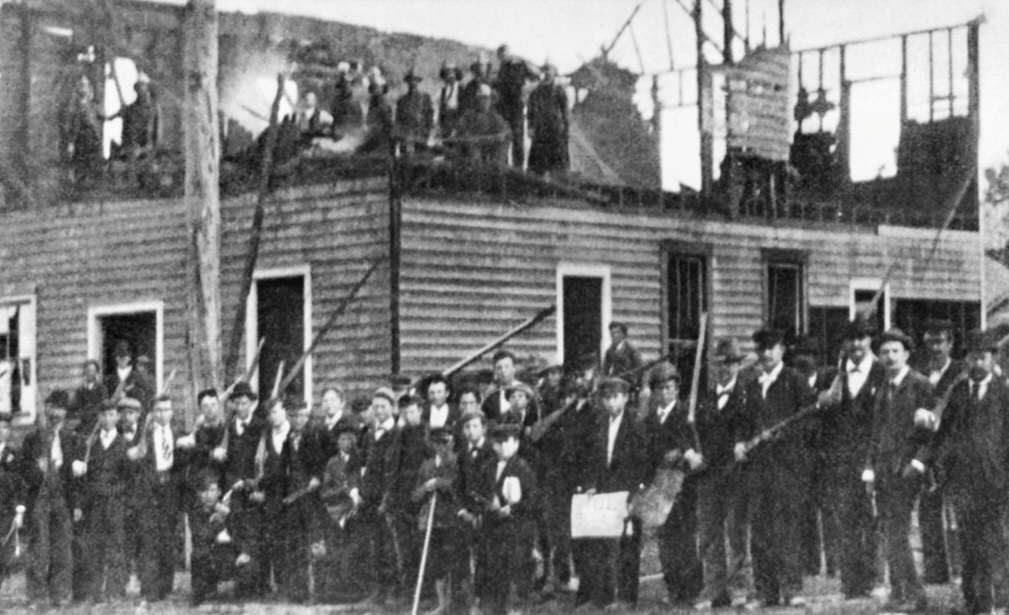
Armed militiamen stand in front and atop the burned building of the black newspaper, the Daily Record.
January 6 looked like a coup: a violent assault on a government, an attempt to seize power by force. Coups take many forms, born of grievances real and imagined, executed by insurgents homegrown or hired, and they can fail or succeed. Amid the endless accounting of January 6, one precedent has gone strangely missing — the only coup d’état in American history that actually succeeded.
On November 10, 1898, more than five hundred armed white men seized Wilmington, North Carolina — a city run by a biracial government born of Reconstruction and sustained by a coalition of white populists and black Republicans. This was no mob; it was an army with commanders, units, even a machine gun mounted on a carriage. The insurgents targeted a black newspaper editor first, torching his office, then turned on the wider black community and its most successful figures.
They didn’t just storm city hall — they stayed. After evicting the elected government at gunpoint, they issued a Declaration of White Independence and installed themselves as the city’s new rulers, liberated, as they saw it, from black rule. One local pastor summed up the mood without shame: “We have taken a city.”
Lauren Collins, a New Yorker staff writer and Wilmington native, tells this story in They Stole a City, an account of “a centuries-long day that isn’t over yet.” Informed by historical research and dozens of interviews, the book runs from the 1770s — when the town was but a hurricane-battered slave port — through the present, with November 1898 as the narrow neck of an hourglass through which everything before and after must pass.
Wilmington’s Fault Lines
Collins builds the book around families. “Families,” she writes, “are both the incubators and life-support machines of memory.” The Moores, MacRaes, Howes, Bellamys, and Halseys recur across generations — coup planners, coup victims, and the descendants who either buried and stood atop its legacy or who dug it back up. Collins herself writes as an “implicated subject,” a term she borrows to describe the gray zone between perpetrator and victim, a way of reckoning with what the past makes of us before we have any choice in the matter.
North Carolina had an odd nineteenth-century history. From the American Revolution until the advent of Jacksonian democracy in 1835, it was the only Southern state that let free black men vote. It produced David Walker, the black abolitionist whose incendiary pamphlet urged the enslaved to seize their freedom by any means necessary, meeting violence with violence. During the Civil War, Wilmington became the Confederacy’s most important port, and by 1864 its last one — the single thread the Confederacy’s survival hung from, more vital even than Richmond.
Defeat forced the planter class to grovel. Slaveholders worth more than $20,000 (roughly $807,000 today) needed a presidential pardon to get back in business. John Dillard of the Bellamy clan received exactly such absolution in the summer of 1865. Meanwhile, freedpeople like Fred Howe set about building a free society on the wreckage of an enslaved one. Bishop Henry McNeal Turner, who had marched with William Tecumseh Sherman as an army chaplain, called Wilmington the best base in the South for black advancement.
He wasn’t wrong. Black Wilmingtonians thrived — establishing workshops, newspapers, and seats on the city council. The old slaveholding class bristled, and the first Ku Klux Klan rose soon after Reconstruction began. Led by planters and staffed by their poorer white neighbors, the Klan functioned as the paramilitary wing of the Democratic Party. Colonel Roger Moore commanded Wilmington’s Klan — a fourth-generation heir of “King” Roger Moore of the Orton Plantation, situated on the Cape Fear River between Wilmington and Southport.
Black Carolinians organized against the Klan. Abraham Galloway, who had spent the war organizing for the Union, built a black militia that beat the Klan into near-total submission in Wilmington.
But the Klan’s spirit lived on in Alfred Moore Waddell and his fellow Wilmington Democrats. A former congressman who’d sat silent through the 1871 Klan hearings, Waddell returned home to lead the state’s campaign against Reconstruction, which succeeded in 1876 with Zebulon Vance’s election as governor. Democrats ran North Carolina unopposed until the early 1890s, when a collapsing farm economy scrambled the political map.
The Coup
“Fusion” was the name given to the alliance that ousted the Democratic regime: Populists (mostly but not entirely white) and Republicans (mostly but not entirely black), intent on returning power to producers rather than owners. The Fusion ticket swept the state in 1896. Black officeholders remained a small share of the total, but their presence — and the rise of a black professional class alongside them — marked North Carolina’s exception to a South rapidly hardening into Jim Crow, a process Mississippi had begun in 1890 but that the Populist and Fusion movements held at bay.
“As white anger over Fusion mounted,” Collins writes, “Wilmington’s black people found themselves in the dangerous position of having both too little power and — in the eyes of white supremacists — too much of it.”
The target was a black journalist. Alexander Manly, editor of the Daily Record, the only black daily in the country, defended his community against a barrage of white insults. Democrats seized on his editorials as proof of “black domination.”
In October 1898, a cabal calling itself the Secret Nine met at Hugh MacRae’s castle and began stockpiling weapons. They lined up the Wilmington Light Infantry — nominally a social club, freshly demobilized from an inactive three-month stint in the Spanish-American War — and put Colonel Roger Moore in command, chosen for his Confederate and Klan credentials alike.
An anti-lynching editorial from Manly gave them the excuse everyone had been waiting months for.
On election day, the White Government Union and the Red Shirts terrorized black voters into staying home and delivered a Democratic sweep. The city council wasn’t even up for election that year. It didn’t matter. Waddell led the charge into the chamber and read the White Declaration of Independence to a crowd starving for power it believed had been stolen from it. The declaration’s signers were Wilmington’s first families.
Waddell and his Secret Nine commanders marched over a thousand Red Shirts through the streets. They hunted the black community leaders on their kill list and indiscriminately terrorized whoever else crossed their path. By that afternoon, the Daily Record lay in ashes, its editor in flight. Alfred Moore Waddell had made himself mayor, carving up the spoils of office among the Secret Nine and their allies. The insurgents hadn’t just taken the city — they’d positioned themselves to run it. Appeals to President William McKinley went nowhere; the Republican “chose to sacrifice equal protection on the altar of white unity.”
1898’s Afterlives
“Sometimes, murder does its best work in memory, after the fact,” the historian Glenda Gilmore has written of the coup. “Terror lives on, continuing to serve its purpose long after the violence that gave rise to it ends.”
In the years that followed, Wilmington’s elite called it a revolution and admitted no wrongdoing, all the while advancing their careers and enriching their lives on gains not only ill-gotten but blood-drenched. No one was ever charged, not for the takeover, not for the murder of dozens if not hundreds of black people (there is no official number), not for a mass displacement that dropped the city’s black population from a pre-coup majority of 56 percent to 49 percent by 1900. Those who fled — years before the Great Migration gave the southern exodus a name — formed a diaspora that could keep the memory of 1898 alive more safely than the white-hot city they’d left behind.
With the state’s last stronghold of black political power demolished, what the Colored American newspaper called “the black man’s Waterloo,” North Carolina Democrats wrote Jim Crow into the statute books. “In their lexicon,” Collins writes, “1898 served as shorthand for the entire bundle of racist strictures they were striving to enshrine in law and practice.”
Black writers, including Charles Chesnutt, who in 1901 fictionalized the coup in The Marrow of Tradition, tried to keep the memory alive against this tide. But mostly it survived where the state’s terror couldn’t reach: in the private memory of survivors and their descendants.
Collins traces 1898’s afterlife through the American century. The Wilmington she describes can sometimes look like a portrait of appeasement, like survival by accommodation in a city still hostile to black life. Yet Wilmington and its people did not live in an isolated, if fraught, memory palace. North Carolina and New Hanover County continued to host black resistance struggles at the so-called nadir of the black experience in the United States.
Resistance to Jim Crow took both institutional and confrontational form. By 1917, for example, the National Association for the Advancement of Colored People (NAACP) had opened three North Carolina branches, immediately launching anti-lynching, fair-employment, voter-registration, and equal-education campaigns — a direct answer to North Carolina’s new disenfranchisement and the Jim Crow codes spreading across the South.
The most confrontational strand of that resistance came from inside the NAACP itself. Robert F. Williams, the veteran who revived Monroe, North Carolina’s moribund branch in the 1950s, concluded that nonviolence was useless in a place where courts and police offered no protection at all. He preached armed black self-defense and organized his neighbors into something that would have been recognizable to Abraham Galloway seven decades earlier.
Public Confrontations
Collins’s account of 1898’s aftershocks lands hardest on the fight over civil rights and schools in the century’s second half. The Rights of White People (ROWP), a group formed in 1969 by white parents furious over desegregation, invites an easy comparison to the Red Shirts — another group preaching violence on behalf of “ordinary” white folks.
But the deepest damage wasn’t done by the group the FBI ranked more dangerous than the Klan. It was done by the school board. Their prime target was Williston Senior High, the crown jewel of black Wilmington’s education system; its closure devastated a community still reeling from decades in which its leaders had been exiled or intimidated.
In 1971, ten black activists were framed on conspiracy and arson charges arising from the desegregation protests that followed. The Wilmington Ten became a national cause célèbre. The pardons didn’t come until 2012.
The complacency of the 1980s gave way to open confrontation with the city’s history as the coup’s centennial neared. Monuments to the perpetrators weren’t relics gathering dust; they were load-bearing pillars of Wilmington’s public space: Hugh MacRae Park, still bound by a 1925 racially restrictive covenant, and the downtown Kenan Memorial Fountain, which honors the coup’s machine gunner.
The Donald Trump era dragged the ghost of Jim Crow disenfranchisement back into daylight. Trump complained about the need for “voter ID laws,” and North Carolina Republicans obliged in 2018 — the day after the Supreme Court forced the state to redraw its racially gerrymandered maps.
1898 vs. January 6
When Collins reaches the inevitable comparison to January 6, she finds more common ground than just red shirts and red hats. Both mobs whipped up resentment through friendly press, and both saw themselves as patriots — “redeemers, drainers of the swamp, righteous purifiers of a world gone to shit.”
But the differences ring louder than the similarities Collins identifies. The target shifted from black professionals, voters, and officeholders in 1898 to immigrants in 2021. One was local and successful, capitalizing on statewide electoral success; the other national and unsuccessful, attempting to overturn national defeat. And whatever planning went into January 6, none of it approached the surgical, military coordination of 1898. The gap between them is the gap between a mob and a military, between political theater and political terror.
The real through line in Collins’s account isn’t simply racism, even at its most blatant. It’s the defense of the ruling class’s power. What made Fusion dangerous wasn’t black and white citizens sharing power; it was the class politics underneath that partnership, a coalition of working people arrayed against their bosses. The ruling class didn’t answer with better arguments. It answered by race-baiting and red-baiting that coalition to death, turning one faction of white workers’ fear and resentment into a weapon against all of them.
One of the lessons They Stole a City leaves you with is how little a political party needs to fear the law once it has decided that power is worth taking by force. The billboard Collins photographs in Wilmington in 2020 — “1898. 2020. VOTE.” — flattens that lesson into civic uplift, as though the failure in 1898 was one of turnout rather than terror, or that terror can be overcome by merely casting a ballot for the next opposition candidate. Black Wilmingtonians didn’t stay home; they were kept home at gunpoint by men who had spent weeks stockpiling rifles and drilling a machine gun crew for exactly that purpose. The ballot box was never the site of the crime. The armory was. The outpost of the Wilmington Light Infantry was. MacRae’s castle was.
What the coup actually dismantled was not a slate of officeholders but a movement — a fragile alliance of black and white producers that had briefly challenged the two-party system in North Carolina and elsewhere. That is the threat the ruling class moved to crush in 1898, and the threat it has moved to crush ever since.
The anemic prosecution of January 6, Trump included, by the very party that beat him at the polls in 2020, tells you what today’s elite actually fears and what it doesn’t. A mob that storms the US Capitol on behalf of a defeated president is containable, even useful, as spectacle. A coalition of workers organizing across the color line is a menace to power. That was true in Wilmington in the 1890s and it is true still: the danger was never memory. It was solidarity.