Britain’s “Sectarian Politics” Narrative Is a Dangerous Con

Right-wing politicians and pundits in Britain have spent the last few months talking about the alleged danger of sectarian politics. It’s a cynical attempt to present British Muslims as a fifth column and to delegitimize opposition to genocide in Gaza.
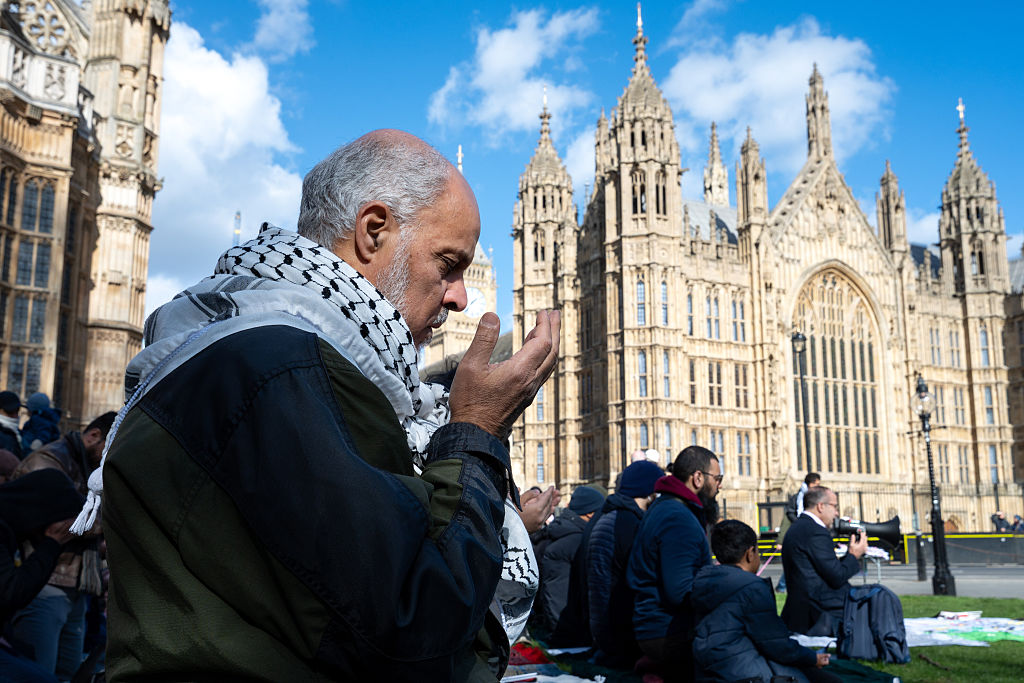
A protester in London, UK, performs a Dhuhr prayer with the House of Parliament and Elizabeth Tower in the background.

The true practitioners of “sectarian politics” in Britain are right-wing politicians like Nigel Farage and Kemi Badenoch who present important issues like the Gaza genocide as if they were illegitimate and only of concern to Muslims. (Andrea Domeniconi / SOPA Images / LightRocket via Getty Images)


“Sectarianism” is a strange term to use when seeking to understand contemporary British politics. However, in recent months, the term has become ubiquitous.

In February this year, the Green Party won a parliamentary by-election in Manchester’s Gorton and Denton constituency. Disgruntled members of Reform UK, whose candidate the Greens had bested, leveled allegations of “sectarianism” and “sectarian voting” at Muslim voters in the constituency.

Since then, use of such language has dramatically increased. Politicians and media commentators routinely use it to stigmatize any political choices by British Muslims of which they disapprove.

“What We Stand For”

During the by-election campaign, the Green Party published a video in Urdu suggesting that Reform and its local candidate, Matt Goodwin, would “fuel the flames of Islamophobia.” Reform sought to present this as a form of sectarian politics and followed up after the polls opened by claiming that Muslims engaged in “family voting.” An inquiry found no evidence to support the allegations.

After his defeat, Goodwin claimed that “a dangerous Muslim sectarianism has emerged.” His party leader Nigel Farage echoed this refrain, presenting the election result as “a victory for sectarian voting and cheating.” The Muslim voters who opted for the Greens in Gorton and Denton had given their support to a non-Muslim woman whose party is led by Zack Polanski, a gay Jewish man. This seems a long way removed from any conventional understanding of “sectarianism.”

It was not the first time that Farage had made such remarks. In May 2024, he claimed that the UK was “moving into an age in our inner cities and towns, I’m afraid, I’m worried to say, of sectarian politics with women completely excluded.” The comments came two days after Farage gave an interview to Sky News, during which he said that “we have a growing number of young people in this country who do not subscribe to British values, [who] in fact loathe much of what we stand for.” In response to the news anchor’s question, he acknowledged that he was talking about Muslims.

Reform was not the only party to make such claims. During campaigning for the local elections this year, the Conservative leader Kemi Badenoch accused Keir Starmer’s Labour government of trying to appease the “sectarian vote” by refusing to join military action against Iran (which was massively unpopular with British public opinion in general, not merely Muslims).

Badenoch has repeatedly expressed such sentiments, condemning “evil Islamist sectarianism” and expressing concern “about the five new MPs elected on the back of sectarian Islamist politics” during her campaign to lead the Conservative Party. This was obviously a reference to the four independent candidates who were elected in seats with substantial Muslim populations after campaigns that highlighted Israel’s atrocities in Gaza.

Policy Considerations

By referring to five instead of four MPs, Badenoch appeared to be identifying Jeremy Corbyn, who also ran successfully as an independent after his exclusion from the Labour Party, as another MP “elected on the back of sectarian Islamist politics.” As with Polanski and the Greens, the “sectarian” label could be applied to non-Muslim left-wingers if they won any support from Muslim voters. Not that there were any grounds for branding the four Muslim independent MPs elected in 2024 as “sectarian” or “Islamist,” either: their critics attacked them for positions that were widely popular with Muslim and non-Muslim voters alike.

Writing in the Daily Telegraph, Tom Harris, a former Labour MP, cut to the heart of the matter by claiming that solidarity with the Palestinians at a time when Israel’s military has been committing acts of genocide in Gaza is inherently “sectarian”:

In previous years, Muslim voters would vote Labour, even when the local candidate was a supporter of Israel: genuine policy considerations were considered more important than a conflict thousands of miles away. Blatant sectarianism in defence of Palestine and Islam — and of course, opposition to Israel — is more mainstream now than years ago.

Of course, those who have refused to vote for Labour because of its support for Israel would insist that this is a “genuine policy consideration” for them, just like any other issue of concern about what the British government is doing at home or abroad.

By presenting the defense of Palestine as a sectarian issue, Harris and his co-thinkers erase all the Jews in Britain and around the world who have condemned the actions of Benjamin Netanyahu’s government in Gaza, the West Bank, and Lebanon. There is a perverse logic behind it all: whether someone is Muslim or Jewish, they cannot take a stand in support of the Palestinians without forfeiting their right to be considered a legitimate political actor by right-wing politicians and commentators.

Their Grievances and Ours

We also have a series of reports from right-wing think tanks propagating the idea that sectarianism is becoming increasingly prevalent in British politics. One such report from the Henry Jackson Society (HJS) claimed that “sectarian politics is corroding British politics” and predicted that 171 “sectarian-style” candidates across thirty-one councils could be elected in this year’s local elections.

The HJS defined “sectarian-style” candidates as those who focused on “issues such as Gaza, Kashmir, or similar overseas grievances associated with Muslims” and warned of an impending “Muslim sectarian wave.” The Telegraph gave the report an enthusiastic write-up, echoing its claims about election candidates who expressed support for Palestine: “Critics have warned these candidates risk ‘stoking divisive sectarian politics’ and ‘distracting voters from local issues’ by injecting Israel’s conflict with Hamas into the heart of the local elections.”

The director of the HJS, Alan Mendoza, is a right-wing political activist who has defected from the Tories to Reform. One of HJS’s employees, Andrew Fox, has gone to extraordinary lengths seeking to deny the overwhelming evidence of Israeli war crimes and crimes against humanity in Gaza. Fox enthusiastically supported Israel’s policy of targeting Palestinian journalists and even traveled to Gaza so that he could offer his solidarity to the self-styled Gaza Humanitarian Foundation after a series of massacres at the sites it controlled.

Another right-wing think tank, Policy Exchange, drew on similar themes when it claimed to have identified the rise of “Islamopopulism.” Whatever terminology the think tanks use, the core argument is the same: issues like the genocide in Gaza have no place in local politics, which should be exclusively concerned with bin collections, fixing potholes, and the like. As Taj Ali pointed out in the Guardian, Muslim voters are in fact perfectly capable of combining anger about international issues with local concerns.

Inclusion and Exclusion

In the May local elections, more than a hundred independent Muslim councilors — or, in the language of the HJS, “sectarian-style” councilors — were elected. Yet what Kemi Badenoch, the HJS, and others are describing bears few of the hallmarks of what we typically understand as “sectarian politics.”

Most efforts to understand sectarianism begin with the work of German sociologists Max Weber and Ernst Troeltsch, who both make a distinction between church and sect. For both Weber and Troeltsch, people are born into a church whereas they choose to join a sect. This is a process understood as a protest against beliefs and practices within society — a deliberate form of dissent couched in claims of authenticity. While the idea of dissent may offer a nod to the ways in which Farage and co. have used the term, there is little sense that voters in Gorton and Denton were trying to set themselves apart from British society.

Others who have analyzed the concept, such as Albert Baumgarten, Irving Howe, and Avishai Margalit, view sectarianism as a process of including and excluding. Building on this, in a recent book I argue that we should understand sectarianism as the process of setting life apart from within. This is a process that can take on a range of different forms and characteristics, with outcomes shaped by the complexities and contingencies of life.

Here, perhaps, we really can see sectarianism in operation, though not in the way intended by those pointing the finger of accusation. Instead, we can see a process of including and excluding that Farage, Goodwin, Badenoch, and others have initiated. Accusations of sectarianism and language that demonizes Muslims serve to undermine legitimate democratic concerns by consolidating the in-group against the out-group.

We can observe similar strategies at work across the world. In Bahrain, where a Sunni minority rules over a Shi‘a majority, sectarianism has been rife. Following the Arab uprisings of 2011, which saw tens of thousands on the streets of the capital Manama chanting “not Sunni, not Shi‘a, just Bahraini,” the ruling Al Khalifa family sought to divide the protesters by alleging nefarious intent and the presence of fifth columnists who were seeking to undermine Bahraini society.

Underpinning such allegations was the long-standing suspicion that Bahrain’s Shi‘a population could be more loyal to Iran than to their own state — a fear exacerbated by a failed coup attempt orchestrated by the Islamic Revolutionary Guards Corps in 1979. More recently, sixty-nine Bahrainis had their citizenship revoked after suspicions about divided loyalties during the US-Israeli war on Iran.

“A New National Order”

In a similar way, allegations of sectarianism in British politics also have deeper and more insidious roots. While the British state is itself no stranger to sectarianism, from Belfast to Glasgow, the “sectarianism” that right-wing politicians and pundits describe has few of the traits we would associate with Northern Ireland (or even Scotland).

Attacks on “sectarian-style candidates” or “Islamopopulists” are emblematic of a broader trend within British politics: the rejection of multiculturalism. Badenoch wrote in a Facebook post that she had been “warning about the rise of sectarianism, and the growing impact of Islamic extremism on our politics” for years. She went on to say how proud she was that Britain “is a multiracial society. But we cannot let it become a multicultural one.”

At the same time as British right-wingers have been condemning the role of Islam in British politics, many from the same quarter have also expressed the view that Christianity should play a foundational role in British public life, as a response to what they present as “transnational, rootless, cosmopolitan ideologies” that are eroding Britain. Indeed, Badenoch promised to “replace the promotion of multiculturalism in schools with a national story, one that is inclusive of the many people who have come to Britain but without the grievance or the guilt which is corroding our cultural confidence.”

The Conservative leader stressed that such lessons would not “teach our children that all cultures are equal.” Reform has made similar arguments: its chief of policy James Orr has argued that Christianity should serve “as the foundation of a new national order” in response to the weakening of British identity, albeit one that is seemingly in tension with the presence of four million Muslims in Britain, not to mention the country’s large Jewish, Hindu, Sikh, Buddhist, or atheist communities.

Both Badenoch and Orr articulate the need for a national story or spirit, one that can unite rather than divide. The irony is that the moment they claim to be looking for may have already been with us.

When the men’s English cricket team won the 2019 World Cup, beating New Zealand in the final, captain Eoin Morgan was interviewed alongside Moeen Ali and Adil Rashid, two Muslim members of the squad.

Reflecting on the tumultuous events of the day, Morgan said that England had luck on their side. Laughing, Ali and Rashid disagreed, instead suggesting that the team had Allah on their side. Morgan later repeated the comment in a press conference. The team exemplified the idea of a multicultural Britain, one that drew strength from its differences.

Morgan was actually born in Dublin and represented Ireland at the start of his cricketing career before opting for England; his teammates Ali and Rashid were born in Birmingham and Bradford respectively, two cities that are now frequently stigmatized as hotbeds of sectarianism. Of course, this raises complex questions around the politics of inclusion and the role played by birthplace, faith, race, and other factors.

Wordplay

Less than a decade after the 2019 victory, the British political landscape presents a very different picture. In Through the Looking Glass, Lewis Carroll’s follow-up to Alice’s Adventures in Wonderland, Humpty Dumpty speaks to Alice about the meaning of words:

“When I use a word,” Humpty Dumpty said in a rather scornful tone, “it means just what I choose it to mean — neither more nor less.”

“The question is,” said Alice, “whether you can make words mean so many different things.”

“The question is,” said Humpty Dumpty, “which is to be master — that’s all.”

In this instance, the choice of the term “sectarianism” is a deliberate one, designed to impose a particular form of social order and set a group apart. When mapped onto preexisting xenophobic and Islamophobic attitudes that are increasingly prevalent across British society, the likely consequences are deeply worrying.