The Super-Elite Is Tightening Its Grip on Combat Sports
Beneath the spectacle of fighters beating each other bloody on the White House South Lawn, fight promoters, tech billionaires, and the Saudi government are working to concentrate wealth and power in fewer, richer hands.
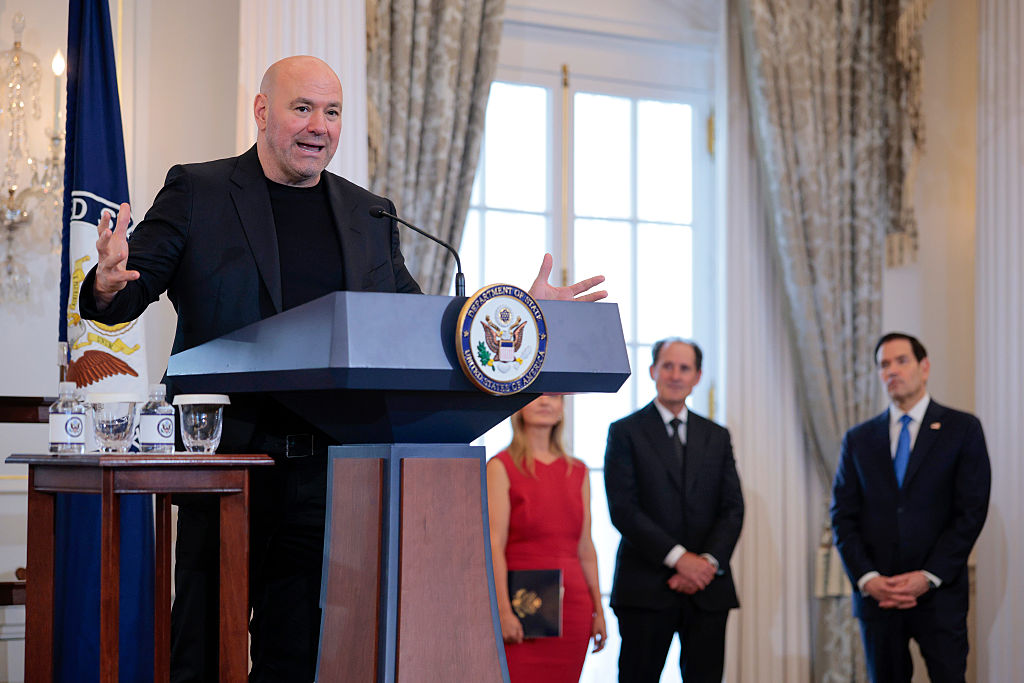
UFC Freedom 250 isn’t just a birthday party for Donald Trump. It’s a gathering of the fight-sport industry’s biggest power brokers — private equity, the Saudi government, and media elites — at the seat of American power. (Chip Somodevilla / Getty Images)
Two thousand years ago, Roman emperors celebrated their birthdays with gladiator shows. The tradition lives on in President Donald Trump, who for his eightieth birthday will host mixed martial arts (MMA) fights at the White House. On Sunday, June 14, in an event promoted by the Ultimate Fighting Championship (UFC), fighters will square off in front of a 4,500-person audience handpicked by Trump. The event, dubbed UFC Freedom 250, doubles as a celebration of Trump’s birthday and the country’s 250th anniversary.
Trump has spent years cultivating the UFC world as a cultural home base, using it to associate himself with toughness, violence, and dominance — and to pull angry young men into his orbit. The president not only frequents UFC events but gets his own entrance music, a ritual normally reserved for fighters. He has a close, decades-long friendship with Dana White, the UFC’s president, who introduced him at the 2024 Republican National Convention. Many of Trump’s highest-profile boosters, like the podcaster Joe Rogan, have deep roots in the UFC world. If it’s true, as the late right-wing pundit Andrew Breitbart said, that politics is downhill from culture, then much of MAGA is downhill from the UFC.
But there’s more to the story. Behind the scenes, UFC Freedom 250 is a tribute to the would-be emperor gifted by capital interests angling to monopolize the fight-sport industry, in alliance with some of the richest people in the world. It’s likely to be a pivotal moment in the consolidation of the fight-sport industry in a small number of enormously powerful hands.
A Puncher’s Chance
In what feels like a previous life, I was a professional Muay Thai boxer. I represented the United States at the Muay Thai world championships, the sport’s version of the Olympic Games, and went on to win a minor world title. I would split the year between stints in Thailand, where I lived in a gym and trained and fought full time, and the states, where I worked various day jobs to support my training. I spent four years teaching at a UFC gym in my hometown in New Jersey, where I instructed and trained alongside athletes in MMA, Muay Thai, jiujitsu, and boxing.
Of all fight sports, MMA is the closest to the type of stereotypical machismo you might expect from UFC marketing. There’s just something about the ground-and-pound, MMA’s signature move, that evokes brute male violence in its most primitive and archetypal form. Still, like all sports, MMA takes all kinds. There are MMA-based “active clubs” that recruit white supremacists, and there are openly anarchist fight clubs. There are MMA gyms for people who want to get healthy and have fun and others for elite athletes looking to compete professionally. There are religiously affiliated MMA programs and queer and trans fight clubs.
People seek out combat sports for a host of reasons, such as fitness, confidence, and self-defense. Some people just kind of like getting punched in the face, or punching others in the face, and combat sports are a socially sanctioned way to do it. For me, it was a combination. As a formerly angry young man myself, I needed an outlet for that anger after graduating out of high school football and dropping out of a Reserve Officers’ Training Corps (ROTC) program over opposition to the Afghanistan and Iraq wars. I found boxing, then Muay Thai. Angry young men get a bad rap, often deservedly so, but there are many things to be angry at, many of them legitimate. Say what you will about the violence of fight sports, but at least it’s consensual.
Despite MMA’s association with the political right, at the core of all fight sports is a culture of respect that is grounded in one thing only: what you can or can’t do when faced one-on-one with an opponent who wants to hurt you. No one can save you once you’re in the ring, not your training partners or coaches. The fundamental premise is performance under equal opportunity pressure. Fighters are matched by weight, experience, and fight record, but even when mismatches occur — and these are endemic — the rules are still applied more or less equally. And fighting is the only set of sports that can end at any moment with a knockout. Each fighter in every fight has what we call a puncher’s chance to land the right shot and win.
It’s this idea of proving oneself on a level playing field, not just the aesthetic of belligerence and dominance, that draws Trump and his circle to the sport. Capitalism’s winners want to imagine and portray themselves as having proven their mettle in an environment of pure, unadulterated, equalizing competition. But capitalism is not like that at all. It runs on cronyism, inherited advantage, rigged rules, uneven matchups, and political favor — and the capitalist enterprises behind the fights are no exception.
Mainstreaming Aggression
According to Dana White, UFC’s all-American business success story started with John McCain.
Versions of sport fighting date to antiquity in all corners of the globe. The second event introduced into the Ancient Greek Olympic Games was wrestling, following the footrace. Soon after, they would add boxing and a free-for-all fight sport called pankration, in which biting, eye gouges, and groin strikes were the only banned techniques. The UFC was founded in 1993 with these same basic rules.
In its first incarnation, UFC was part underground martial arts competition, part street fight. There were no weight classes or time limits, and fights, which took place in a chain-link-fence cage, went on until one fighter yielded or was left unconscious. The sport’s appeal lay in the opportunity to answer in real life questions that previously had only been askable in movies or video games, such as, what happens if a middle-aged Dutch karate champion fought a four-hundred-pound Samoan sumo wrestler? That was, in fact, the inaugural UFC fight; the karate guy won by kicking the sumo wrestler in the face after the latter had lost his footing, sending a tooth flying into the crowd.
As the story goes, Senator John McCain soon caught wind of the UFC and was mortified, deriding it as “human cockfighting.” Notwithstanding the fact that cockfighting was legal in McCain’s home state of Arizona at the time, the presidential hopeful went on a high-publicity crusade to ban the human version and very nearly succeeded. By 1997, MMA was outlawed in thirty-seven states and forbidden on pay-per-view, relegating its distribution to the depths of the video stores of that era, somewhere between the pornography and professional wrestling sections — which is where I first encountered it in my youth.
In response to the political blowback, MMA was forced to professionalize. Rules were invented. Judges, gloves, and timed rounds were added. Dana White took over as UFC president in 2001, the year it officially codified its new “unified rules of mixed martial arts,” rebranding as a legitimate sport and lobbying state athletic commissions for approval.
It worked. Slowly working its way up the ladder of public respectability, White balanced a commitment to full legality with a promotional style hearkening to the sport’s brutal underground origins. UFC brought in announcers, including Joe Rogan, who would continually educate audiences about the sport’s rules while reminding everyone that the fighters were serious athletes. Still, UFC broadcasts began with a video montage of Roman gladiators, set to a heavy metal soundtrack. The UFC’s branding threaded a needle between boxing, which is definitely a sport, and professional wrestling, which is definitely a show, to create a niche that would draw in hordes of mostly young men drawn to ostentatious displays of toughness.
But UFC’s rise to the world’s most profitable combat-sport promotion owed to more than an organic fan base of angry young men. It also had heavily invested corporate sponsors. In 2001, the year of its relaunch, a pair of casino executives in Las Vegas bought UFC under a parent company called Zuffa. In 2016, Zuffa was purchased by media management giant Endeavor, which also represented the NFL and NHL. In 2023, Endeavor announced the merger of UFC with the World Wrestling Entertainment (WWE), the main professional wrestling promotion (“professional wrestling” meaning fake, circus-style fighting) into a new company, TKO Group Holdings.
Two years later, Endeavor was wholly acquired by Silver Lake, one of the world’s largest private equity firms, which focuses on technology-sector investing. For TKO, two big moves rapidly followed the buyout. First, a seven-year, exclusive rights deal with David Ellison’s Paramount for nearly $8 billion. Second, a new campaign to take over America’s premier traditional fight sport, boxing, under the banner of yet another new subsidiary, Zuffa Boxing.
Enter the Saudi Royal Family
Zuffa is trying to do to boxing what Trump has done to the United States government: use legitimate critique of a bad system as justification to impose one that is far worse, with the goal of consolidating more power and profit in fewer, richer hands.
Like any enterprise in capitalism, the professional fight game is organized around money-making, and it’s a famously grimy sector of sports entertainment. Athletes in major team sports like football, basketball, baseball, soccer, and hockey are represented by labor unions. Fighters are not. In combat sports, contracts are negotiated between promoters and managers, if a fighter is successful or connected enough to have one, and otherwise between promoters and coaches or even the athletes themselves. Historically, this has enabled gross exploitation in a sport that exacts a severe physical toll.
In 2000, Congress passed the Muhammad Ali Boxing Reform Act designed to protect boxers from exploitation by sanctioning organizations, promoters, and managers. Introduced by McCain, the Ali Act essentially applied baseline guardrails against corruption and coercion.
The Ali Act was passed in the years following the sport’s devolution into a profiteering mess. Fighters were at the mercy of the deals cut between their managers and sanctioning organizations that dictated athletes’ standing and opportunities. Since the 1980s, there have been four main sanctioning bodies in the world, each with its own champions and ranking systems across weight classes and of course its own fees and networks. The heavyweight champion of the world used to be considered one of the most important titles in sports; now there can be four of them at the same time.
The Ali Act was a vast improvement, but it still left the sport disjointed into cliques, with loopholes enabling different institutions and rules across sanctioning bodies and states. Making “unification” fights — and, depending on the state, making fights at all — hinges on whose pockets get lined and little else, resulting in a sport where fighters couldn’t advocate for themselves and the best rarely fought the best.
Enter the Saudi royal family. As part of its bid to sportswash the country’s well-earned reputation for human rights abuses, head of the Saudi General Entertainment Authority Turki Al-Sheikh made a strategic intervention in boxing. The idea was to dump so much money into the sport that it incentivizes the unification fights fans were craving. Made possible through the application of essentially unlimited resources that the Saudis did not expect to turn a profit on — after all, they were buying legitimacy, not doing business, at least in the short term — boxing was transformed virtually overnight, with Riyadh quickly hosting the biggest fights fans could only dream of in the years prior. Instead of only pursuing the rankings of different sanctioning bodies, fighters and their promoters started auditioning for Turki.
This looked good to Dana White, whose UFC had pursued a similar model with a newer, growing sport. While they are often used interchangeably, MMA is a sport; UFC is a sanctioning body. There are others, such as ONE Championship, Professional Fighters League, and Bellator, but UFC dominates with more than 90 percent of the global MMA market.
For MMA fighters, it’s a bit like being an independent contractor where the UFC is at once the licensing bureau, the recruitment agency, and the only employer in town. One of the consequences is that base pay is extremely low. In most professional sports leagues, athletes’ pay accounts for upward of half the total revenue. In the UFC, it’s less than 20 percent.
For years, UFC has been mired in labor disputes and antitrust lawsuits. But with no major alternatives and without a union like athletes in major team sports have, MMA fighters are acutely vulnerable to exploitation in a business that takes an extreme physical toll. This looked good to Turki Al-Sheikh; he and Dana White cofounded Zuffa Boxing to merge the Saudi approach to boxing with UFC’s near-monopoly on MMA.
Zuffa is sponsoring new legislation, the Muhammad Ali Revival Act, which would allow Zuffa to become a “unified boxing organization” (UBO) governing boxing across states the way UFC functions in MMA. The legislation frames itself as giving fighters a choice between the old system and the UBO, but this is essentially the “choice” of right-to-work laws.
It’s a brilliant intervention in the way Turki Al-Sheikh’s was. Boxing experts and fans have long clamored for a national commission that could standardize the sport and mitigate corruption, and this appears to do just that. In reality, it enables a bad actor to seize control over the entire industry.
The Price of Entry
UFC Freedom 250 is a crash course in Trumpian politics. The birthday celebration, the fan base, the spectacle of violence and domination on the South Lawn, the exclusive access event are all a gift to curry favor with the self-styled strongman. TKO is expecting to lose at least $30 million on the White House fights, even after bringing in corporate sponsors. Trump, by the way, bought stock in TKO in March.
In essentially putting on the show as a tribute to the president, TKO is taking a page from Paramount’s book — the company run by a close Trump ally and the second richest man in the world behind Elon Musk, now exclusively broadcasting UFC fights on its streaming service. In 2025, while Paramount’s $8 billion merger with Skydance was pending approval by the Trump-appointed FCC chair, the company abruptly agreed to pay Trump a $16 million settlement in a suit Trump had brought against Paramount subsidiary CBS. The merger was approved, and soon thereafter, Paramount bought Warner Brothers in a record media acquisition worth well over $100 billion.
With UFC Freedom 250, Trump gets many things he loves. There’s money, in the form of cage-side seats that are reportedly costing upward of $1.5 million apiece. There’s social power, in the form of an exclusive event where he can handpick the invitees. He gets to merge his own birthday celebration with America’s, a flourish of self-flattering mythmaking. And he can literally reshape the White House for it; he’s now claiming the arena being built will stay.
Is all this technically a bribe to the man who wields unprecedented influence over a party in control of all three branches of government? No. But with pending lawsuits and TKO’s de facto command over American combat sports in the balance, will the gesture hurt their chances? Also no.
Trumpian politics is akin to a series of stage magician’s tricks, constantly drawing attention to a shiny object over here while making a lot of money disappear over there. Rarely, however, does a singular event so tightly converge the political, social, and economic forces that define an era of politics.
Dana White can claim that UFC Freedom 250 is an apolitical event, and there is probably a sense in which he is being honest. It isn’t about “red or blue or politics,” as he puts it. I’s about using flag-waving to squeeze the maximum amount of profit and influence out of everyone, as long as Trump is in on it — a single-minded goal that is the core of the Trumpian ideology.