No, Brexit Didn’t Make Britain a Far-Right Dystopia
The British vote to leave the European Union is often cited as a far-right breakthrough. But as anti-immigration parties surge across the EU, Europe's own claim to represent internationalist values looks increasingly in doubt.
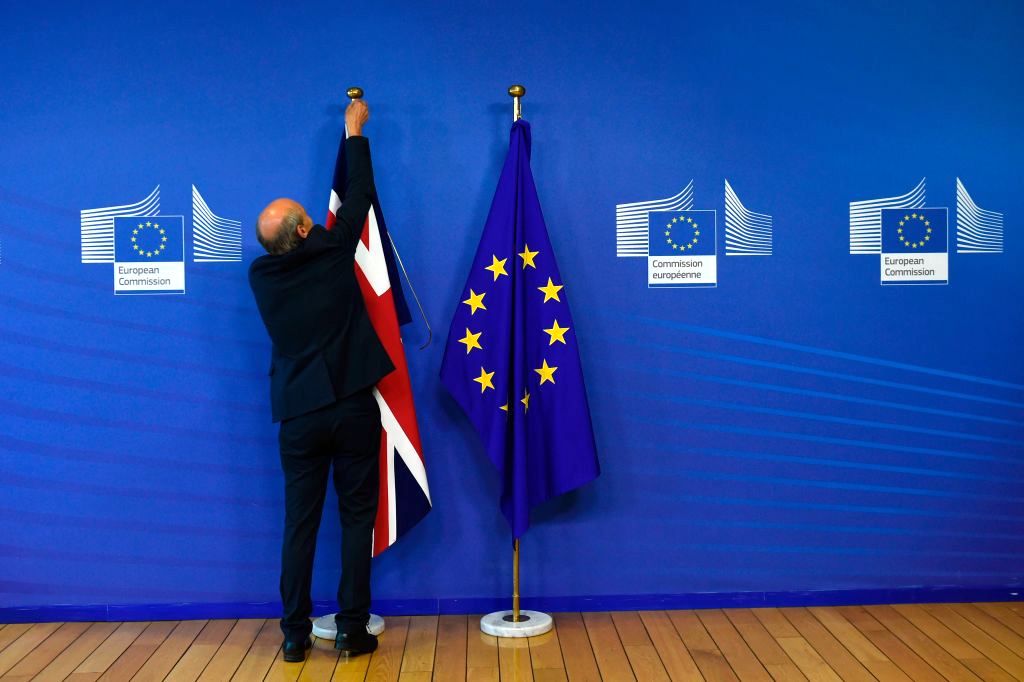
A clerk puts a Union Jack nex to a flag of the European Union at the European Commission in Brussels on June 19, 2017, as Britain is to start formal talks to leave the EU. (John Thys / AFP via Getty Images)
During the last decade, and especially since 2016, there has been a widespread tendency to view both domestic and international politics in an extraordinarily simplistic way. International politics is widely seen as a struggle between authoritarianism and democracy, and its domestic counterpart as a struggle between liberal centrists and illiberal “populists,” who are in turn aligned with and supported by authoritarian states like Russia. Since the Russian invasion of Ukraine two years ago, this tendency to see politics in terms of good and bad guys has become even more pronounced.
One of the consequences of this binary thinking has been to equate a whole series of heterogenous figures, movements, and parties around the world which were seen as following what is often called a “populist playbook.” In the case of the British referendum on leaving the EU in 2016, this inflationary use of the concept of populism was even extended to include a decision. Opponents of Brexit, both in the UK and beyond, identified it with the far right — and in the United States, it was seen as a kind of British equivalent of Donald Trump, who was elected as US president just a few months later.
However, Brexit was in reality a much more complex and open-ended phenomenon. All kinds of different arguments were made for leaving the EU from political actors of different kinds. In particular there were left-wing arguments for leaving the EU as well as right-wing ones (though this is often forgotten or dismissed), and arguments that are difficult to classify into left/right terms, such as those around democracy and sovereignty. In the referendum in June 2016, voters were not asked to make a choice between parties with manifestos setting out policy positions but rather to answer the simple question of whether to leave or remain in the EU. Equating Brexit with the far right obscures not only what actually happened in 2016, but also the trajectory of British society since.