Inside the Schism Threatening the Catholic Church

Pope Leo excommunicated four newly consecrated bishops last week, members of the conservative Society of Saint Pius X. Their movement represents a broader traditionalist reaction in the Catholic church, fueled by Christian nationalists in the US and beyond.
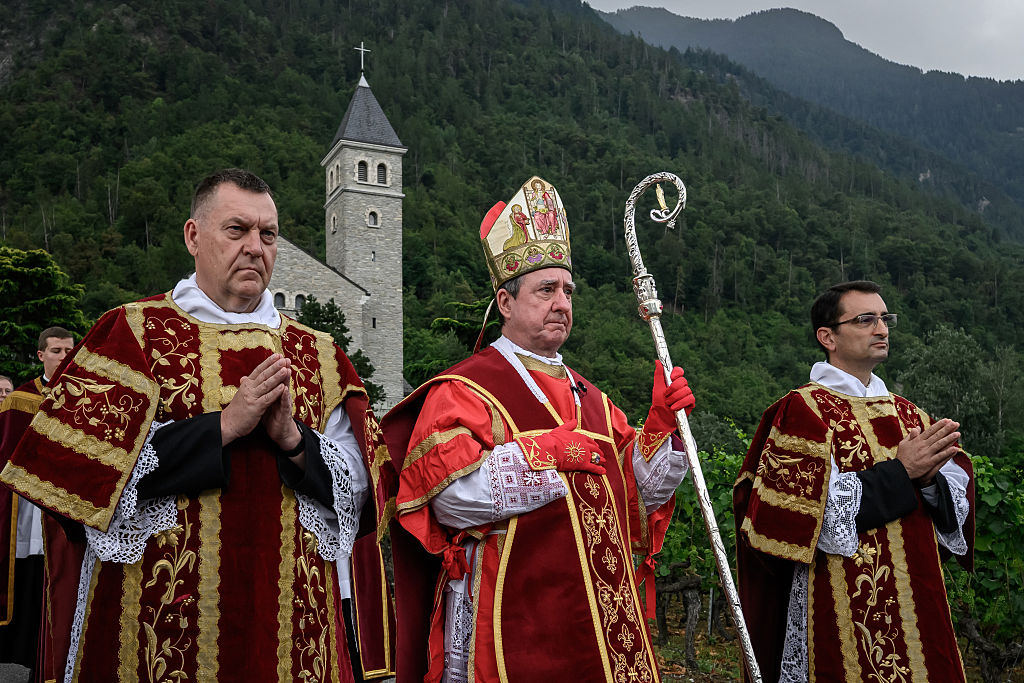
Leaders of the controversial ultraconservative Catholic Society of Saint Pius X (SSPX) gather in Econe, western Switzerland, July 1, 2026. (Fabrice COFFRINI / AFP)


When Pope Leo XIV signed off on the excommunication of four newly consecrated bishops and other formal followers of the Society of Saint Pius X on July 2, the dark cloud of schism floated over the Christianity’s largest religious denomination. Leo, only in office since last year, invoked the extraordinary measure in the first big public test for the first American pontiff.

Whether the faithful rally around the smart and apparently amiable man who sits on the throne of St Peter or draw back from the move will determine the immediate trajectory of the former Robert Prevost, of Chicago, who over the last year has emerged as a world leader unafraid to speak truth to power. Leo has famously stood up to President Donald Trump and Vice President J. D. Vance on immigration, the war in Iran, and Catholic doctrine.

Declaring a group “in schism” is rare, meaning it is no longer considered inside the church. A memorable schism was the Protestant Reformation, five hundred years ago.

The SSPX, as the society is known for short, or Lefebvrists, as outsiders call them after Archbishop Marcel Lefebvre, who founded the movement in 1970, amounts to a mere splinter within a global Catholic population of 1.4 billion. Yet it is an outsize symbol of recalcitrance at the heart of the church, a mirror of the traditionalism that was meant to disappear in the wake of the global Second Vatican Council (Vatican II, 1962–65) but has been spreading with spiritual and political effects beyond the SSPX.

Catholic traditionalists have ultraconservative social views. The SSPX has maintained ties to ultraright figures in Europe such as France’s late Jean-Marie Le Pen, Alternative for Germany lawmaker Maximilian Krah, and Italian neofascists. In the United States, archconservative Catholic groups like the Napa Institute, where Vice President Vance has spoken, promote pre-Vatican II theology. The US contingent of traditionalists represented by the Institute is wealthy, connected to its European counterparts, and aims to influence policy in the direction of its beliefs, such as against gay rights.

Isolating the SSPX may isolate this politically powerful group of Catholics. “In the US, you have a grey area of some bishops and certain circles of the clergy that were saying, ‘These guys are a little crazy, but they have a few valid points,’” Massimo Faggioli, a theology professor and historian of the church in the United States told the Financial Times. “Pope Leo did the right thing in making clear, you cannot be in the grey area any more.”

To followers of Lefebvre, who died in 1991, and myriad other “traditional Catholics,” Vatican II was a turning point. The bishops of the world had set out to modernize the church and, as Pope John XXIII, who called for the meetings, said, “to open the windows and let in the fresh air.” They did not abandon doctrine but traded Latin for vernaculars, turned the altar around so the faithful might see the priest instead of staring at his back during Mass, allowed the liturgy to reflect local culture without changing its essentials. They also condemned antisemitism and elevated ecumenism, embracing friendship and understanding with other faith traditions. To traditionalists, the new direction was anathema. Richard Williamson, an SSPX bishop, denied the Holocaust, and at the consecration in Switzerland current SSPX leader Davide Pagliarini declared it was “humiliating” to see Pope Leo meet with representatives of other religions, “false and incapable of bringing salvation.”

SSPX’s Followers

“No good fruit came of Vatican II,” avers one of the six hundred thousand SSPX adherents who attends Mass at one of the society’s eighty chapels worldwide (by ecclesial rule they may not be called “churches”). Most are in France and the United States, but they exist in sixty more countries too. There followers are baptized, married, and confirmed, and their children may go to SSPX schools. In 2021, Leo’s predecessor, Pope Francis, declared there was “no place in the church” for those who reject the council, whose guiding principles were a return to the sources of the early church, connecting it more closely to the gospels and the poor, and aggiornamento, bringing things up to date. The immediate trigger for Leo’s action was the SSPX decision to consecrate four new bishops after he expressly told them not to. “It’s very sad, bittersweet,” said B, an SSPX follower who spoke to me on the condition of anonymity. “The Society has done everything it can to prevent this,” he said. “Our bishops were old and couldn’t travel all over the world anymore. We needed younger ones.” Nevertheless, B remains firm in his convictions. “If I say things correctly it comes from God, not me,” he said.

B is a third-generation SSPX adherent living in Michigan, where he was taught at home before attending one of the society’s ninety-four schools from fifth grade through high school. There he received what he described as a “very good education which taught Catholic studies first, because that is most important, but other things, math, science.” B, who works in supply chain management, and his wife, who has not worked outside the home since she had their first child, were married several years ago by an American SSPX priest, Michael Goldade of St Marys, Kansas, one of the four men consecrated bishops in front of seventeen thousand people in a Swiss vale on July 1 without the necessary papal mandate. Goldade is now excommunicated.

The Vatican decree was directed at formal members of the society. Because of this, B doesn’t believe that he is subject to excommunication since he is not attached to the Society as its priests or seminarians are. Even if B had been excommunicated, it is unclear how much of a difference it would make. He told me he would not attend a non-SSPX church. Although excommunication renders invalid any sacraments the society’s priests will now administer, such as baptism and matrimony, B believes this is overridden by canon law that provides legitimacy to any priest acting in a grave crisis or emergency. B’s claims about canon law are true; they rely on the same reasoning Lefebvre gave decades earlier.

And what, I asked him, is the grave crisis? “I am not able to attend a [mainline Catholic] parish without peril of losing my soul and those of my children,” B said. SSPX services, he believes, are the only true version of Catholic practice and the only way he can fulfill his religious obligations.

A friend of B’s brother, Cassandra Hackstock of Steubenville, Ohio, was, along with others in her extended family, a devout SSPX adherent for more than seven years before leaving disillusioned at age twenty-four. She didn’t like what she saw as the society’s treatment of women as inferior to men and felt she had been lied to after reading published material about what she saw as the valid excommunication of Lefebvre in 1988, which SSPX had said was unjustified. She was riddled with fear lest it be discovered that she also read documents of the Second Vatican Council. “Vatican II was demonized so it was evil to read them,” she said. “I was shocked to find nothing shocking.”

While in the society, Hackstock tutored young girls, who are taught separately from boys in SSPX education, in a basement forty minutes away from the main church. “I begged the pastor for a classroom, but he said the girls couldn’t be on the property where boys were except for assembly and Mass.” Hackstock said she was taken aback when introduced as their “teacher” because she had no degree or teaching certificate. “We don’t want you to have a college degree,” the priest told her. “He always tried to smooth over whatever was troubling my soul. I had the faith, that’s all that was needed.” Now forty-eight, having completed a master’s degree in Catholic studies, Hackstock said she still carries “a tremendous burden of guilt” for the deception. Adherents were “encouraged to tell each other their faults,” and Hackstock said she felt isolated from the rest of the world in the society, but it was nonetheless sad to leave behind the warm sense of community.

Her disquiet didn’t go away when she left. She needed therapy, as if to be deprogrammed, but mental health professionals will drive you to suicide, she said she had been told, which would condemn you to hell. “I needed to unlearn many things I believed were true,” she said. “When you leave, it takes a long time to recover.” For years, she was estranged from siblings, cousins, aunts and uncles who stayed in the society.

Hackstock said her SSPX experiences “fit in really well” with the current surge in traditionalist religion and “the MAGA movement,” as if its beliefs were spilling into the mainstream. The movement was, she suggested, part of a broader wave of Christian nationalism, which she sees in mandatory Bible reading in Texas schools, “the rise of the alpha-male type,” and a new push by some for large families.

The Spirit of SSPX Lives in Washington

As news of the excommunications spread, canon lawyer Father Gerald Murray told the Catholic commentator Raymond Arroyo that the extraordinary penalty was meant “to bring the offending party back to full communion by recognizing their offense,” but it had an important second meaning: “To warn the rest of the faithful who engage in similar behavior.”

Many Catholics are returning to traditionalist practices. Young people and converts especially may be drawn to the beautiful and exotic-seeming Latin Mass, which Pope Francis discouraged, following the Vatican II mandate to celebrate Mass in the vernacular so it would be more accessible.

Beliefs like those of the SSPX are rife among Catholic “trads,” social conservatives championing the church of yore, such as Vice President Vance, who said that part of what drew him to become a convert in 2019 was that the church was “just really old.” Take the Lefebvrists’ insistence that women should have many children, sometimes ten or more. Vance has famously disparaged childless “cat ladies” as bad for society and told the traditionalist attendees of the Napa Institute that families were “not having enough children . . .  causing a civilizational crisis in this country.” At a Budapest rally just before Prime Minister Victor Orban lost reelection, Vance praised the Hungarian leader for policies encouraging women to have more children, guaranteeing cancellation of of home-loan debt after three children and lifetime exception from income tax after four. The “number one thing” that the Republican Party “should be is pro-babies and pro-families,” the vice president said at Napa.

Justice Amy Coney Barrett, a Catholic mother of seven, typically votes with the conservative Supreme Court supermajority made up of six judges who grew up Catholic. She belongs to a secretive, insular Christian community with 1,700 members called People of Praise who, like the Lefebrists, are patriarchal and complementarian, believing that men and women are created by God for different roles, with the man the undisputed head of the family. The husband is obliged to correct his wife if she strays from the straight and narrow path of the group’s beliefs.

B, the Michigan SSPX follower, who has two children and another on the way, told me that he and his wife are determined to have “as many children as God gives us. . . .  Five is considered a small family.” He consults his wife on matters, but his faith tells him that he is the ultimate authority in the marriage, “responsible for decisions before God.” He is heartened, he says, that “Catholics in positions of power now are advocating bigger families — the replacement helps the country to be stronger.”

Catholic traditionalists are often closer in their social views to extremist white evangelical Christians such as Speaker of the House Mike Johnson than to mainstream Catholics. Johnson belongs to the patriarchal and complementarian Southern Baptist Convention (SBC), the largest US Christian denomination after the Catholic Church. Secretary of Defense Pete Hegseth’s evangelical sect, the Communion of Reformed Evangelical Churches (CREC) preaches women’s submission to men. In Hegseth’s case, it is difficult to distinguish the belief from straightforward misogyny. He has fired accomplished women officers left and right or blocks them from promotion. He has shared a video showing CREC pastors arguing that women should not have the right to vote. Like the ultraconservative Catholic Opus Dei movement whose Washington, DC, center on K Street draws policymakers, CREC opened a DC branch for members who relocated to work in the Trump administration, CREC founder Douglas Wilson told the Associated Press. “This is the first time we’ve had connections with as many people in national government as we do now.” Wilson, who has called for a Christian theocracy, is one of three CREC pastors to have appeared at monthly “voluntary” sessions (some say individuals feel pressured to go) at the Pentagon prayer meetings organized by Hegseth.

Pope Leo holds no sway over non-Catholics, but his condemnation of the SSPX carries weight against Catholic traditionalists. It may weaken the position of religious extremists in Washington and elsewhere.

On the other hand — and this cannot be known immediately — the Vatican’s very public condemnation of the SSPX, whose beliefs so sharply mirror those of religious conservatives in general, might also fuel the traditionalist fire.