Judge Platner’s Character by How He Fights the Oligarchs

The fact that Graham Platner still holds a general election lead amid scandalous personal revelations should give us hope. Voters may be shifting to judge politicians more on their willingness to take on economic inequality and war than their private lives.
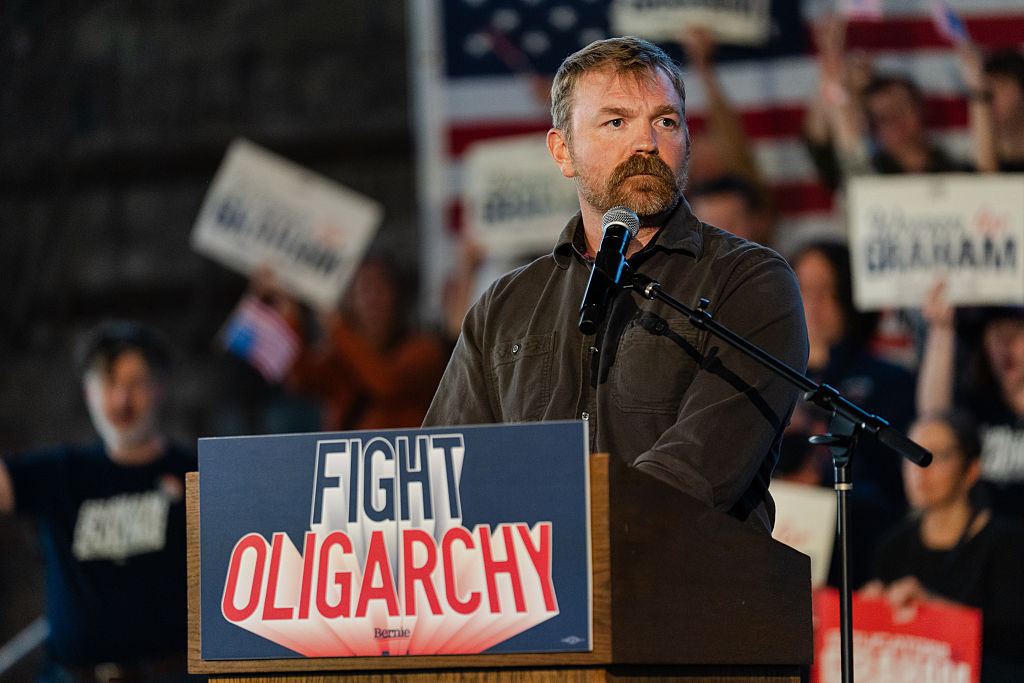
Graham Platner, Maine candidate for US Senate, speaks at a rally in Portland, Maine, on May 25, 2026.

Voters who can’t afford anything and who feel totally ignored by their government are likely to understand “character” on economic and anti-corruption terms — rather than on old definitions of personal moral rectitude. (Sophie Park / Bloomberg via Getty Images)


On CBS’ Face the Nation on Sunday, Sen. Chris Murphy (D-CT) was asked whether all the controversies surrounding US Senate candidate Graham Platner mean he doesn’t “pass the character test.” Murphy offered a subtly radical answer: “Character involves standing up to people who are bankrupting and corrupting this country.” It was an echo of Rep. Ro Khanna, who credited Platner with “having the character to stand up against the war in Iran, against genocide, and against an unfair & lopsided economy.”

What’s radical here is that Murphy and Khanna are suggesting the possibility of a new political reality, one that I think the affluent class of New York and DC media and political elites literally cannot process: A reality in which many voters are so economically pulverized and politically disillusioned that they now define “character” in a politician solely as whether or not they are single-mindedly focused on destroying oligarchy and ending corruption.

To be clear: I don’t know exactly how many voters think this way. I don’t know if such anti-system voters have reached enough of a critical mass to sway elections (though clearly, many voters were willing to overlook Donald Trump’s personal flaws to vote for someone they believed would blow up the system). As I said in my new story for the Lever on the US Senate race in Maine, I have no idea whether the current (or future?) controversies surrounding Platner will sink his candidacy. And I think that — other than the private stuff about his marriage, which is his private business — much of the journalistic scrutiny of his past “character” is appropriate for someone running for public office (which is why I participated in conducting some of that scrutiny!).

But stop and consider those polls showing Platner’s laser-focused anti-oligarch candidacy maintaining a general election lead amid all the revelations about his past. That survey data suggest a new paradigm of materialist politics may be upon us. It is, potentially, a new era in which voters who can’t afford anything and who feel totally ignored by their government have reimagined their entire definition of political “character” on economic and anti-corruption terms — rather than on old definitions of personal moral rectitude.

In this potential new reality, the personal shortcomings of individual politicians — which often have little effect on voters’ actual lives — are less important and electorally salient than the policies those politicians support and oppose. And such a shift would make sense in the current moment.

After all, if the last few depressing decades have led you to the understandable conclusion that almost everyone in politics is corrupt and disgusting, then come election time, you are going to be more likely to support whichever politicians you think will most blow up the entire system in the way you want it blown up — regardless of whether you think they are “good” or “bad” people on an individual level.

This would be the world of a gritty noir film — a moment in which America feels like Gotham and voters are looking for their particular version of the Joker. And there’s evidence that this world is now upon us: A 2025 poll found 54 percent of Americans agreed that “when it comes to politics and society, nothing really matters because powerful people will always do whatever they want.”

If this is actually the new reality of how voters view politics, then controversies surrounding Platner — and any other anti-oligarch candidates — might not shape elections in isolation. (Example: the “scandal” over Michigan populist Senate candidate Abdul El-Sayed’s medical degrees has failed to halt his rise in the polls). As I detailed in my profile of Platner, such controversies will likely become electorally salient only if they appear to corroborate larger narratives suggesting that, once in office, the candidates will abandon their anti-oligarch policy promises.

Would this new world of rougher, more personally flawed politicians be a better reality? It’s hard to know for sure. But one taboo truth is clear, even if nobody wants to say it aloud: If this is the new world, then — mathematically speaking — the Democratic Party cannot electorally survive in its current form as the party only of West Wing nerds who, since infancy, have been running for office, living perfect lives, and coddling power on their way up the ladder.

Many elite liberals can’t stand imperfect people who don’t have fancy credentials — they see them as “low class” or “deplorables.” But — without weighing in on the merits of any specific candidate, including Platner — I genuinely believe liberals’ political party will not survive unless it becomes a party that is open to regular people who’ve lived regular, imperfect lives outside the so-called professional-managerial class — and who want to fundamentally tear down oligarchy.

Of course, the ruling class has spent half a century trying to prevent this kind of new, materialist political reality from ever emerging. As we showed in Season 1 of Master Plan, the 1971 Powell Memo was essentially a clarion call to oligarchs and corporations for them to invest in snuffing out materialist politics (or diverting it into right-wing causes). One of the ways they’ve done that is by using their media machine to define political “character” in explicitly nonmaterial ways.

This is how someone like, say, Mitt Romney is depicted as a figure of high moral character because he appears to be a family man who occasionally criticized Trump — all while Romney’s rampage of self-enriching layoffs isn’t cast as a serious character flaw.

It is how George W. Bush is portrayed as a man of moral character because he seems folksy and paints pictures — all while him lying America into a war and cratering the economy isn’t depicted as a negative character reflection.

And it is how Maine Sen. Susan Collins is depicted as a thoughtful person of high character because she pretends to be “concerned” a lot — all while her votes for oligarchy are rarely cast by the media as proof of her poor character.

Meanwhile, the more of a threat a political figure is to oligarchy, the more their extracurricular behavior is scrutinized and mercilessly scandalized by oligarchs’ sprawling political and media machines. Anyone remember what ultimately happened to Sheriff of Wall Street Eliot Spitzer after he targeted the real heart of power in America? Call this the Client 9 Doctrine of American Politics — which Platner is now contending with.

But here in 2026 — amid so much economic pain, so much corruption, and so many political betrayals — things may be changing. There is now the potential for much different definitions of political “character” and even “scandal.” As Matt Stoller summarized it: tattoos, shitposting, and marital controversies “aren’t scandals. Invading Iraq was a scandal. Foreclosing on tens of millions of people was a scandal. Attacking Iran was a scandal.”

And those new definitions — equating character with anti-oligarchy and scandal with the world’s real crises — are terrifying and bewildering to the people in power.

Indeed, if you are a powerful politician, a political operative, or a pundit and/or reporter at a fancy news outlet — and you are being paid six or seven figures while living the high life in the Acela Corridor — you probably have trouble even entertaining the possibility that political “character” may now be defined on materialist terms. You’re probably like nepo baby pundit Jonah Goldberg this week — you simply cannot allow yourself to entertain the possibility that Murphy and Khanna floated.

You cannot allow yourself to believe that Americans might not be so easily duped anymore. You cannot allow yourself to believe the possibility that voters might actually respond to the signal of candidates’ anti-oligarch message through the distracting noise of the gossipy clickbait that you and your cronies feed them and monetize.

Why can’t you let yourself believe this new paradigm is possible? Because you are one of the financial and status winners of the old system that this new political reality could start ending.

And so if that’s you, you are probably logging onto the internet to try to fan the flames of whatever salacious new allegations you can find against any anti-oligarch upstart in an attempt to focus the voters’ attention anywhere other than on voters’ own material conditions. (Which is why we see breathless “character” concern-trolling from a partner at a Trump-connected lobby firm, a former Andrew Cuomo adviser, a former top aide to literally Dr Evil, and basically every Republican staffer in Washington.)

If you are comfortably insulated from the economic dystopia happening across the country, you probably want voters to believe the big marital scandal in the Maine Senate race is allegations of infidelity against the anti-oligarch challenger, not the incumbent Republican senator having become a multimillionaire after marrying a corporate superlobbyist.

If you are in a cushy political or media gig with no economic care in the world, you have the privilege and motivation to pretend gossipy clickslop, rather than economic policy, should define America’s political discourse. And so you are probably frantically promoting the idea that what matters in politics is the alleged goodness of individual politicians rather than whether they will wield power against your paymasters.

If you are so totally insulated from all the crises bearing down on this country that you can treat politics as a parlor game, then, as journalist Ken Klippenstein joked, you might find yourself unironically posting on social media: “Why can’t Maine voters nominate a squeaky clean asexual McKinsey sociopath who would wear your skin like a wetsuit if it got them a promotion?”

In sum: If you are part of this political-media elite, you are probably desperately promoting the idea that politicians’ “character” is defined by their manners, civility, family life, and anything else that has no material impact on voters. You cannot allow politicians’ “character” to be defined by something new: their willingness to fight against you, your fellow elites, and the oligarchs who many voters believe are ruining their lives and destroying the world.