Pedal to the Metal
Despite tariffs, Chinese electric vehicles are entering the European auto market at full throttle.
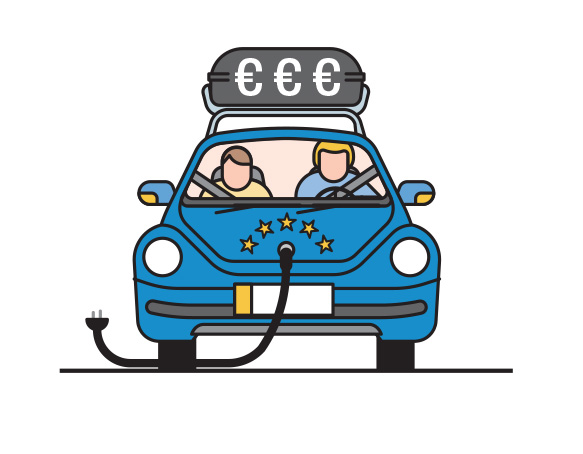
Illustration by Meg Studer
In mid-2024, Chinese automaker BYD opened a sparkling showroom in Paris, just steps from the Champs-Élysées. A few months later, the European Union imposed tariffs of up to 35% on Chinese electric vehicles (EVs). The duties did little to slow Chinese carmakers’ march into Europe’s shopping districts and city streets. Last December, Chinese vehicles accounted for a record 9.3% of new cars sold in the EU; in the UK, which doesn’t have tariffs, their share of sales hit 20.6%. The rise has posed difficult problems for European policymakers, who hope to protect their domestic automakers while disentangling their economies from the volatile United States and advancing the green transition.
Europe previously feared for the viability of its domestic auto industry in the 1970s and ’90s, when Japanese and Korean cars came on the scene. Chinese cars are gobbling up market share even more quickly than their predecessors did. Prices are part of the story: the average cost of a European EV is around €50,000, whereas a typical BYD sells for between €30,000 and €45,000, with compact models like the Dolphin going for as little as €20,000. But the Chinese auto industry is also better developed than that of Japan in the ’70s or Korea in the ’90s, and a variety of economic incentives are drawing its carmakers to Europe. Growth in China’s domestic auto market is slowing, the US market is largely closed to Chinese vehicles, and the yuan is weak against the euro; all this, plus the EU’s incentives for EV adoption, makes Europe a prime target for the industry. The biggest loser so far has been Tesla, whose European sales plunged by 40.2% year over year as BYD’s tripled.
European automakers have good reason to worry that they’ll be next. Though the EU’s tariffs on China’s battery-powered EVs dented demand, it has since recovered. Meanwhile, Chinese automakers seized the opportunity to vastly expand their sales of plug-in hybrids, which are not subject to the same duties, and to build plants in the Middle East and North Africa, which would offer them another way around the tariffs. Now the European Commission is considering a different approach. Instead of punishing Chinese automakers with anti-subsidy tariffs, it wants to cut deals that would limit the number of cars they export and set a price floor. The advantages of this strategy include a perceived need for accommodation with China amid tensions with the United States, as well as the fact that European firms like Volkswagen make cars in China and thus have an interest in deescalation. Yet the EU made similar agreements with Chinese solar panel manufacturers in 2013, and the results were far from encouraging: Chinese competition forced most European solar producers to downsize or close.