Trump Is Pressing Lawyers to Share Info on Migrant Children

The Trump administration is withholding pay from legal aid groups while demanding they share confidential case data about the unaccompanied migrant children whom immigration enforcement agencies are trying to deport.
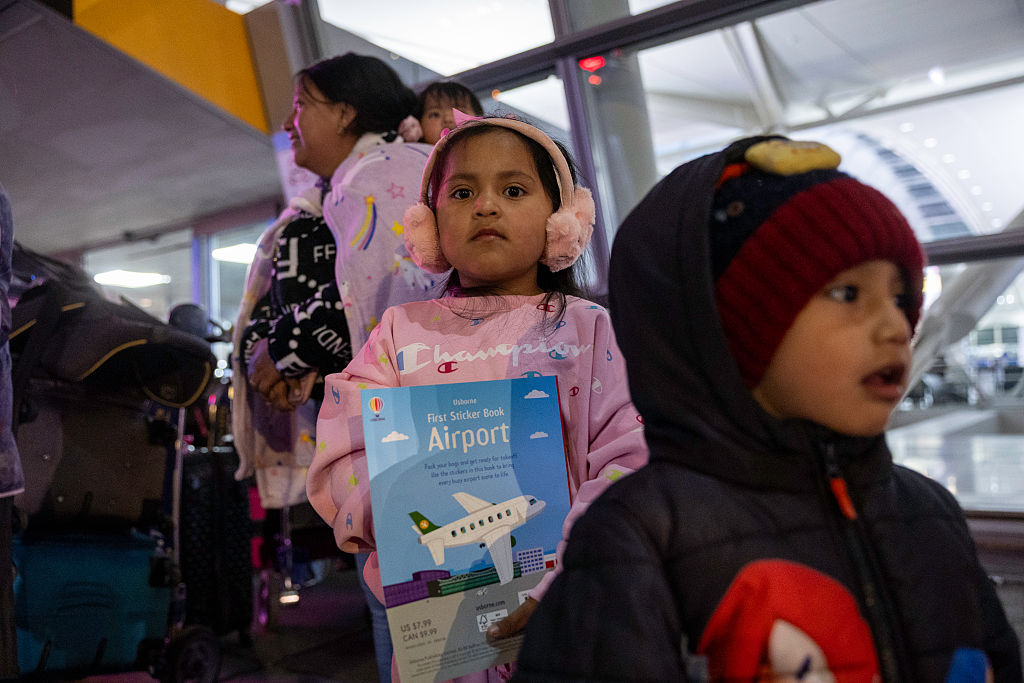
Undocumented Ecuadorian immigrant Jazlyn, six, and her cousin Adrian, three, arrive to JFK International Airport for a flight to Ecuador with their mothers on October 26, 2025, in New York, New York.

Undocumented Ecuadorian immigrant Jazlyn, six, and her cousin Adrian, three, arrive to JFK International Airport for a flight to Ecuador with their mothers on October 26, 2025, in New York, New York. Their mothers decided to “self-deport” with their children after their husbands were detained by US Immigration and Customs Enforcement agents and later deported. (John Moore / Getty Images)


The Trump administration is withholding pay from legal aid groups while demanding they share confidential case data about unaccompanied migrant children fighting to remain in the country, according to records reviewed by the Lever.

For months, the records show, the primary legal services provider for unaccompanied migrant youth has been locked in a standoff with the federal government over these unprecedented demands, which advocates say would represent a breach of attorney-client privilege and could put vulnerable children at risk.

As a result, legal clinics across the country that provide a critical lifeline to migrant children, shepherding them through the byzantine immigration court system that they would otherwise face on their own, have not been paid for their work since December, threatening their existence.

At the same time, immigration courts are using novel tactics to hasten deportations, including in cases involving children, straining lawyers’ resources, immigration lawyers tell the Lever. Such government efforts have reportedly picked up in recent weeks, including the use of “mega” hearings to expedite deportation proceedings.

The developments could threaten the safety of migrant children, already an incredibly vulnerable population, lawyers and advocates say. Without legal support, children would be forced to fend for themselves against Immigration and Customs Enforcement (ICE) lawyers calling for their deportation. And if the federal government is handed granular data about children’s legal defense, their cases could be undermined.

“There’s this whole-of-government approach right now, it seems, to target children,” said Michael Lukens, the executive director of the Amica Center for Immigrant Rights. “What they’re trying to do is get a workaround to get the information that we don’t want to give them about our child clients.”

“I Consider This a War on Children”

In the United States, if you are charged with a crime and cannot afford a lawyer, you are guaranteed a public defender. This is not the case in immigration court, even for young children who arrive in the country alone. More than a third of unaccompanied immigrant children do not have a lawyer to represent them in deportation proceedings.

Congress has in the past made some attempts to address this problem. In 2008, lawmakers passed legislation requiring the government to provide lawyers for migrant children “to the greatest extent practicable.” After this mandate, the Unaccompanied Children Program, which provides protections to migrant children, began to fund more robust legal services for child clients. The federal program now disburses funds to a constellation of nonprofits and law firms across the country that represent children.

The Unaccompanied Children Program is funded by the Office of Refugee Resettlement, an arm of the Department of Health and Human Services. Although unaccompanied children typically spend time in the custody of ICE and other branches of the Department of Homeland Security, by law, they ultimately fall under the charge of the Office of Refugee Resettlement.

Under the Trump administration, the legal aid program has been under attack. Shortly after taking office last year, President Donald Trump froze funding for it entirely. A judge blocked the move, restoring the program, but it was only a temporary reprieve.

As the Lever revealed in the fall, the Department of Health and Human Services subsequently developed plans to privatize the program, taking it out of the hands of nonprofits that had historically run it and handing the reins to a private company, an ICE technology contractor.

It is not yet clear whether that company, ICF, will ultimately secure the new contract. But it was during this bidding process — which is still ongoing — that the Trump administration began demanding that attorneys in the program disclose detailed data about the legal cases of migrant children they’re representing, which would give the federal government insight into their asylum claims, case status, and lawyers’ defense strategies.

Indeed, until a federal judge stepped in, the Department of Homeland Security was telling children — even those pursuing asylum claims and fleeing violence — to self-deport or face extended detention. “I consider this a war on children,” one longtime immigration lawyer said of the tactics.

Lawyers are often an important backstop against such coercion. Without legal representation, it is far more difficult for children to pursue and win their asylum claims. And it is that legal representation that advocates say is now under dire threat by the Trump administration.

Unprecedented Demands

For years, the nonprofit Acacia Center for Justice has served as the primary contractor for the legal aid program, distributing federal funds to dozens of groups that provide legal representation to children nationwide.

But none of these groups’ lawyers have been paid for any work completed since December, as Acacia contends with requests from the federal government for additional information about the clients it and other organizations represent, according to emails between the contractor and the Department of Health and Human Services viewed by the Lever, as well as interviews with multiple legal providers.

Beginning with invoices submitted for work completed in December 2025, Health and Human Services began demanding additional information to dispense payment to children’s attorneys — specifically, their clients’ A-numbers, or immigration identification numbers, that would allow officials to determine each child’s identity. To justify the request, officials said they needed the documentation to support the contractor’s invoices for its work for the government.

In the emails reviewed by the Lever, Acacia raised concerns with the government about the ethics of the demands, which the organization said could violate confidentiality rules, and their potential impacts on clients. Such requests departed from long-standing practice, the contractor noted.

Both the Office of Refugee Resettlement and Acacia declined to comment on the matter.

Multiple legal services providers confirmed to the Lever that they have gone without payment for months of work. (Some providers declined to be quoted on the record about the situation, citing concerns about retaliation.) They say this has proved a serious financial hardship for their organizations, many of which are small nonprofits that operate on a shoestring budget.

The “long delay in government payments to reimburse us for our services” was impacting organizations’ finances, wrote Malou Chávez, the executive director of the Northwest Immigrant Rights Project, in an email to the Lever.

“These are exponentially more difficult for smaller organizations,” she wrote.

Mounting Pressure

While the government considers whether to hand responsibility for the legal aid program from the Acacia Center for Justice to the ICE contractor ICF, it’s doubling down on its demands for children’s legal case data.

In procurement documents released in May — restarting the bidding process after both Acacia and ICF filed protests over the initial proposal — the Office of Refugee Resettlement added new contract language requiring both the new and prior contractor to turn over client case information to the government.

There are various other problematic parts of the contract, claim advocates, which they say seem designed to dismantle — and privatize — the legal aid program. As the Lever reported in the fall, the government’s refashioning of the contract includes background check requirements so burdensome that they risk scaring off organizations from continuing to work under the program’s umbrella.

Now the data-sharing demands are drawing particular concern.

“What would [the Office of Refugee Resettlement] do with this information?” said Lukens. “They’re not a law enforcement agency. Are they planning to turn this over to [the Department of Homeland Security]?”

He said the requests in the new procurement documents likely represented the government “continuing its all-hands approach in trying to undercut kids’ cases and force self-deport.”

The Office of Refugee Resettlement did not respond to the Lever’s questions about its plans for migrant children’s case information.

Under the Trump administration, the lines between the refugee office, an agency theoretically tasked with caring for unaccompanied children, and the Department of Homeland Security’s immigration enforcement arms, which are tasked with prosecuting and deporting them, have become increasingly blurred.

The Heritage Foundation’s Project 2025, the right-wing, dark-money-backed blueprint for the second Trump administration, recommended merging the two agencies, a goal that the Trump administration appears to be advancing. As ProPublica and the Texas Tribune reported in May 2025, the White House has installed ICE officials to run the agency and demanded additional data sharing with the Department of Homeland Security.

Shortly after Trump took office, the Department of Health and Human Services released a final rule that reversed a Biden-era prohibition on the Office of Refugee Resettlement sharing information about the immigration status of the families of children in its custody. It was the first step in what advocates now describe as significantly expanded information sharing between the deputized Office of Refugee Resettlement and law enforcement agencies.

“The Walls Have Been Closing In”

Meanwhile, in the immigration courts, the Trump administration is pioneering new tactics to deport immigrants as fast as possible. Over the past several weeks, the use of “master calendar hearings,” large-scale sessions in which dozens of cases are heard all at once, has swept across the country.

Unaccompanied migrant youth have seen their cases similarly expedited en masse, several immigration lawyers working across multiple jurisdictions told the Lever. Immigration judges, who are not part of an independent judiciary but operate under the thumb of the Department of Justice, have been systematically curtailing the time between hearings.

Under longstanding procedure, unaccompanied children and their lawyers often had months between hearings to prepare their cases to remain in the country and reunite with family. But the time period between hearings in many immigration courts has recently been shortened to three weeks or less, say immigration lawyers.

This has led to crowded calendars and vastly expedited caseloads, straining legal aid organizations’ capacity at a time when many are already strapped for cash.

“The walls have been closing in for a long time, but they are slamming shut right now,” one immigration lawyer told the Lever.

Now, along with navigating these mounting efforts to speed up deportations, legal groups are being pressured to share unprecedented information about their young clients with the officials working to deport them.

“There’s a financial motivation for nonprofits to comply, at least in some form or fashion,” Lukens said, calling the months without pay “a huge amount of money that the government can hold over our heads to try and force us to do these things.”