Deportation as Class Strategy
Mass deportations may hurt big business and working people alike. But Donald Trump is betting that the fallout will hit Democrats harder — and cement a lasting right-wing majority.
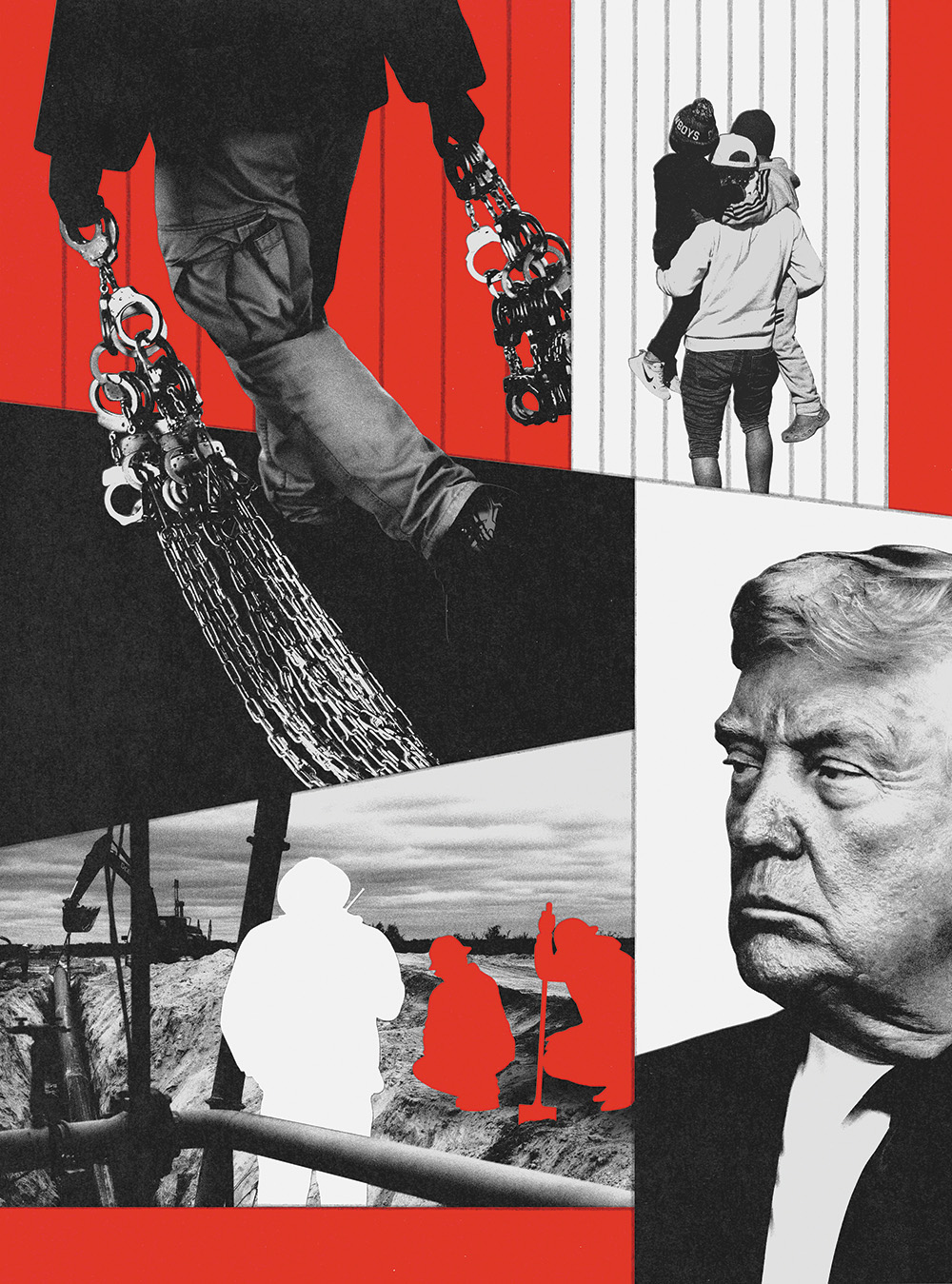
(Illustration by Chantal Jahchan)
By making immigration the defining issue of the 2024 election, Donald Trump simultaneously created two political liabilities for his incoming administration. First, it was unclear whether he could fulfill his promise to launch the “largest deportation operation in American history,” vowing to expel at least a million people each year while “sealing the border” through tighter laws and crackdowns on crossings. Were these ambitious targets a recipe for failure, which his nativist base would inevitably read as betrayal? Second, even if Trump managed to follow through on such pledges, the economic fallout — depriving the country of essential workers, skills, tax revenues, and consumer spending — could be dramatic. Would it hit the very groups that had propelled him to the White House?
More than six months into Trump’s second term, the answers are beginning to crystallize. Commentators have rightly warned against “sanewashing” the president, or parsing Trump’s actions for signs of a grand plan or long-term vision. In one sense, it would be easy to view his hard-border program as little more than a spectacle of cruelty, driven by a fantasy of alien invasion rather than a coherent political project. Still, there are members of Trump’s team who genuinely believe they can use migration policy to maintain an electoral coalition that will keep Republicans in power for years to come. By coalescing different classes and interest groups, they hope to transcend the current polarized landscape and effect a deeper realignment in which the Right commands a firm majority.
To understand this approach and measure its chances of success, it is first necessary to recap the administration’s record to date. Immediately after his inauguration, Trump declared the situation at the border a national emergency and issued a series of executive orders in response. Fresh obstacles were put in place, from physical barriers to surveillance technologies and drone swarms. Routes to claim asylum were shut down, with the refugee program suspended entirely and appointments canceled en masse. The “Remain in Mexico” protocol was reinstated, forcing people to wait south of the border in crowded and unsanitary conditions while their cases are processed.