Single-Payer Champion Abdul El-Sayed Is Running for Senate
Physician Abdul El-Sayed, one of the most prominent advocates of Medicare for All, is now running for US Senate in Michigan. Jacobin spoke to him about his campaign and the continuing fight for single-payer health care.
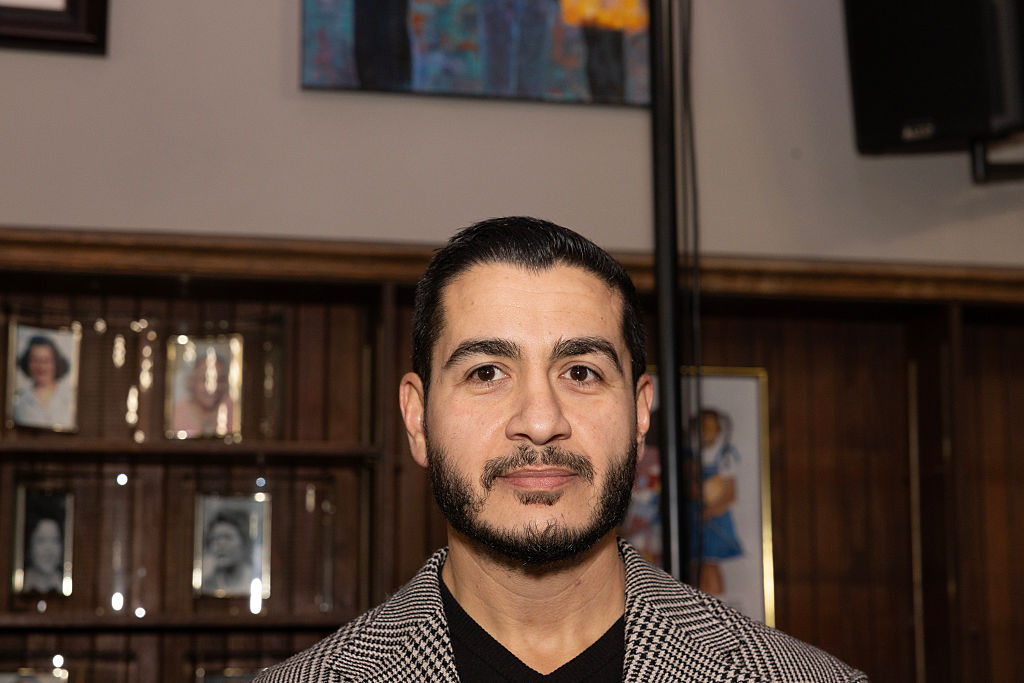
With Abdul El-Sayed’s Democratic primary campaign for Senate, the fight over Medicare for All is happening right now in Michigan, which Axios has called “ground zero” for the struggle for single-payer health care. (Monica Morgan / Getty Images)
- Interview by
- Jonathan Michels
Apart from Bernie Sanders, few public figures stump more often and more energetically for single-payer health care than physician-turned-public-servant Dr Abdul El-Sayed. El-Sayed is now campaigning to become Michigan’s next US senator. In his recent endorsement, Sanders cited El-Sayed’s experience as a physician and epidemiologist as to why he is uniquely suited to address the country’s broken health care system. If elected, El-Sayed will be in a stronger position than ever to advance the cause of Medicare for All.
The stakes could not be higher. Each day brings fresh attacks from the Trump administration on an already anemic public health infrastructure, forcing medical professionals and patients on their back feet. Public health agencies charged with disease prevention, environmental regulation, scientific research funding, and the provision of life-saving vaccines are on the chopping block. Measles infections, once eradicated in the US, now risk becoming commonplace. And nearly five million Americans are expected to lose their health insurance due to premium increases as a result of Republicans’ refusal to extend the Affordable Care Act’s enhanced tax credits under the Affordable Care Act (ACA).
Medicare for All took center stage in the 2016 and 2020 presidential elections but then disappeared after Joe Biden took office. But single-payer may be poised to make a comeback. A large majority of Americans — 65 percent — continue to support the creation of a national health insurance program, according to a recent poll conducted by Data for Progress. Not only does Medicare for All enjoy the support of the majority of Democrats and independents; the transformational reform is also backed by nearly half of Republicans.
“If Zohran Mamdani’s victory in New York City’s mayoral election is any indication,” Meagan Day wrote recently, “the Sanders-inspired economic left has plenty of runway, which means the fight over Medicare for All within the Democratic Party is likely to reignite at some point.” With El-Sayed’s Democratic primary campaign for Senate, that fight is happening right now in Michigan, which Axios has called “ground zero” for the struggle for single-payer health care. El-Sayed’s outspoken support for Medicare for All places him at odds with the Democratic establishment; neither of his two primary opponents support single-payer.
Jacobin contributor Jonathan Michels recently sat down with El-Sayed to discuss his Senate campaign, his long fight for health care reform, and his call to abolish Immigration and Customs Enforcement (ICE) in the wake of its latest abuses.
What led you to become a vocal proponent of single-payer?
I was in medical school when the ACA passed, and I was so grateful that we had an American president that was willing to jump on this issue. But as it got negotiated, I realized that the broader promise of health care in America as we were reading about the history of the unmet promise of health care — during the Truman years, and then again during the LBJ years, and then again under the leadership of folks like Ted Kennedy, and then under the Obama administration — we still have yet to make good on that promise.
As I went through my medical education, I came to realize, training in hospitals in New York, which are some of the best, most prestigious hospitals in the world — these hospitals too often are incentivized to do all they can to ignore the plight of folks in their communities, while flying in people from all over the world to get access to the most technologically advanced care for people who can afford it. I realized that I did not want to be a part of a system that did not provide the best care to people who need it the most right in their backyard. And so I’ve been an advocate for Medicare for All, frankly, since medical school.
A lot of my work in public health has been about recognizing that in our system, the inability to provide health care for people who need it is part and parcel of our failure to provide preventive services for all of us. I think we need to build a system that guarantees every single person the care that they need and deserve and also invests in the means of keeping us healthy in the first place.
Often candidates publish political memoirs that say very little about themselves or their policy stances. Your 2021 book, Medicare for All: A Citizen’s Guide, seems to have had a real-world impact, as it is used by single-payer advocates as an educational and organizing tool. What does Medicare for All say about you and your priorities?
Too often politics is transacted at the surface level: “Do I like them? Could I have a drink with them? Do I think they are being honest?” I want folks to understand that when I say we can guarantee health care in this country, I mean it. I’ve thought about it; I’ve dreamt about it. I put pen and paper to it, and I want folks to understand exactly how we could do it.
Why do you think pursuing elected office is the best way to advance the cause of a national health program?
Three reasons. We haven’t had a Democratic doctor in the US Senate since 1969, and our current health care policy shows that. And in the Senate, I think there is an opportunity to actually put pen to paper on the legislation that would carry it forward and [help develop] the thinking and the architecture about how to do that.
The other part of it is that a lot of folks want to push back on the political possibility of [enacting single-payer]. As a US senator, specifically from a state like Michigan — which is such a microcosm of the broader country — I get to demonstrate the political feasibility, right from the political heart of our country, of advocating for Medicare for All and getting elected.
Then third, as a senator, yes, you are involved in sponsoring and passing legislation. But you’re also a political advocate and a persuader, and my goal is to use that platform as a persuader to continue to have the conversation with the American public about just how critical it is that we pass Medicare for All in our country.
Throughout the history of the single-payer movement, doctors have played an important role in both promoting and opposing transformative health care reform. The American Medical Association was the single most powerful opponent of national health insurance for much of the twentieth century. On the other side of the ledger are physicians like Dr Quentin Young with the Medical Committee for Human Rights, Dr Sidney Wolfe of Public Citizen, and the founders of Physicians for a National Health Program (PNHP) who have fought to make healthcare a human right.
Do you feel like a minority voice among physicians today, or do you think your opinions about single-payer actually represent the majority of clinicians?
There are good numbers on this. Polling of doctors show that the majority support Medicare for All.
Certainly among younger doctors, whose opportunities have been foreclosed upon because of our corporatized health care system, watching mergers and acquisitions increase the power of health care corporations against their employees. . . . Doctors, increasingly, are employees. In 2018, the median physician no longer worked for a physician-owned practice. They worked for a large health care system. And in 2018, the median physician began to support Medicare for All.
The numbers have only grown, and so I represent where doctors are. A lot of times, the doctors who’ve been in the Senate as Republicans represent where money is. Increasingly, as it’s become harder for physicians to own their own businesses and harder for physicians to compete against big corporate practices, they’ve come to realize that the only fair platform is one that’s fair for both patients and doctors.
How does the Michigan Democratic primary underscore the importance of voting in primaries for candidates backing progressive causes? Oftentimes, it seems like policies such as Medicare for All are killed at the primary level before they even get to the general election.
Michigan is both a microcosm of the broader country, and it is the one of the most important states at the crossroads of our political conversation in America. We are paving a pathway through Michigan built by people coming together around solutions to one of their biggest problems, which is health care.
I’m running on a simple platform: money out of politics, money in your pocket, Medicare for All. All three of those things interlock, and we’re building a movement of people who didn’t vote at all, who voted for Vice President [Kamala] Harris, and who voted for Donald Trump. And they’re coming together because they recognize that the current system is not working.
We can build a broad-based movement of people coming together around this kind of politics as we do it right here in Michigan. If we could prove that out, it suggests a way forward in the rest of the country. I think it’s why people need to get involved, especially here in Michigan, but also to pay attention to this race and to important campaigns that are willing to speak truth to power and also speak truth to pain.
Why do you think the Democratic Party is dead set on playing defense to protect insufficient poverty-relief programs like Medicaid — and when Democrats are in a position of power to pass comprehensive legislation, they instead promote less ambitious policy reforms like the ACA, which saw public funds funneled into private coffers?
Too many Democrats take money from the same corporations who make money on our current system. So they’re in this position where they’re trying to appease people in front of them but also appease the corporations who write their campaign checks.
I’m the only candidate in my race who’s never touched corporate money. I’m also the only one running on Medicare for All. Those two things are not a coincidence.
Do you think Zohran Mamdani’s historic campaign for New York City mayor is a bellwether for how to organize for Medicare for All and similar policies — campaigns that address broad issues like affordability by making an argument for expanding public goods?
New York is obviously a different place than Michigan, and I’m really focused here on Michigan. But what we do know is that people are sick and tired of a politics that is bought and paid for by corporations. They want a politics that’s willing to speak truthfully and honestly to the challenges that they face and about how to take them on, and we know that if we speak to those issues honestly, directly, and specifically, we can win. That’s exactly what we’re doing here in Michigan.
I’ve been up and down my state. I’ve met people who survived cancer three times and made it with their life savings intact, only to get cancer a fourth time and lose them then. I’ve met folks who have to make a decision between their health care and their mortgage. I’ve met people who are worried about why we are sending our tax dollars to drop bombs on other people’s kids when we can’t afford health care here at home. I’ve met people in all sorts of industries, whether it’s automotive manufacturing or agriculture, who can’t afford health care and are worried about whether they can provide it for their families. I have met small businesses who will tell me every single time that health care is the single biggest issue that they face.
All of them need and deserve something different. And we’re speaking to all of them. That’s how you build a broad-based movement.
The unprecedented ICE incursions into our cities and towns represent a threat to all Americans regardless of immigration status, as evidenced by the recent murders of Renée Good and Alex Pretti by federal immigration agents in Minneapolis. Tell me about your recent call to abolish ICE, which has put you at odds with your Democratic opponents.
Americans are sick to their stomachs about what we’re seeing on our peaceful streets. Renée Good and Alex Pretti were murdered by their own government. ICE has become the danger it says it is protecting us from.
We cannot continue to pour funds into a rogue paramilitary entity while almost half the country can barely afford health care. I went to Minneapolis last week because we as Americans must hold our government accountable for the violence they’re committing against our neighbors. I could see the writing on the wall in 2018, when I called to abolish ICE then. Because an agency with its expressed mission, with these kinds of leaders, can very easily spiral out of control.